


Ukrainians living in the UK have spoken of the “perpetual hell” of this year and their hopes of reuniting with their “patriotic” loved ones when they get their country back in 2023.
The UN estimates that seven million Ukrainians have been internally displaced since Russia invaded in February, while millions have fled to find safety elsewhere.
More than 115,000 Ukrainians had arrived in the UK under the Ukraine Family Scheme and Ukraine Sponsorship Scheme (Homes for Ukraine) as of mid-August, data from the Home Office showed.
The Ukraine Family Scheme allowed fleeing Ukrainians to join or accompany a UK-based family member, while the Homes for Ukraine programme matched refugees with someone in the UK willing to sponsor them and provide suitable accommodation for a minimum of six months.
For Valentina Butenko, a 19-year-old student who was studying at the University of Central London at the start of the year, “2022 has been perpetual hell”.
“This is probably going to sound very strange, but it’s also a year that I realised how lucky I am to be able to have things that I really love, and that I’m willing to fight for and protect,” she said.
Ukraine latest — in pictures
-
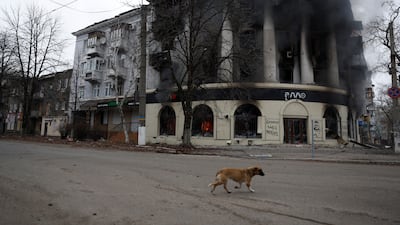
A building burned from a strike as Russia's attack on Ukraine continues, in Bakhmut. Reuters -
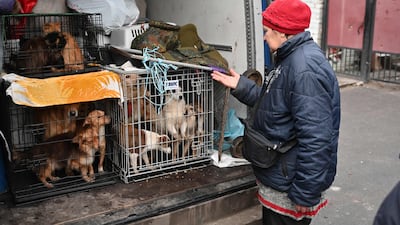
Antonina, a refugee from Bakhmut in Donetsk region, with dogs she rescued in Izyum, Kharkiv. AFP -
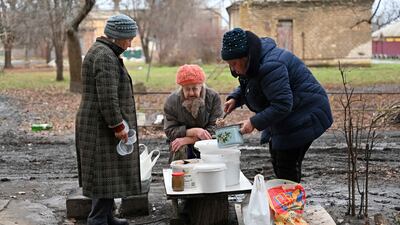
A resident gives her neighbours hot food brought by volunteers in Izyum. AFP -
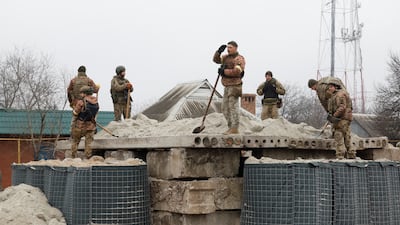
A Ukrainian soldier salutes as he works to build a bunker with sand in Bakhmut. Reuters -
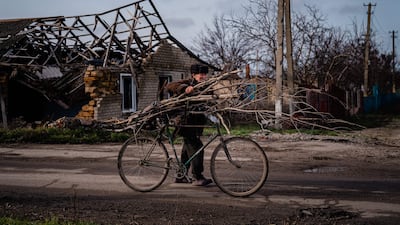
Volodymyr Kovalov, 77, carries tree branches attached to his bike as he collects wood for heating and cooking in Kherson region. AFP -
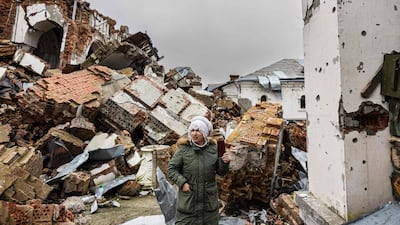
A local resident takes pictures of a destroyed monastery in Dolyna, eastern Ukraine. AFP -
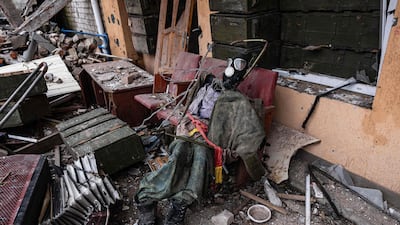
A decoy dummy made with the clothes of a Russian soldier at the entrance of a destroyed cinema in Kamyanka, eastern Ukraine. AFP -
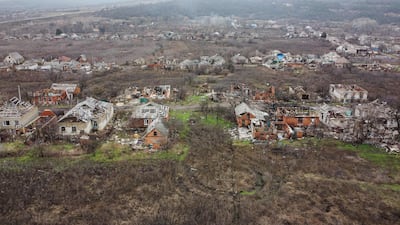
Destroyed houses in the city of Kamyanka. AFP -
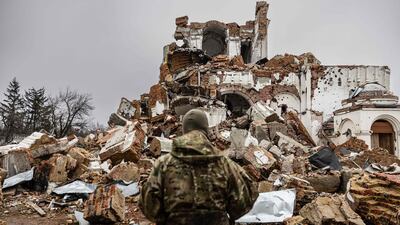
Caesar, 50, a Russian who joined the Freedom of Russia Legion to fight on the side of Ukraine, stands in front of a destroyed monastery in Dolyna. AFP -
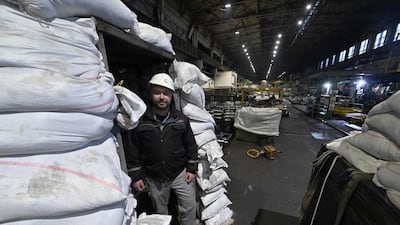
An employee stands next to a shelter at a stainless pipes plant in Nikopol, Dnipropetrovsk region. AFP -
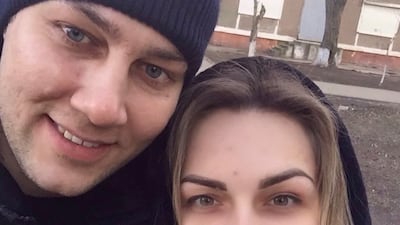
Ivan and Iryna Kalinin before the start of the Russian invasion of Ukraine. Iryna, who was pregnant, was killed in a Russian air strike on Mariupol's maternity hospital. Ivan returned to the occupied city to rebury his wife and baby. AP -
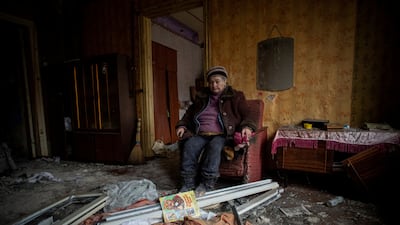
Natalia, 67, sits inside her house that was damaged in a Russian military strike, in Kramatorsk, Ukraine. Reuters -
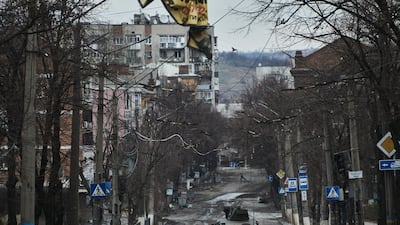
Ukrainian soldiers ride in a military vehicle in Bakhmut, a city in the Donetsk enclave. AP -
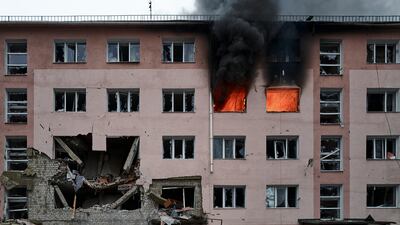
Smoke billows from a building on fire after a Russian attack in Bakhmut. AP -
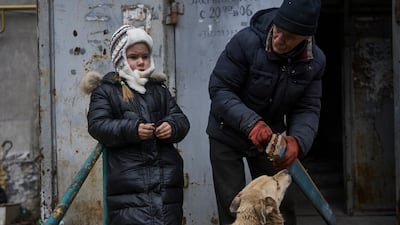
Sasha and her grandfather stand outside their home in Bakhmut. AP -
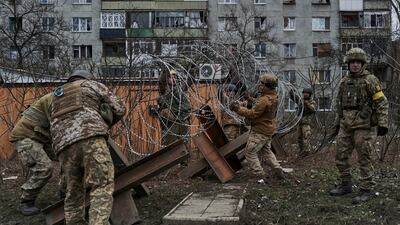
Ukrainian soldiers set up a barricade in Bakhmut. AP -
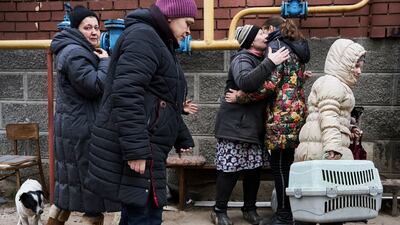
Nastya carries her cat as her mother Anna says goodbye to neighbours with whom they lived for months in a basement during Russian attacks in Soledar, a city in the Donetsk enclave of Ukraine. AP -
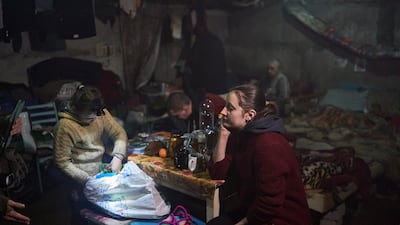
Anna and Nastya in the basement during a Russian attack nearby. AP -
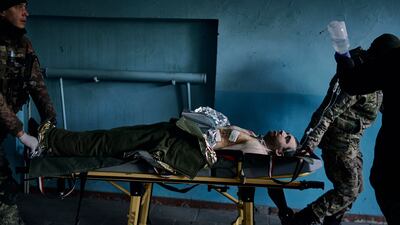
A Ukrainian soldier is wheeled on a stretcher at a hospital in the Donetsk enclave. AP -
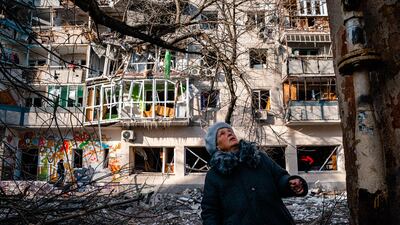
A woman looks a building damaged by Russian shelling in Kherson. AFP -
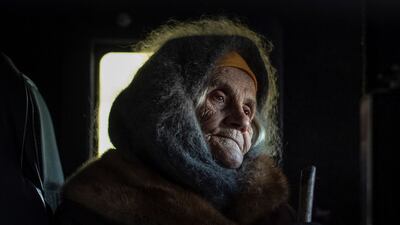
Oleksandra Koshkina, 85, sits in a car as she returns to her village of Torske, in the Donetsk enclave. Reuters -
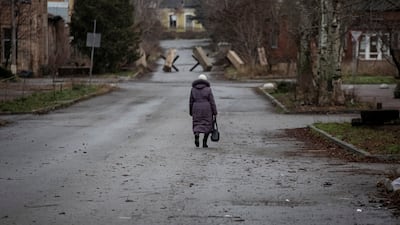
A resident of Bakhmut walks along an empty street. Reuters -
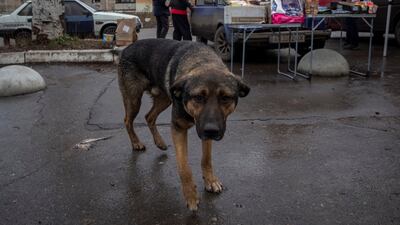
A street market in Bakhmut. Reuters -
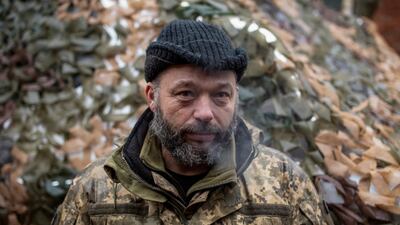
A Ukrainian soldier poses for a picture in the Donetsk enclave. Reuters -
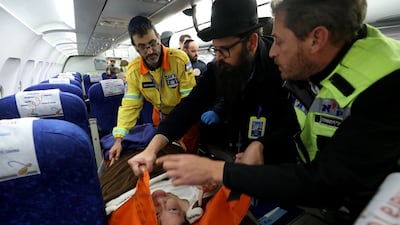
Officials tend to a patient on a plane carrying Ukrainian Jewish refugees as they wait to disembark at Israel's Ben Gurion Airport near Tel Aviv. AFP


Ms Butenko, who has a British mother and a Ukrainian father, made the decision to return to her family home in Kyiv shortly before the war began and swapped studying for her degree for learning how to administer first aid and fire a gun.
“You have this building sense of an immense responsibility to something that really matters to you and you’re afraid of losing. But you can’t quite grasp what that responsibility is,” she said.
“I remember, the week before the invasion, I had a conversation with my father about what would happen and what we would do.
“We both settled on the idea that if the war happened, we had to stay and we had to support Ukraine. I felt we couldn’t leave.”
Since the war began, Ms Butenko has worked with her father getting people to safety in the West of Ukraine or out of the country altogether, and spoke about one occasion when the pair got trapped in the middle of an aerial bombardment a few weeks into the invasion as they were moving people out of Kyiv.
“The place we were staying, there was no bomb shelter and it didn’t have a basement,” Ms Butenko said.
“There were air sirens. You could hear explosions happening. And I thought, ‘Oh my God, if something actually falls, that’s it’.
“I think it’s the helplessness for me, that’s the scariest feeling.”
Ukraine becomes dark patch in night satellite images — in pictures
-

A satellite image showing the night radiance of Europe from space on November 23 shows Ukraine in almost total darkness. Photo: Nasa -

People walking in the dark city centre of Kyiv which lost electrical power after Russian rocket attacks. AP -
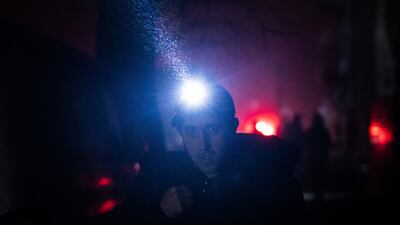
A man using a head torch to make his way around Kyiv. AP -
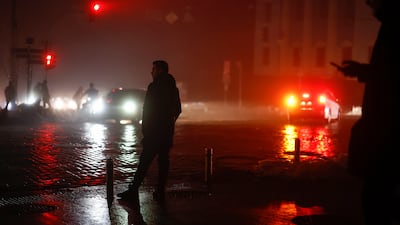
An unlit street following missile strikes in Kyiv. Getty Images -
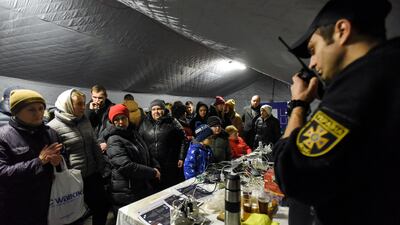
People charge their devices using a power generator in Kyiv. EPA -
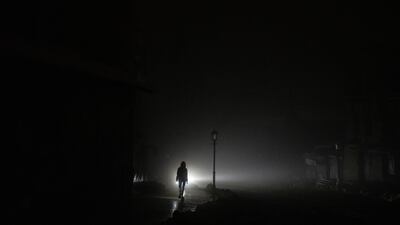
Since October, Russia has launched regular strikes on the Ukrainian power grid. AP -
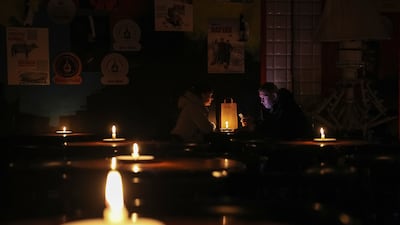
People sit in candlelight in Lviv. Reuters


Despite this, she said that risking her life for her country has been worth it.
“The way I dealt with the scariest moments was thinking, ‘I’m doing this for Ukrainians’.
“Every time I go back to Kyiv, there’s just incredible optimism. People just get on with their life and fight for it.
“And I think that actually just gives such a richness to life, understanding there is nothing — no hell, no dictator and no army — that can break your willingness to live.”
Ms Butenko — who flies back to the UK every few weeks to pick up supplies and medicine for people back home on the front line — added that being in the UK can sometimes be more frightening than being in Ukraine.
“The one habit I kind of got into in Ukraine is that I didn’t sleep. Every few hours, I would wake up to check the news,” she said.
“I needed to know, have they taken Kyiv? Do we still have a country? And I think my body’s got quite used to waking up every few hours. And I desperately check the news.
“To be completely honest, it is much scarier for me reading about bombings sitting in London than actually being there when it’s happening.”
Some of the weapons and military equipment sent to Ukraine so far — video
February 24 — the day Russia invaded Ukraine — is etched into Ms Butenko’s mind.
“I vividly remember waking up to something that sounded like an explosion, and I just instinctively knew, ‘Oh my god, it’s begun’,” she recalled.
“I looked at the news and they said that the first bombs had been dropped on Kyiv. And it was kind of a very intense sense of fear, a sense there is a possibility that I might not have a country tomorrow.”
Anna Tysovska, who worked for a beauty products company in Kyiv and fled Ukraine a few weeks after the war began, also spoke about her memories of the day Russia invaded.
“Until I heard the first bombing, I couldn’t believe there was going to be a war,” the 32-year-old told PA.
“I was in denial for a long time.”
Ms Tysovska came to the UK in April with her mother, aunt and cousin. They were forced to leave their male relatives and friends behind after Ukraine banned men aged 18-60 from leaving the country due to the war effort.
“My dad is 55 and, obviously, he will not leave,” she said.
“He’s really very passionate and he’s patriotic to Ukraine, but I don’t want him to fight because I know how bad things are on the front line.
“My cousin, she’s 17, and finished school last year. A lot of boys, ex-classmates, can’t leave Ukraine because they are 18.
“They’re basically kids, but they need to be in Ukraine, because it’s our law. It’s very tragic to see kids who need to start their life, need to make their own decisions, suffer from all the things that are going on.”
World is starved of peace, Pope Francis says in Christmas message — video
Ms Tysovska and her family moved in with a host family in Cornwall in April as part of the Homes for Ukraine programme.
After a few months, she enrolled in a master's programme at the local university, which she hopes will allow her to help her country from afar.
“I always wanted to get my master's in psychology,” she said.
“I will hopefully write my dissertation on post-traumatic stress disorder and I will try to help the people of Ukraine living in the UK who suffer from PTSD.
“But actually, you know, I think every Ukrainian will suffer from PTSD so I would like to help in any way I can.”
She added that she wants to go “home”, despite loving the UK.
“I want to go back to Ukraine. I want to build my future there. I want to help to rebuild my country.”
Putin 'planning for a long war' in Ukraine, says Nato chief — video
As for Ms Butenko, she has one big hope for 2023.
“I want us to win this war,” she said.
“And I really mean win. I don’t just mean I want this war to end — I want us to win this war, and claim back all our territory. Because a lot of us, a lot of Ukrainians, have sacrificed a lot for this.”
Ms Tysovska also has hopes for the future.
“I want to celebrate my birthday next year in Ukrainian Crimea,” she said.
“I want everyone to have their country back. I want Russia to repay for everything they’ve done. It can’t be repaid obviously, but that’s what I want.
“And I want Ukrainian kids to live in a peaceful country. They deserve it because their childhoods were stolen.”

