Two-thirds of junior doctors in England have sought alternatives to working in the national health service in recent months, a survey has shown.
The results come ahead of the British Medical Association’s ballot of junior doctors, set to open on January 9, asking whether they support strike action.
Junior doctors, who received a 2 per cent pay rise this year, have seen their salaries over the past 15 years reduce in real terms by more than a quarter, the union said. This refers to all doctors until they become consultants, GPs or specialists.
A poll conducted by the BMA on 3,819 junior doctors in England during November and December showed 79 per cent “often think about leaving the NHS”, while 65 per cent “have actively researched leaving the NHS in the last 12 months”, according to the i newspaper.
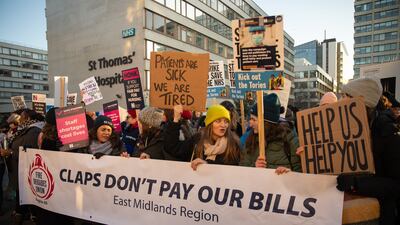
The NHS, still reeling from massive backlogs created by the Covid-19 pandemic, has this year been rocked by strikes, and the threat of further action remains.
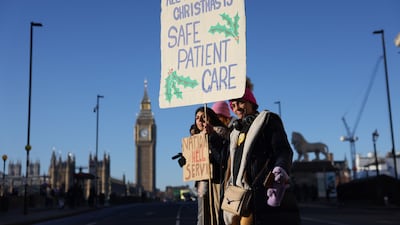
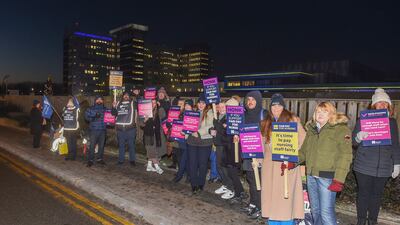
Thousands of ambulance workers across England and Wales walked out in the run up to Christmas in a bitter dispute over pay.
After the Royal College of Nursing’s pay request of 19 per cent for nurses was rejected by the government, more strike dates were added for January. The announcement came after two days of strike action in England, Wales and Northern Ireland in the lead up to Christmas.
Nurses strike in the UK - in pictures
Industrial action is also being considered by doctors in Scotland and Wales amid the cost of living crisis.
BMA Scotland announced earlier this month its junior doctors would be balloted in the first quarter of 2023 on striking in a battle over pay.
The organisation’s Scottish Junior Doctors Committee said on December 8 it had “reluctantly entered into a trade dispute with the Scottish government” following talks over pay failing to reach an agreement.
Dates will be outlined in January for industrial action in the NHS in Scotland as staff claim the government in Holyrood has imposed a pay offer despite overwhelming rejection from three health unions.
Days before Christmas, the BMA Cymru announced doctors in Wales were considering going on strike for the first time.
Almost two-thirds of the just under 1,000 hospital doctors surveyed by the union this month said they would be willing to take some form of industrial action, including strikes, over their current pay and conditions.
The BMA’s Welsh Council chairwoman, Iona Collins, on December 22 called the result of the survey “upsetting to all” and said it is “gut-wrenching for doctors to consider walking away from work”.
Leading doctors recently warned the NHS was “in danger of complete collapse”, with a poll revealing more than two in five of the most senior hospital medics are planning to leave in the next year.
The survey by the BMA found that 44 per cent of hospital consultants in England plan to leave the NHS, or take a break from it, over the next year.
Among consultant surgeons, the figure was 50 per cent.
Dr Vishal Sharma, chairman of the BMA consultants' committee, said that NHS doctors “are on their knees” following “years of demoralising real-terms pay cuts and chronic staffing shortages”.

If you go
Flight connections to Ulaanbaatar are available through a variety of hubs, including Seoul and Beijing, with airlines including Mongolian Airlines and Korean Air. While some nationalities, such as Americans, don’t need a tourist visa for Mongolia, others, including UAE citizens, can obtain a visa on arrival, while others including UK citizens, need to obtain a visa in advance. Contact the Mongolian Embassy in the UAE for more information.
Nomadic Road offers expedition-style trips to Mongolia in January and August, and other destinations during most other months. Its nine-day August 2020 Mongolia trip will cost from $5,250 per person based on two sharing, including airport transfers, two nights’ hotel accommodation in Ulaanbaatar, vehicle rental, fuel, third party vehicle liability insurance, the services of a guide and support team, accommodation, food and entrance fees; nomadicroad.com
A fully guided three-day, two-night itinerary at Three Camel Lodge costs from $2,420 per person based on two sharing, including airport transfers, accommodation, meals and excursions including the Yol Valley and Flaming Cliffs. A return internal flight from Ulaanbaatar to Dalanzadgad costs $300 per person and the flight takes 90 minutes each way; threecamellodge.com
Starring: Jamie Foxx, Angela Bassett, Tina Fey
Directed by: Pete Doctor
Rating: 4 stars
The biog
Favourite food: Tabbouleh, greek salad and sushi
Favourite TV show: That 70s Show
Favourite animal: Ferrets, they are smart, sensitive, playful and loving
Favourite holiday destination: Seychelles, my resolution for 2020 is to visit as many spiritual retreats and animal shelters across the world as I can
Name of first pet: Eddy, a Persian cat that showed up at our home
Favourite dog breed: I love them all - if I had to pick Yorkshire terrier for small dogs and St Bernard's for big
Who's who in Yemen conflict
Houthis: Iran-backed rebels who occupy Sanaa and run unrecognised government
Yemeni government: Exiled government in Aden led by eight-member Presidential Leadership Council
Southern Transitional Council: Faction in Yemeni government that seeks autonomy for the south
Habrish 'rebels': Tribal-backed forces feuding with STC over control of oil in government territory
The candidates
Dr Ayham Ammora, scientist and business executive
Ali Azeem, business leader
Tony Booth, professor of education
Lord Browne, former BP chief executive
Dr Mohamed El-Erian, economist
Professor Wyn Evans, astrophysicist
Dr Mark Mann, scientist
Gina MIller, anti-Brexit campaigner
Lord Smith, former Cabinet minister
Sandi Toksvig, broadcaster
UAE v Zimbabwe A, 50 over series
Fixtures
Thursday, Nov 9 - 9.30am, ICC Academy, Dubai
Saturday, Nov 11 – 9.30am, ICC Academy, Dubai
Monday, Nov 13 – 2pm, Dubai International Stadium
Thursday, Nov 16 – 2pm, ICC Academy, Dubai
Saturday, Nov 18 – 9.30am, ICC Academy, Dubai
Abu Dhabi GP schedule
Friday: First practice - 1pm; Second practice - 5pm
Saturday: Final practice - 2pm; Qualifying - 5pm
Sunday: Etihad Airways Abu Dhabi Grand Prix (55 laps) - 5.10pm
Mercer, the investment consulting arm of US services company Marsh & McLennan, expects its wealth division to at least double its assets under management (AUM) in the Middle East as wealth in the region continues to grow despite economic headwinds, a company official said.
Mercer Wealth, which globally has $160 billion in AUM, plans to boost its AUM in the region to $2-$3bn in the next 2-3 years from the present $1bn, said Yasir AbuShaban, a Dubai-based principal with Mercer Wealth.
“Within the next two to three years, we are looking at reaching $2 to $3 billion as a conservative estimate and we do see an opportunity to do so,” said Mr AbuShaban.
Mercer does not directly make investments, but allocates clients’ money they have discretion to, to professional asset managers. They also provide advice to clients.
“We have buying power. We can negotiate on their (client’s) behalf with asset managers to provide them lower fees than they otherwise would have to get on their own,” he added.
Mercer Wealth’s clients include sovereign wealth funds, family offices, and insurance companies among others.
From its office in Dubai, Mercer also looks after Africa, India and Turkey, where they also see opportunity for growth.
Wealth creation in Middle East and Africa (MEA) grew 8.5 per cent to $8.1 trillion last year from $7.5tn in 2015, higher than last year’s global average of 6 per cent and the second-highest growth in a region after Asia-Pacific which grew 9.9 per cent, according to consultancy Boston Consulting Group (BCG). In the region, where wealth grew just 1.9 per cent in 2015 compared with 2014, a pickup in oil prices has helped in wealth generation.
BCG is forecasting MEA wealth will rise to $12tn by 2021, growing at an annual average of 8 per cent.
Drivers of wealth generation in the region will be split evenly between new wealth creation and growth of performance of existing assets, according to BCG.
Another general trend in the region is clients’ looking for a comprehensive approach to investing, according to Mr AbuShaban.
“Institutional investors or some of the families are seeing a slowdown in the available capital they have to invest and in that sense they are looking at optimizing the way they manage their portfolios and making sure they are not investing haphazardly and different parts of their investment are working together,” said Mr AbuShaban.
Some clients also have a higher appetite for risk, given the low interest-rate environment that does not provide enough yield for some institutional investors. These clients are keen to invest in illiquid assets, such as private equity and infrastructure.
“What we have seen is a desire for higher returns in what has been a low-return environment specifically in various fixed income or bonds,” he said.
“In this environment, we have seen a de facto increase in the risk that clients are taking in things like illiquid investments, private equity investments, infrastructure and private debt, those kind of investments were higher illiquidity results in incrementally higher returns.”
The Abu Dhabi Investment Authority, one of the largest sovereign wealth funds, said in its 2016 report that has gradually increased its exposure in direct private equity and private credit transactions, mainly in Asian markets and especially in China and India. The authority’s private equity department focused on structured equities owing to “their defensive characteristics.”
The Sheikh Zayed Future Energy Prize
This year’s winners of the US$4 million Sheikh Zayed Future Energy Prize will be recognised and rewarded in Abu Dhabi on January 15 as part of Abu Dhabi Sustainable Week, which runs in the capital from January 13 to 20.
From solutions to life-changing technologies, the aim is to discover innovative breakthroughs to create a new and sustainable energy future.