


Britain is sending border force officials to Albania as it seeks to ease a backlog of asylum seekers by deporting illegal migrants back to the south-eastern European country by the end of next year.
Prime Minister Rishi Sunak announced the plan on Tuesday in the House of Commons as part of a new strategy to tackle the UK's accumulation of asylum claims.
He told MPs that Britain had agreed a new deal with Albania to crack down on the number of illegal migrants arriving on small boats, after figures showed Albanians accounted for a third of those making the treacherous journey across the English Channel.
Migrants at immigration processing centre in Manston — in pictures
-

A person gestures through a fence at the immigration processing centre in Manston, Kent in southern England. Reuters -
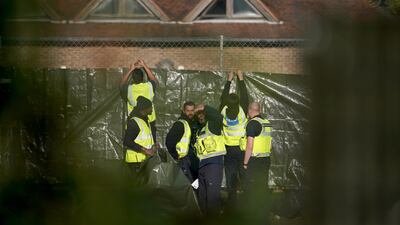
Security staff work to cover the view of people thought to be migrants in the Manston centre. PA -
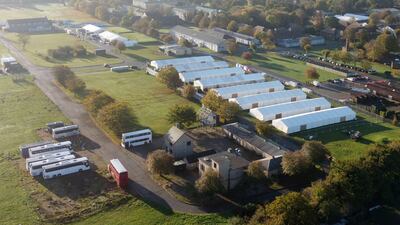
An aerial view of the facility in Manston. PA -

Seven hundred people were moved to the centre for safety reasons after incendiary devices were thrown at a Border Force migrant centre in Dover on Sunday. Reuters -

A man holds up a baby in the immigration processing centre. Reuters -

A woman at the Manston centre. Reuters -

A tent inside the processing centre. Reuters -
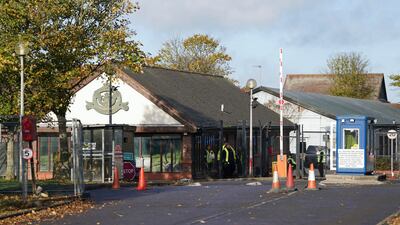
The entrance to the Manston immigration holding facility. AP


Mr Sunak said the government would fast-track the assessment of claims from countries deemed safe, creating a new dedicated unit to process, and deport, the vast majority of Albanian applicants within weeks.
He said weekly flights would be made to Albania until the backlog of “bogus” asylum claims was cleared.
“We will embed border force officers in Tirana Airport for the first time ever, helping to disrupt organised crime and stop people coming here illegally,” he said.
“Albania is a safe, prosperous European country. It is deemed safe for returns by Germany, Italy, France, Sweden.
“It is an EU accession country, a Nato ally and a member of the same treaty against trafficking as the UK. The [Prime Minister] of Albania has himself said there is no reason why we can’t return Albanian asylum seekers immediately.”
Mr Sunak said Germany, France, Belgium and Sweden rejected almost 100 per cent of all Albanian asylum claims last year, but the UK's rejection rate was just 45 per cent.
“That must not continue,” he said.
“We have to stop the boats and this government will do what has to be done,” said Mr Sunak, announcing the five-point plan to address the immigration crisis.
“The only way to come to the UK for asylum will be through legal routes,” he said.
The UK will establish a small boat operational command to police the Channel and crack down on criminal gangs, and anyone who enters the UK illegally will be barred from settling here, he added.
The plans also include doubling the number of asylum case workers and simplifying paperwork to speed up claims.
Disused holiday parks, former student halls and military sites will be repurposed to house migrants, cutting the £5.5 million ($6.7 million) daily cost in half of housing asylum seekers in hotels.
Official figures from September showed more than 143,000 asylum seekers were waiting for a decision on their claims, while nearly 100,000 had been waiting more than six months.
The overall figure was more than three times higher than it was in the same period of 2019, when 26,125 had been waiting for more than half a year.
However, Mr Sunak's pledge to “abolish” the backlog of asylum claims by the end of 2023 has been called into question after officials admitted only a portion of applications would be cleared.
Later, his official spokesman told reporters the Prime Minister was committing only to getting rid of clearing a backlog of 92,601 initial asylum claims made before June, when the Nationality and Borders Act came into force.
“It wouldn’t be right to prioritise those more recent claims, it would be right to focus on the legacy claims that predate the introduction of the Act,” he added.
The spokesman could not give a deadline to tackle all the claims, nor could he give a figure for a planned quota for asylum seekers.
The government is also under pressure to tackle unauthorised journeys across the Channel, which estimates suggest has been made by more than 43,000 people this year.
Ministers have singled out Albanians as accounting for more than a third of the 33,000 migrants who crossed the Channel in the first nine months of the year, compared with the 3 per cent recorded in the whole of last year.
Mr Sunak said the changes mean the vast majority of claims from Albania will be considered unfounded and “those individuals can be swiftly returned”.
Over the coming months “thousands of Albanians will be returned home”.
“And we will keep going with weekly flights until all the Albanians in our backlog have been removed.”
Mr Sunak said the government also intends to restart flights to Rwanda, so “those here illegally who cannot return to their own country can build a new life there”.
“Early next year we will introduce new legislation to make it unambiguously clear, that if you enter the UK illegally you should not be able to remain here.
“Instead, you will be detained and swiftly returned, either to your home country, or to a safe country where your asylum claim will be considered. And you will no longer be able to frustrate removal attempts with late or spurious claims or appeals,” said Mr Sunak.
“And once removed you should have no right to re-entry, settlement or citizenship.”
Mr Sunak recently held his first talks with Albanian Prime Minister Edi Rama, during which they agreed to close “loopholes” preventing the rapid return of failed asylum seekers.
But Mr Rama has been angered by comments from Home Secretary Suella Braverman. He said she was using his citizens as scapegoats for failed immigration policies.
Mr Rama criticised her “crazy” use of language and said she was “fuelling xenophobia” after she claimed there was an “invasion” of England from across the Channel.
Last month, Ms Braverman admitted the government had “failed to control our borders” as she came under pressure over the number of crossings and the conditions asylum seekers were facing after arriving in the UK.

