



Tight control of the transport budget is at the centre of a growing number of wage disputes in the UK as highway workers on Friday joined staff on the railways and underground networks in declared strike action over the Christmas period.
Union representatives of the National Highways operators said there would be a series of 12 one-day walkouts from mid-December to early January.
"We know our members’ action could inconvenience travellers who plan to visit their relatives over the festive period, but our members have been placed in this situation by a government that won’t listen to its own workforce," Public and Commercial Services union general secretary Mark Serwotka said. “With the serious cost-of-living crisis, they deserve to be paid properly for the important work they do, keeping our roads running safe and free."
Options for those seeking to drive home for Christmas are increasing under threat as the action will coincide with planned strikes by RMT members on the railways.
The RMT union has planned four 48-hour walkouts between mid-December and early January. Workers are demanding better pay and conditions. Talks at the weekend involving RMT boss Mick Lynch and transport ministers will be crucial to any breakthrough. Speaking after a meeting on Friday, Mr Lynch said "anyone you want to name" was going to be on strike soon.
But the rail unions are concerned about what they see as overall lack of engagement from the Transport Secretary, Mark Harper. He says he wants to be a facilitator, not a negotiator, and wants to work with all sides in “good faith” to “reach a resolution that is fair to all".
Spending plans issued by Mr Harper's department for the rail network up to 2027 appear to take little account of the need for wage rises. In fact the projected outlay is set to fall 10 per cent in the next five years compared to the previous funding period.

Mr Harper should be sitting in a negotiator’s chair, according to lawyer working for the Trades Union Congress (TUC), not simply bringing the unions and the train firms' management together. The TUC had commissioned a report from well-regarded independent lawyer, Michael Ford. He determined that the government has very extensive powers over what may be agreed. For example, if the train companies were too generous, the Department of Transport could fine the publicly subsidised operator.
Some conclude from this that the train operators, while privatised, remain within the orbit of the Department of Transport, because they are subsidised by taxpayer money.
But the rail strikes are merely a part of a much broader and expanding picture of industrial action in the UK. Thousands of workers in a host of sectors have also gone on strike, or plan to in the near future, including those in the postal service, bus drivers, nurses and telecoms workers.
And it all comes at a bad time for the economy: at 11.1 per cent, inflation in the UK is running at a 41-year high and many analysts say the economy will be in recession by the end of the year.
“We are concerned about the impact that strikes by multiple unions will have on the people of this country as we enter into this Christmas period,” a government spokesman told reporters this week.
-
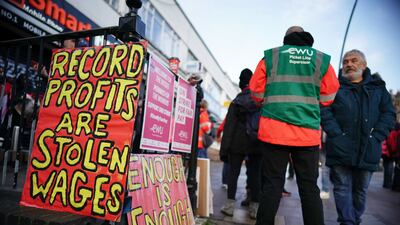
Postal workers on the picket line at the Kilburn Delivery Office in north-west London. Members of the Communication Workers Union are holding a 48-hour strike in a long-running dispute over jobs, pay and conditions. PA -

Teachers on the picket line outside Oxgangs Primary School in Edinburgh, Scotland, during in a protest over pay. PA -
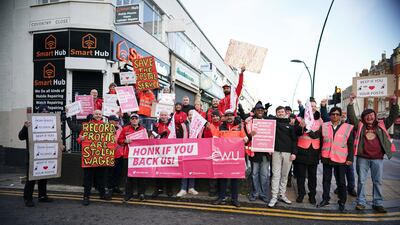
Postal workers protest outside the Kilburn Delivery Office in London. PA -
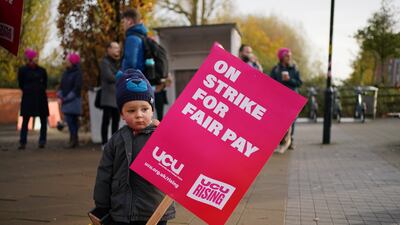
A child holds a placard as lecturers join the protest at the University of Birmingham. PA -
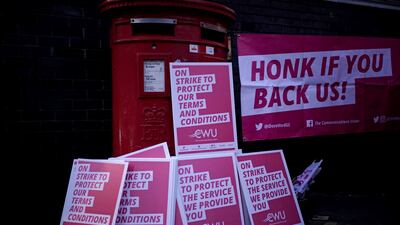
Placards stacked by postal workers at the Camden Town Delivery Office in north-west London. AP -

Lecturers hand out leaflets outside the University of Birmingham. PA -
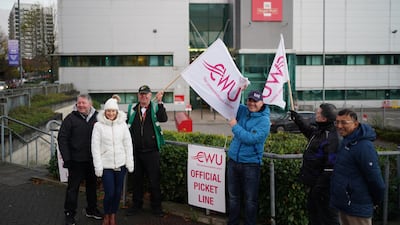
Postal workers are also protesting in Birmingham. PA -
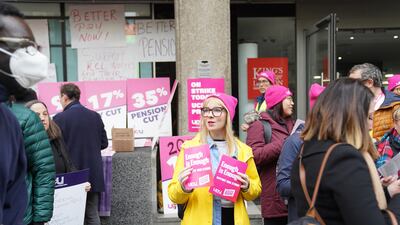
Lecturers join the picket line outside King's College London. PA -
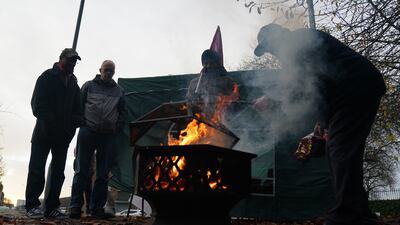
Postal workers light a fire outside the Central Delivery Office and Mail Centre in Birmingham. PA


Maxine Wade, a nursing associate from Yorkshire, said her motivation to vote to strike in a recent ballot was a belief that she and her fellow 300,000 members were protecting the NHS for future generations.
“We need a robust, well-funded supportive nursing workforce to support future generations to come," she said, ”and unless we take action now, we're not going to have that and that could lead to the privatisation of the health service."
Prime Minister Rishi Sunak has called the nurses’ 19 per cent wage rise demands "unaffordable". The Resolution Foundation believes wage rise settlements peaked at about 6 per cent in September and has remained steady since.
The widespread protest action and strikes in the public sector, combined with a government rejecting demanded wage rises and the sharp fall in temperatures in the past week has prompted many to draw a comparison with the so-called winter of discontent at the end of the 1970s.
Lasting from November 1978 to February 1979, it was a period of intense social and industrial tension in the UK. Rubbish piled up in London’s Leicester Square as waste collectors went on strike. And when they were joined by gravediggers, Liverpool city council had to hire an empty factory to store unburied bodies. According to the UK’s Office for National Statistics, the industrial unrest caused 29,474,000 working days to be lost from the economy during that period.
Wages and strife
But is the UK, once again, heading into a winter of discontent?
Some say it could be even worse. Back in the 1970s, the legal thresholds to hold a strike were much lower than they are today and labour laws were much less restrictive. A senior Conservative MP, Steve Brine, said that co-ordinated strike action across sectors “suggests that there is deep unhappiness with levels of pay”.
“We keep hearing that this is a repeat of the winter of discontent of the 1970s," he told Sky News. "In some ways it is not, but in some ways actually it is possibly more concerning because of course different industrial dispute legislation since the 1970s has made it harder to reach a strike mechanism trigger ballot."
Some observers claim that the worse the situation gets, the more the government will be in a position to push new anti-strike laws through parliament.
“If the unions refuse to come to their senses, the government should absolutely push ahead with minimum-service legislation,” said Tory MP and former chief secretary to the Treasury, Simon Clarke.
It probably will not be until the spring that the full fallout of the winter strikes becomes apparent. From now until Christmas and beyond, at least one sector of the UK economy will be gripped by industrial action on any given day. The 1970s winter of discontent led to the downfall of Labour prime minister James Callaghan — a Christmas present that Mr Sunak may not want to unwrap.

