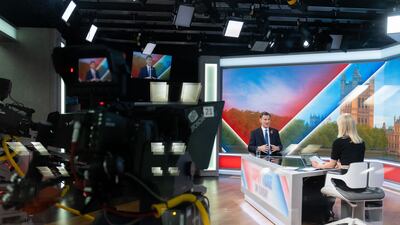
Chancellor of the Exchequer Jeremy Hunt delivers his autumn statement to MPs in the House of Commons. PA

UK tries economic conjuring to delay bad news for later day


Thomas Harding
  • English
  • Arabic

“As Conservatives, we don’t leave our debts to the next generation,” Chancellor Jeremy Hunt told the UK Parliament on Thursday as the opposition benches jeered incredulously and Tories remained muted.

It was tacit acknowledgement that Mr Hunt was attempting to pull off the magical trick of stimulating growth in a recession while not cutting back public spending or drastically raising taxes.

His “autumn statement” was the Conservatives’ last gambit to avoid meltdown at the next general election by restoring faith in their economic competence rocked by Liz Truss’s disastrous tax giveaways.

The essential thrust was to shift the real pain of debt and taxation to 2025, when Mr Hunt’s economic stimulation either surmounted the financial challenges or his party was out of government.

If the first trick was to be convincing, Mr Hunt certainly achieved that in his 50 minutes spent detailing the economic road map.

Without histrionics, in a headmaster’s measured manner, he laid out the degree of pain he was willing to inflict while lauding the most optimistic outcomes.

The recession that Britain found itself in, he was quick to point out, was firmly pinned on Russian President Vladimir Putin’s invasion of Ukraine that had led to energy costs in Britain to rise eight-fold to an astonishing £150 billion — the “equivalent to a second NHS”.

It was a “recession made in Russia” but a “recovery made in Britain”, he affirmed, winning a few nods of approval.

Prime Minister Rishi Sunak’s head barely stopped nodding throughout, demonstrating that the former chancellor had been intimately involved in proposals whose importance was such that he had cancelled then reinstated his Cop 27 appearance.

Given the markets’ role in dismantling Ms Truss's stay in No 10, the budget was written with their response at its heart. A measure of Mr Hunt’s success was that there was, unlike his predecessor Kwasi Kwarteng’s fantastical tax generosity, no crumbling of the pound, tumbling of stocks or soaring gilt borrowing costs.

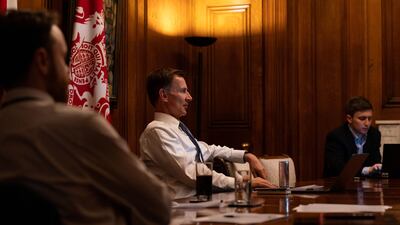
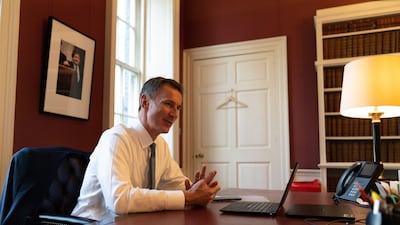
  • The Chancellor, Jeremy Hunt, works on his speech before the Autumn Statement in his office in No 11 Downing Street, London. All photos: Zara Farrar / HM Treasury
    The Chancellor, Jeremy Hunt, works on his speech before the Autumn Statement in his office in No 11 Downing Street, London. All photos: Zara Farrar / HM Treasury
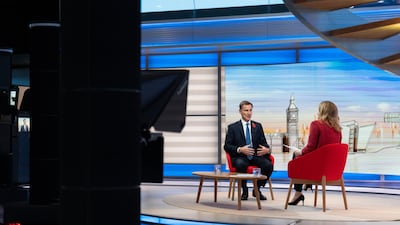
  • Mr Hunt is interviewed over details of his budget statement
    Mr Hunt is interviewed over details of his budget statement
  • The Chancellor faces anger from some Conservative Party members about the prospect of raising taxes to weather Britian's economic storm
    The Chancellor faces anger from some Conservative Party members about the prospect of raising taxes to weather Britian's economic storm
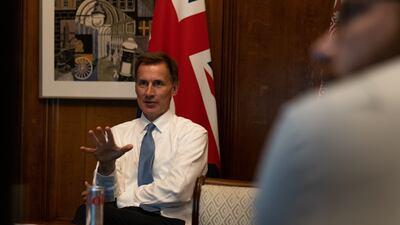
  • Mr Hunt will insist to MPs that his financial plan puts the UK on a 'balanced path to stability'
    Mr Hunt will insist to MPs that his financial plan puts the UK on a 'balanced path to stability'
  • Mr Hunt insists his strategy 'protects long-term economic growth' while showing compassion to the most vulnerable in society
    Mr Hunt insists his strategy 'protects long-term economic growth' while showing compassion to the most vulnerable in society
  • Mr Hunt leaves TV studios after being interviewed
    Mr Hunt leaves TV studios after being interviewed
  • His package will stand in stark contrast to his predecessor Kwasi Kwarteng’s splurge of tax cuts, which further dented the UK’s finances
    His package will stand in stark contrast to his predecessor Kwasi Kwarteng’s splurge of tax cuts, which further dented the UK’s finances

With much of the announcements well trailed in the press, they were as measured as Mr Hunt’s tone and tailored suit.

In addition to Mr Putin, it was the “once-in-a-century pandemic” blamed for Britain’s ailments.

“Brexit!” yelled an MP from the Labour benches, reflecting the point made by financial analysts who suggest breaking from the European Union cost Britain up to 4 per cent in gross domestic product.

“The UK will always pay its way,” the chancellor said, warming up Britain’s creditors before disclosing that the government would be borrowing £140 billion in the coming year.

Looking on were two of the three former prime ministers who remain MPs, with Theresa May furiously taking notes while sitting across the aisle from her nonchalant political nemesis, Boris Johnson.

Chancellor Jeremy Hunt has unveiled an austerity budget with £55 billion of tax rises and spending cuts. AFP

Ms Truss was not there to hear the unrestrained opposition laughter when Mr Hunt declared that for Conservatives, “credibility cannot be taken for granted”.

Despite their differences, the Labour leadership was astute enough to realise the difficulties Britain faces, listening intently to the economic plan that they will most likely inherit.

Keir Starmer and his team managed to restrain their own nods of approval when the Tory chancellor stated that “those with more will contribute more”, as he introduced earners of £125,000 to the 45 per cent tax threshold previously enjoyed by those in the £150,000 bracket.

The Labour nods were also kept in check as the chancellor shook down the energy firms with a windfall tax increase that Ms Truss blindly refused. Even renewable companies would face a swift 45 per cent levy on their profits.

Electric cars did not escape either, with vehicle taxation coming in 2025 when half the country is expected to be driving them.

Despite the Russian threat, the defence ministry's dreamy thoughts of a 50 per cent increase in promised spending were curtailed when its budget trimmed back to the current 2 per cent of GDP.

And there was no respite for the international aid budget, which would remain at 0.5 per cent rather than its customary 0.7 per cent of GDP.

But Labour’s unspoken agreement ended when Mr Hunt suggested that a proposal to raise money by introducing VAT on private schools might raise £1.7 billion but it would lead to parents sending a further 90,000 pupils into the state sector.

In essence, it was a statement that raised taxes by a further £25 billion, taking them to their highest level since the Second World War as part of the plan to reduce a £50 billion hole in public finances.

With his tax raising job done, Mr Hunt, watched by his wife and son in the gallery above, eulogised Britain’s wizardry of “a national genius for innovation” that might turn it into “the next Silicon Valley” with “Scandinavian quality and Singaporean efficiency”.

His riposte to the cynical Labour jeers was that “they have never been interested in growth”, earning the biggest cheer from his backbenches.

Poorer pensioners and those on benefits will have cheered, too, at the 10 per cent inflation-linked increase in their incomes.

But that rejoicing may well be curtailed if Mr Hunt’s conjuring flops and Britain finds itself weighed down by years of debt and low productivity.


The Details

Article 15
Produced by: Carnival Cinemas, Zee Studios
Directed by: Anubhav Sinha
Starring: Ayushmann Khurrana, Kumud Mishra, Manoj Pahwa, Sayani Gupta, Zeeshan Ayyub
Our rating: 4/5 

THE SPECS

Engine: 6.75-litre twin-turbocharged V12 petrol engine 

Power: 420kW

Torque: 780Nm

Transmission: 8-speed automatic

Price: From Dh1,350,000

On sale: Available for preorder now

The specs: 2018 Infiniti QX80

Price: base / as tested: Dh335,000

Engine: 5.6-litre V8

Gearbox: Seven-speed automatic

Power: 400hp @ 5,800rpm

Torque: 560Nm @ 4,000rpm

Fuel economy, combined: 12.1L / 100km

Pots for the Asian Qualifiers

Pot 1: Iran, Japan, South Korea, Australia, Qatar, United Arab Emirates, Saudi Arabia, China
Pot 2: Iraq, Uzbekistan, Syria, Oman, Lebanon, Kyrgyz Republic, Vietnam, Jordan
Pot 3: Palestine, India, Bahrain, Thailand, Tajikistan, North Korea, Chinese Taipei, Philippines
Pot 4: Turkmenistan, Myanmar, Hong Kong, Yemen, Afghanistan, Maldives, Kuwait, Malaysia
Pot 5: Indonesia, Singapore, Nepal, Cambodia, Bangladesh, Mongolia, Guam, Macau/Sri Lanka

Mercer, the investment consulting arm of US services company Marsh & McLennan, expects its wealth division to at least double its assets under management (AUM) in the Middle East as wealth in the region continues to grow despite economic headwinds, a company official said.

Mercer Wealth, which globally has $160 billion in AUM, plans to boost its AUM in the region to $2-$3bn in the next 2-3 years from the present $1bn, said Yasir AbuShaban, a Dubai-based principal with Mercer Wealth.

Within the next two to three years, we are looking at reaching $2 to $3 billion as a conservative estimate and we do see an opportunity to do so,” said Mr AbuShaban.

Mercer does not directly make investments, but allocates clients’ money they have discretion to, to professional asset managers. They also provide advice to clients.

“We have buying power. We can negotiate on their (client’s) behalf with asset managers to provide them lower fees than they otherwise would have to get on their own,” he added.

Mercer Wealth’s clients include sovereign wealth funds, family offices, and insurance companies among others.

From its office in Dubai, Mercer also looks after Africa, India and Turkey, where they also see opportunity for growth.

Wealth creation in Middle East and Africa (MEA) grew 8.5 per cent to $8.1 trillion last year from $7.5tn in 2015, higher than last year’s global average of 6 per cent and the second-highest growth in a region after Asia-Pacific which grew 9.9 per cent, according to consultancy Boston Consulting Group (BCG). In the region, where wealth grew just 1.9 per cent in 2015 compared with 2014, a pickup in oil prices has helped in wealth generation.

BCG is forecasting MEA wealth will rise to $12tn by 2021, growing at an annual average of 8 per cent.

Drivers of wealth generation in the region will be split evenly between new wealth creation and growth of performance of existing assets, according to BCG.

Another general trend in the region is clients’ looking for a comprehensive approach to investing, according to Mr AbuShaban.

“Institutional investors or some of the families are seeing a slowdown in the available capital they have to invest and in that sense they are looking at optimizing the way they manage their portfolios and making sure they are not investing haphazardly and different parts of their investment are working together,” said Mr AbuShaban.

Some clients also have a higher appetite for risk, given the low interest-rate environment that does not provide enough yield for some institutional investors. These clients are keen to invest in illiquid assets, such as private equity and infrastructure.

“What we have seen is a desire for higher returns in what has been a low-return environment specifically in various fixed income or bonds,” he said.

“In this environment, we have seen a de facto increase in the risk that clients are taking in things like illiquid investments, private equity investments, infrastructure and private debt, those kind of investments were higher illiquidity results in incrementally higher returns.”

The Abu Dhabi Investment Authority, one of the largest sovereign wealth funds, said in its 2016 report that has gradually increased its exposure in direct private equity and private credit transactions, mainly in Asian markets and especially in China and India. The authority’s private equity department focused on structured equities owing to “their defensive characteristics.”

Company Profile

Company name: Yeepeey

Started: Soft launch in November, 2020

Founders: Sagar Chandiramani, Jatin Sharma and Monish Chandiramani

Based: Dubai

Industry: E-grocery

Initial investment: $150,000

Future plan: Raise $1.5m and enter Saudi Arabia next year

At a glance

Global events: Much of the UK’s economic woes were blamed on “increased global uncertainty”, which can be interpreted as the economic impact of the Ukraine war and the uncertainty over Donald Trump’s tariffs.


Growth forecasts: Cut for 2025 from 2 per cent to 1 per cent. The OBR watchdog also estimated inflation will average 3.2 per cent this year


Welfare: Universal credit health element cut by 50 per cent and frozen for new claimants, building on cuts to the disability and incapacity bill set out earlier this month


Spending cuts: Overall day-to day-spending across government cut by £6.1bn in 2029-30 


Tax evasion: Steps to crack down on tax evasion to raise “£6.5bn per year” for the public purse


Defence: New high-tech weaponry, upgrading HM Naval Base in Portsmouth


Housing: Housebuilding to reach its highest in 40 years, with planning reforms helping generate an extra £3.4bn for public finances

Jeff Buckley: From Hallelujah To The Last Goodbye
By Dave Lory with Jim Irvin

The National Archives, Abu Dhabi

Founded over 50 years ago, the National Archives collects valuable historical material relating to the UAE, and is the oldest and richest archive relating to the Arabian Gulf.

Much of the material can be viewed on line at the Arabian Gulf Digital Archive - https://www.agda.ae/en

Benefits of first-time home buyers' scheme
  • Priority access to new homes from participating developers
  • Discounts on sales price of off-plan units
  • Flexible payment plans from developers
  • Mortgages with better interest rates, faster approval times and reduced fees
  • DLD registration fee can be paid through banks or credit cards at zero interest rates
Yahya Al Ghassani's bio

Date of birth: April 18, 1998

Playing position: Winger

Clubs: 2015-2017 – Al Ahli Dubai; March-June 2018 – Paris FC; August – Al Wahda

Labour dispute

The insured employee may still file an ILOE claim even if a labour dispute is ongoing post termination, but the insurer may suspend or reject payment, until the courts resolve the dispute, especially if the reason for termination is contested. The outcome of the labour court proceedings can directly affect eligibility.


- Abdullah Ishnaneh, Partner, BSA Law 

Results
%3Cp%3E%0D%3Cstrong%3EElite%20men%3C%2Fstrong%3E%0D%3Cbr%3E1.%20Amare%20Hailemichael%20Samson%20(ERI)%202%3A07%3A10%0D%3Cbr%3E2.%20Leornard%20Barsoton%20(KEN)%202%3A09%3A37%0D%3Cbr%3E3.%20Ilham%20Ozbilan%20(TUR)%202%3A10%3A16%0D%3Cbr%3E4.%20Gideon%20Chepkonga%20(KEN)%202%3A11%3A17%0D%3Cbr%3E5.%20Isaac%20Timoi%20(KEN)%202%3A11%3A34%0D%3Cbr%3E%3Cstrong%3EElite%20women%3C%2Fstrong%3E%0D%3Cbr%3E1.%20Brigid%20Kosgei%20(KEN)%202%3A19%3A15%0D%3Cbr%3E2.%20Hawi%20Feysa%20Gejia%20(ETH)%202%3A24%3A03%0D%3Cbr%3E3.%20Sintayehu%20Dessi%20(ETH)%202%3A25%3A36%0D%3Cbr%3E4.%20Aurelia%20Kiptui%20(KEN)%202%3A28%3A59%0D%3Cbr%3E5.%20Emily%20Kipchumba%20(KEN)%202%3A29%3A52%3C%2Fp%3E%0A
Updated: November 17, 2022, 4:53 PM