The windfall tax on energy giants in the UK is set to increase under Chancellor Jeremy Hunt's plan. AFP

Jeremy Hunt raises windfall tax on UK energy companies in autumn statement


Laura O'Callaghan
  • English
  • Arabic

Jeremy Hunt, Britain’s Chancellor of the Exchequer, on Thursday announced he was hitting oil and gas giants with an increase in windfall tax after years of the Conservatives resisting calls to raise the levy.

From January 1 until March 2028, the energy profits levy will increase from 25 per cent to 35 per cent. Together with a 45 per cent tax on electricity generators, it will help raise an estimated £14 billion ($16.61 billion) next year.

The changes were unveiled as part of a raft of economic reforms laid out by Mr Hunt to MPs in the House of Commons in his autumn statement.

The Chancellor drew jeers, laughs and calls from the Labour benches to “say sorry” as he sought to repair the economic damage inflicted by his predecessor's disastrous mini-budget.

He said his plan, which included tens of billions of pounds of tax rises and spending cuts, would “rebuild our economy”, which is reeling from a cost-of-living crisis.

He said the UK was already in a recession.

Mr Hunt insisted he was not entirely against windfall taxes.

“I have no objection to windfall taxes if they are genuinely about windfall profits caused by unexpected increases in energy prices,” he said. “But any such tax should be temporary, not deter investment and recognise the cyclical nature of many energy businesses.

“The structure of our energy market also creates windfall profits for low-carbon electricity generation. So from January 1, we’ve decided to introduce a new temporary 45 per cent levy on electricity generators.”

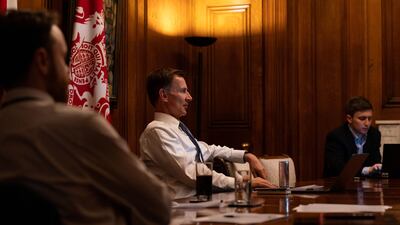
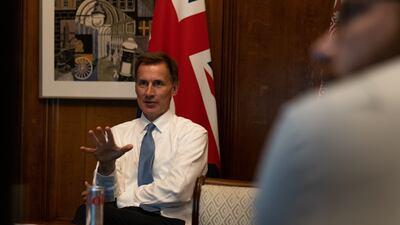
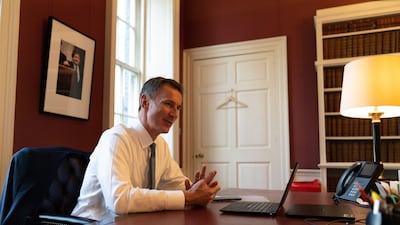
Jeremy Hunt works on his autumn statement — in pictures

  • The Chancellor, Jeremy Hunt, works on his speech before the Autumn Statement in his office in No 11 Downing Street, London. All photos: Zara Farrar / HM Treasury
    The Chancellor, Jeremy Hunt, works on his speech before the Autumn Statement in his office in No 11 Downing Street, London. All photos: Zara Farrar / HM Treasury
  • Mr Hunt is interviewed over details of his budget statement
    Mr Hunt is interviewed over details of his budget statement
  • The Chancellor faces anger from some Conservative Party members about the prospect of raising taxes to weather Britian's economic storm
    The Chancellor faces anger from some Conservative Party members about the prospect of raising taxes to weather Britian's economic storm
  • Mr Hunt will insist to MPs that his financial plan puts the UK on a 'balanced path to stability'
    Mr Hunt will insist to MPs that his financial plan puts the UK on a 'balanced path to stability'
  • Mr Hunt insists his strategy 'protects long-term economic growth' while showing compassion to the most vulnerable in society
    Mr Hunt insists his strategy 'protects long-term economic growth' while showing compassion to the most vulnerable in society
  • Mr Hunt leaves TV studios after being interviewed
    Mr Hunt leaves TV studios after being interviewed
  • His package will stand in stark contrast to his predecessor Kwasi Kwarteng’s splurge of tax cuts, which further dented the UK’s finances
    His package will stand in stark contrast to his predecessor Kwasi Kwarteng’s splurge of tax cuts, which further dented the UK’s finances

The introduction of the 45 per cent levy on electricity generators will not mean, as some had claimed, that wind farms will have to fork out more tax than oil and gas rigs.

Under the existing rules oil and gas firms are subject to a corporation tax of 30 per cent, and a supplementary tax of 10 per cent. On top of that there is the energy profits levy, which has been raised to 35 per cent. This takes the overall tax to 75 per cent.

The government has contracts for difference (CfD) with a range of low-carbon electricity generating companies, designed to provide firms with price certainty over the lifetime of the agreement.

This means that any renewable energy company — including a wind farm — that is engaged with the government under such a contract will be exempt from the 45 per cent tax.

Green Party MP Caroline Lucas welcomed the windfall tax but said maintaining an investment allowance for oil and gas companies was “scandalous”, as it gave “a massive subsidy to obscenely wealthy” companies in the sector.

Molly Scott Cato, the Green Party’s spokeswoman on finance, hit out at the Chancellor for being “silent on [Rishi] Sunak’s absurd loophole for oil and gas investment”.

“We need all investment in new oil and gas to end if we can possibly save our climate,” she wrote on Twitter.

Her tweet was in reference to the government’s policy which allows oil and gas giants to offset tax owed against spending on new investments. Environmental campaigners have repeatedly warned that such a system could encourage firms to pursue further fossil fuel projects.

Labour MP Richard Burgon accused Rishi Sunak's administration of saddling working Britons with the cost of economic reforms.

“While ordinary people are being made to pay for this crisis, the Tories are letting the oil and gas giants off the hook with massive loopholes in the Windfall Tax,” he tweeted.

Watched on from the gallery by his wife and young son, Mr Hunt announced a string of reforms which will affect the budget of millions of households across Britain.

He insisted the changes were necessary to help the UK make it through the global challenges exacerbated by Russia's invasion of Ukraine.

Under Tory leadership, he said the UK would “face into the storm” that he repeatedly linked to global pressures. “There may be a recession made in Russia but there is a recovery made in Britain — and we do so today with British resilience and British compassion,” he said.

He announced he will reduce the threshold for the 45p tax rate from £150,000 to £125,140. People earning £150,000 or more will pay slightly more than £1,200 more in taxes each year.

His plan will see the annual exempt amount for capital gains tax slashed from £12,300 to £6,000 in 2023. The following year it will be further lowered to £3,000.

He announced two new fiscal rules. The first will mean that underlying debt must fall as a percentage of GDP by the fifth year of a rolling five-year period. Secondly, public sector borrowing must be below 3 per cent of GDP over the same period.

Under his plan, tax as a percentage of the country’s gross domestic product will increase by slightly more than 1 per cent over the coming five years.

Turning to electric vehicles, he said greener cars would no longer be exempt from Vehicle Excise Duty from April 2025. The changes will beam that from January 1 to March 2028 the energy profits levy will jump from 25 per cent to 35 per cent.

Stamp duty cuts will stand until March 2025.

Amid a worsening cost-of-living emergency, the government’s priorities are to create stability, encourage economic growth and protect public services, he said. He fashioned his budget as the government’s way of “responding to an international crisis with British values”.

He vowed to protect the National Health Service, still suffering from the Covid-19 pandemic, and education.

He pledged the NHS would receive £3.3 billion annually over the next two years.

Rachel Reeves, the Shadow Chancellor, blamed the “chaos” which has in recent weeks engulfed the government for “the mess we are in”. She said the ruling party was also to blame for “12 years of Conservative economic failure”.

Mr Hunt was parachuted into 11 Downing Street after Liz Truss sacked Kwasi Kwarteng following his mini-budget which sent financial markets into a meltdown.

Mr Sunak reappointed Mr Hunt as Chancellor after he was sworn in as Prime Minister on October 25.


First Person
Richard Flanagan
Chatto & Windus 

David Haye record

Total fights: 32
Wins: 28
Wins by KO: 26
Losses: 4

What vitamins do we know are beneficial for living in the UAE

Vitamin D: Highly relevant in the UAE due to limited sun exposure; supports bone health, immunity and mood.Vitamin B12: Important for nerve health and energy production, especially for vegetarians, vegans and individuals with absorption issues.Iron: Useful only when deficiency or anaemia is confirmed; helps reduce fatigue and support immunity.Omega-3 (EPA/DHA): Supports heart health and reduces inflammation, especially for those who consume little fish.

Ten tax points to be aware of in 2026

1. Domestic VAT refund amendments: request your refund within five years

If a business does not apply for the refund on time, they lose their credit.

2. E-invoicing in the UAE

Businesses should continue preparing for the implementation of e-invoicing in the UAE, with 2026 a preparation and transition period ahead of phased mandatory adoption. 

3. More tax audits

Tax authorities are increasingly using data already available across multiple filings to identify audit risks. 

4. More beneficial VAT and excise tax penalty regime

Tax disputes are expected to become more frequent and more structured, with clearer administrative objection and appeal processes. The UAE has adopted a new penalty regime for VAT and excise disputes, which now mirrors the penalty regime for corporate tax.

5. Greater emphasis on statutory audit

There is a greater need for the accuracy of financial statements. The International Financial Reporting Standards standards need to be strictly adhered to and, as a result, the quality of the audits will need to increase.

6. Further transfer pricing enforcement

Transfer pricing enforcement, which refers to the practice of establishing prices for internal transactions between related entities, is expected to broaden in scope. The UAE will shortly open the possibility to negotiate advance pricing agreements, or essentially rulings for transfer pricing purposes. 

7. Limited time periods for audits

Recent amendments also introduce a default five-year limitation period for tax audits and assessments, subject to specific statutory exceptions. While the standard audit and assessment period is five years, this may be extended to up to 15 years in cases involving fraud or tax evasion. 

8. Pillar 2 implementation 

Many multinational groups will begin to feel the practical effect of the Domestic Minimum Top-Up Tax (DMTT), the UAE's implementation of the OECD’s global minimum tax under Pillar 2. While the rules apply for financial years starting on or after January 1, 2025, it is 2026 that marks the transition to an operational phase.

9. Reduced compliance obligations for imported goods and services

Businesses that apply the reverse-charge mechanism for VAT purposes in the UAE may benefit from reduced compliance obligations. 

10. Substance and CbC reporting focus

Tax authorities are expected to continue strengthening the enforcement of economic substance and Country-by-Country (CbC) reporting frameworks. In the UAE, these regimes are increasingly being used as risk-assessment tools, providing tax authorities with a comprehensive view of multinational groups’ global footprints and enabling them to assess whether profits are aligned with real economic activity. 

Contributed by Thomas Vanhee and Hend Rashwan, Aurifer

Washmen Profile

Date Started: May 2015

Founders: Rami Shaar and Jad Halaoui

Based: Dubai, UAE

Sector: Laundry

Employees: 170

Funding: about $8m

Funders: Addventure, B&Y Partners, Clara Ventures, Cedar Mundi Partners, Henkel Ventures

Generational responses to the pandemic

Devesh Mamtani from Century Financial believes the cash-hoarding tendency of each generation is influenced by what stage of the employment cycle they are in. He offers the following insights:

Baby boomers (those born before 1964): Owing to market uncertainty and the need to survive amid competition, many in this generation are looking for options to hoard more cash and increase their overall savings/investments towards risk-free assets.

Generation X (born between 1965 and 1980): Gen X is currently in its prime working years. With their personal and family finances taking a hit, Generation X is looking at multiple options, including taking out short-term loan facilities with competitive interest rates instead of dipping into their savings account.

Millennials (born between 1981 and 1996): This market situation is giving them a valuable lesson about investing early. Many millennials who had previously not saved or invested are looking to start doing so now.

Dubai World Cup nominations

UAE: Thunder Snow/Saeed bin Suroor (trainer), North America/Satish Seemar, Drafted/Doug Watson, New Trails/Ahmad bin Harmash, Capezzano, Gronkowski, Axelrod, all trained by Salem bin Ghadayer

USA: Seeking The Soul/Dallas Stewart, Imperial Hunt/Luis Carvajal Jr, Audible/Todd Pletcher, Roy H/Peter Miller, Yoshida/William Mott, Promises Fulfilled/Dale Romans, Gunnevera/Antonio Sano, XY Jet/Jorge Navarro, Pavel/Doug O’Neill, Switzerland/Steve Asmussen.

Japan: Matera Sky/Hideyuki Mori, KT Brace/Haruki Sugiyama. Bahrain: Nine Below Zero/Fawzi Nass. Ireland: Tato Key/David Marnane. Hong Kong: Fight Hero/Me Tsui. South Korea: Dolkong/Simon Foster.

What is blockchain?

Blockchain is a form of distributed ledger technology, a digital system in which data is recorded across multiple places at the same time. Unlike traditional databases, DLTs have no central administrator or centralised data storage. They are transparent because the data is visible and, because they are automatically replicated and impossible to be tampered with, they are secure.

The main difference between blockchain and other forms of DLT is the way data is stored as ‘blocks’ – new transactions are added to the existing ‘chain’ of past transactions, hence the name ‘blockchain’. It is impossible to delete or modify information on the chain due to the replication of blocks across various locations.

Blockchain is mostly associated with cryptocurrency Bitcoin. Due to the inability to tamper with transactions, advocates say this makes the currency more secure and safer than traditional systems. It is maintained by a network of people referred to as ‘miners’, who receive rewards for solving complex mathematical equations that enable transactions to go through.

However, one of the major problems that has come to light has been the presence of illicit material buried in the Bitcoin blockchain, linking it to the dark web.

Other blockchain platforms can offer things like smart contracts, which are automatically implemented when specific conditions from all interested parties are reached, cutting the time involved and the risk of mistakes. Another use could be storing medical records, as patients can be confident their information cannot be changed. The technology can also be used in supply chains, voting and has the potential to used for storing property records.

Updated: November 17, 2022, 3:03 PM