


Jeremy Hunt on Thursday told MPs his three priorities were “stability, growth and public services”, as he delivered his belt-tightening autumn statement which confirmed Britain was already in recession.
The economy is set to shrink by 1.4 per cent next year after the fiscal watchdog slashed growth forecasts due to rampant inflation, the UK Chancellor said.
He promised to “tackle the cost-of-living crisis” and “rebuild our economy” as he set out plans for tax rises and spending cuts.
He said there would be a “shallower downturn” as a result of his measures.
After his statement, Sterling fell one per cent against the dollar to $1.1778 from $1.1845, while the FTSE was down 0.5 per cent.
Mr Hunt was setting out a package of £30 billion ($35.59 billion) of spending cuts and £24 billion in tax rises over the next five years to help address the UK’s fiscal hole, the extra money needed by the government to meet self-imposed targets to bring down the size of state debt relative to national income.
He said the Office for Budget Responsibility (OBR) forecasted the UK’s inflation rate will be 9.1 per cent this year and 7.4 per cent next year. It currently stands at 11.1 per cent, a 41-year high, driven up by surges in the cost of energy and food.
-
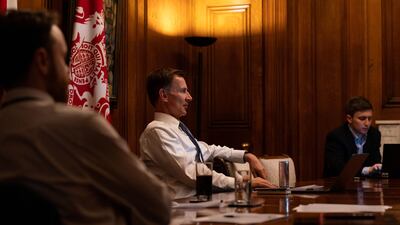
The Chancellor, Jeremy Hunt, works on his speech before the Autumn Statement in his office in No 11 Downing Street, London. All photos: Zara Farrar / HM Treasury -
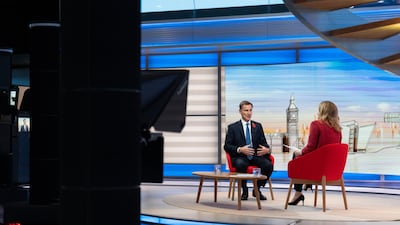
Mr Hunt is interviewed over details of his budget statement -

The Chancellor faces anger from some Conservative Party members about the prospect of raising taxes to weather Britian's economic storm -
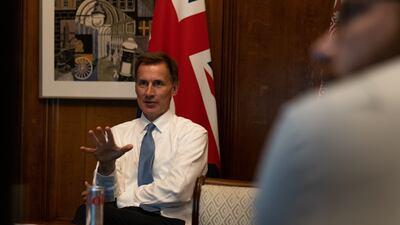
Mr Hunt will insist to MPs that his financial plan puts the UK on a 'balanced path to stability' -
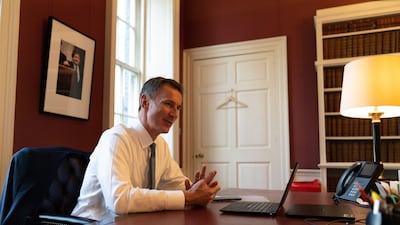
Mr Hunt insists his strategy 'protects long-term economic growth' while showing compassion to the most vulnerable in society -

Mr Hunt leaves TV studios after being interviewed -
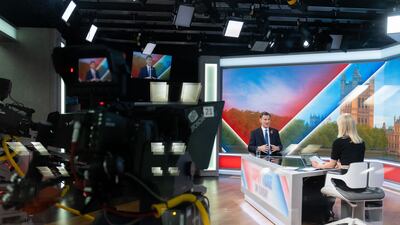
His package will stand in stark contrast to his predecessor Kwasi Kwarteng’s splurge of tax cuts, which further dented the UK’s finances


He said of the OBR predictions: “They confirm that our actions today help inflation to fall sharply from the middle of next year. They also judge that the UK, like other countries, is now in recession. Overall this year, the economy is still forecast to grow by 4.2 per cent."
He said GDP would fall in 2023 by 1.4 per cent, before rising by 1.3 per cent, 2.6 per cent and 2.7 per cent in the next three years.
He noted “today’s decisions mean that over the next five years, borrowing is more than halved”, adding: “This year, we are forecast to borrow 7.1 per cent of GDP or £177bn; next year, 5.5 per cent of GDP or £140bn; then by 2027-28, it falls to 2.4 per cent of GDP or £69bn."
The OBR’s latest forecasts have been long awaited after the official forecasting body was not used during the September mini-budget, led by former chancellor Kwasi Kwarteng.
Economists partially linked the shock to the pound and bond yields following the mini-budget announcement to a lack of visibility on the impact of the previous government’s fiscal plan.

In his statement, Mr Hunt announced:
· The windfall tax on oil and gas giants will increase from 25 per cent to 35 per cent and he imposed a 45 per cent levy on electricity generators to raise an estimated £14 billion next year
· The threshold at which the top rate of income tax is paid is reduced from £150,000 to £125,140
· Electric vehicles will no longer be exempt from Vehicle Excise Duty from April 2025 to make the motoring tax system “fairer”
· State pensions will increase in line with inflation in April, the “biggest ever cash increase in the state pension”
· The defence budget will be maintained at at least 2 per cent of GDP
· It will “not be possible” to return to the 0.7 per cent overseas aid target “until the fiscal situation allows”
· Stamp duty cuts announced in Mr Kwarteng’s mini-budget will now be time-limited, ending on March 31 2025
· The National Health Service budget will increase by an extra £3.3 billion in each of the next two years. Mr Hunt said he wants “Scandinavian quality alongside Singaporean efficiency” in the NHS
He also said: “I have no objection to windfall taxes if they are genuinely about windfall profits caused by unexpected increases in energy prices. But any such tax should be temporary, not deter investment and recognise the cyclical nature of many energy businesses. Taking account of this, I have decided that from January 1 until March 2028 we will increase the Energy Profits Levy from 25 per cent to 35 per cent.”
His package is in stark contrast to his predecessor Mr Kwarteng’s ill-fated plan for £45 billion of tax cuts, less than two months ago, which spooked the markets, pushed up the cost of borrowing and contributed to the downfall of Liz Truss’s short-lived administration.
Mr Hunt said: “I understand the motivation of my predecessor’s mini-budget and he was correct to identify growth as a priority. But unfunded tax cuts are as risky as unfunded spending.”
The OBR has confirmed “global factors are the primary cause of current inflation”, the Chancellor said as he began his statement.
He told the Commons: “Most countries are still dealing with the fallout from a once-in-a-century pandemic.
“The furlough scheme, the vaccine rollout, and the response of the NHS did our country proud but they all have to be paid for.
“The lasting impact on supply chains has made goods more expensive and fuelled inflation, this has been worsened by a made-in-Russia energy crisis.”
High inflation is the “enemy of stability”, he said.
He added: “We are not alone facing these problems but today our plan reflects British values as we respond to an international crisis.
“We are honest about the challenges and fair in our solutions. Yes, we take difficult decisions to tackle inflation and keep mortgage rises down but our plan also leads to a shallower downturn; lower energy bills; higher long-term growth; and a stronger NHS and education system.
"Three priorities then today: stability, growth and public services. I start with stability. High inflation is the enemy of stability. It means higher mortgage rates, more expensive food and fuel bills, businesses failing and unemployment rising. It erodes savings, causes industrial unrest, and cuts funding for public services. It hurts the poorest the most and eats away at the trust upon which a strong society is built.”
Mr Hunt concluded by saying the UK would “face into the storm” that he linked to global pressures, and told MPs: “There may be a recession made in Russia but there is a recovery made in Britain — and we do so today with British resilience and British compassion.”
Shadow Chancellor Rachel Reeves responded by saying it was an “invoice for the economic carnage” of the mini-budget.
She told MPs: “What people will be asking themselves at the next election is this — 'are me and my family better off with a Conservative government?' And the answer is no.”
“Yes!” Conservative backbenchers shouted back.
Ms Reeves continued: “The mess we are in is the result of 12 weeks of Conservative chaos, but also 12 years of Conservative economic failure. Growth dismal, investment down, wages squeezed, public services crumbling.”
She said the government had forced the UK economy into a “doom loop”.
“The Chancellor is saying today he will be honest, so let’s be honest: no one was talking about cuts to public spending two months ago and no other advanced economy is cutting spending or increasing taxes on working people as they head into recession.
“This government has forced our economy into a doom loop where low growth leads to higher taxes, lower investments and squeezed wages, with the running down of public services — all of which hits economic growth again.”

