


UK prime minister Liz Truss was accused of “cowering under a desk” and being “afraid of her own shadow” when she failed to appear in parliament on Monday for an urgent question on the economy.
Labour leader Keir Starmer had tried to force Liz Truss to justify her almost wholesale abandonment of her flagship economic package but the UK leader deferred to her cabinet colleagues.
Penny Mordaunt defended Ms Truss, stating there was “a very good reason” why she could not attend herself only for the leader to then appear after an hour. Towards the end of the statement she took her place on the bench without an explanation for not appearing when the question was asked.
On a day of high drama in British politics, the new Chancellor Jeremy Hunt ditched all possible tax cuts from a calamitous mini-budget in a bid to stabilise the markets.
Mr Hunt announced that not only would he row back the 1 per cent cut in income tax but also curtail the energy price cap to just six months, in a huge move to reduce the Conservative Party’s tumbling financial reputation.
In effect he brought the guillotine down on the prime minister’s “Trussonomics” experiment of low taxes for high growth, an announcement that will very likely decapitate her premiership. As the package was brought to the House of Commons, the Labour leader pointed out the turbulence in the markets had inflicted real pain for the UK.
“There is long-term damage that can’t be undone,” he said. “Once you’ve crashed a car at 100mph you’ve damaged it for good, and you’re going to be paying much more on your insurance for years to come. And it’s working people who will pay.”
Any chance of Ms Truss remaining in power over the coming days will depend on whether Mr Hunt’s evisceration of her economic plans manages to stabilise the markets.
Watch: How Liz Truss could be forced out
From the first moments of trading on Monday it appeared the new chancellor had restored some fiscal confidence after the 10 year yield on gilts — bonds issued to finance public spending — dropped below the important 4 per cent mark.
That level is crucial as at least one big pension fund was liable to go bust if it remained above 4 per cent after the Bank of England withdrew its unlimited liability financing on Friday.
As Mr Hunt finished his brief but brutal statement on Monday the yield hovered just below the benchmark at 3.95 per cent. Similarly, the pound gained some strength against the dollar and the FTSE 100 share trading index remained on a marginally upwards trajectory.
If the UK markets continue to stabilise then there will be significant relief among Conservatives that Mr Hunt has managed to restore a small degree of respectability to their tarnished economic reputation.
The market situation had become so dire — amid concern that there was a £70 billion ($78bn) shortfall in UK government finances — that the chancellor had to get special permission from the House of Commons’ Speaker to make the announcement before parliament opened.

It was the government’s “essential responsibility to do what is necessary for economic stability”, Mr Hunt said, admitting that “no government can control the markets” but it could at least “give certainty about the sustainability of public finances”.
That certainty had been obliterated by the extraordinarily risky September 23 mini-budget put forward by his predecessor Kwasi Kwarteng who, with Ms Truss’s full blessing, introduced massive tax cuts in the hope this would stimulate growth but without saying how any of it would be financed.
Bafflement turned to astonishment and disbelief as pension funds tanked and interest rates rose with a visceral effect on incomes. Households renewing mortgages faced having to pay an average £500 a month more.
The sudden loss of confidence in economy management led to a plunging pound and surge in Whitehall’s borrowing costs.
Initially Mr Kwarteng had blithely stated he would announce how the cuts would be funded after assessment by the Office of Budget Responsibility in the new year. Then he said November 23. Then, following the furore, he said October 31.
But that was not enough. He was sacked on Friday and Mr Hunt spent the weekend in talks with the prime minister and the Governor of the Bank of England, in an attempt to placate the markets.
Sir Keir and other MPs asked how the prime minister could survive the crisis caused by her mini-budget of unfunded tax cuts.
Ms Mordaunt claimed that Ms Truss had shown “courage” in sacking her former chancellor and had “acted in the national interest” by rowing back on the mini-budget.
Ms Mordaunt displayed calm and wit in deflecting the Labour jibes, and at one point laughter by affirming to the “cowering” jibe that “the prime minister is not under a desk.” It was with regret she could not attend but there was “very good reason” for her absence.
That absence only appeared to reinforce the view that Ms Truss’s days in office are limited and strengthen the status of Ms Mordaunt as a possible replacement. But there are other contenders too, including Rishi Sunak.
The only surviving policies from the mini-budget wreckage are the 1.25 per cent cut to National Insurance, a reduction on house buying stamp duty and the abolishment of a cap on bankers’ bonuses.
Mr Hunt, a veteran centrist, implied he was now in complete charge of the government’s direction by stating in the first person that “I have decided” to keep the basic rate of income tax at 20 per cent “indefinitely”.

After six weeks in office Ms Truss is unlikely to surpass George Canning’s 119 days — he died in office.
Tory MPs realise that the quicker the mismanagement wound is excised, the less it can potentially be remembered.
By noon four Tory MPs had publicly called for Ms Truss to resign. The feeling in Westminster is that her time in office is now measured in days, if not hours.
UK chancellor Jeremy Hunt - in pictures
-
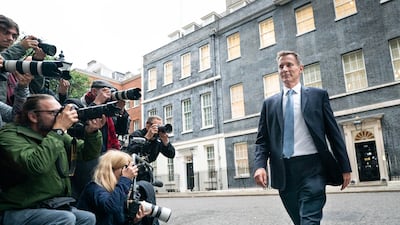
Jeremy Hunt leaves 10 Downing Street in London after he was appointed Chancellor of the Exchequer following the resignation of Kwasi Kwarteng. Here 'The National' looks back through Mr Hunt's political career. PA -
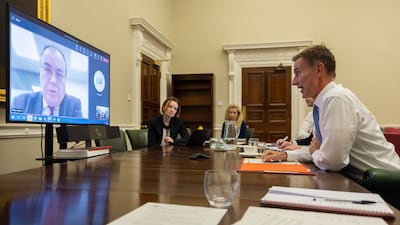
Mr Hunt holds a video conference call with Bank of England Governor Andrew Bailey from his offices in the Treasury. Photo: HM Treasury -
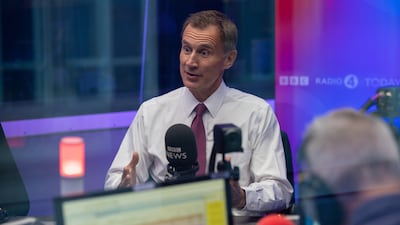
Mr Hunt conducts a series of television and radio interviews after his appointment as chancellor. Photo: HM Treasury -
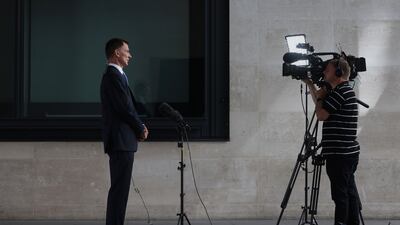
Mr Hunt speaks during an interview outside BBC Broadcasting House in July. At the time he was a contender to replace Prime Minster Boris Johnson as Conservative Party leader. Getty -
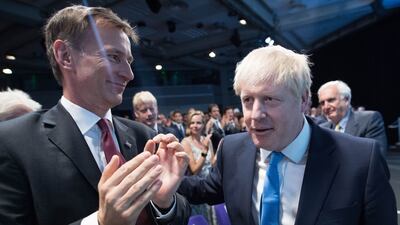
Mr Hunt after losing to leadership contender Boris Johnson, who became British Prime Minister in July 2019. Getty -

Showcasing his credentials in July 2019. Now, Mr Hunt is charged with leading Britain out of an economic malaise. Getty Images -
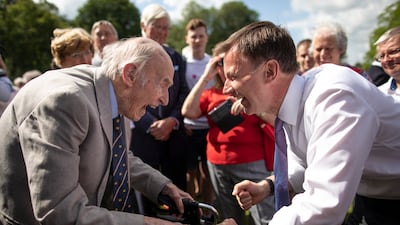
With party member and president of the Bramshot and Liphook Conservative branch Tony Rudgard, 96, in 2019. Getty -
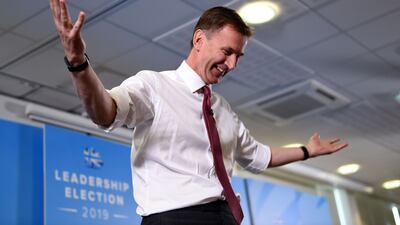
Mr Hunt speaks at the South-West Hustings in Exeter, in June 2019. Getty -
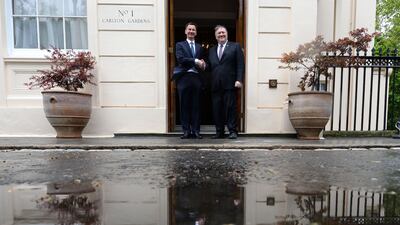
Meeting then-US secretary of state Mike Pompeo in May 2019 in London. Getty -
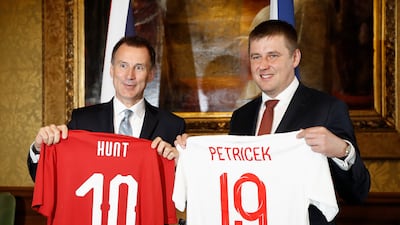
Mr Hunt and his Czech counterpart Tomas Petricek hold up football shirts on arrival at the Foreign Office in London in March 2019. Getty -
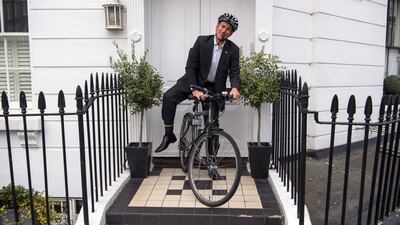
Mr Hunt as health secretary, outside his home in London in 2016. Getty -
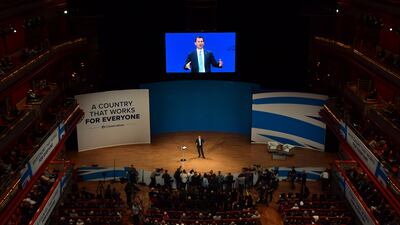
He delivers a speech at the Conservative Party Conference in Birmingham in 2016. Getty -
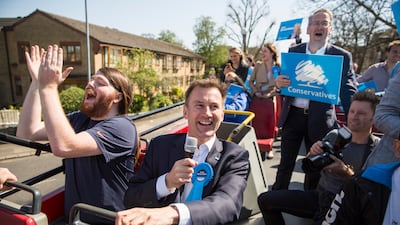
Mr Hunt joins local Conservative Party activists as they campaign on the constituency's battle bus in Thurrock in 2015. Getty -
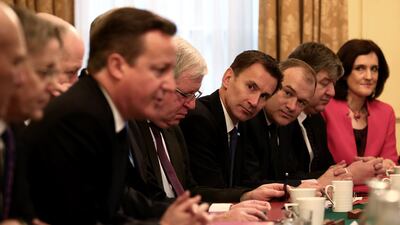
Mr Hunt looks on as then-prime minister David Cameron hosts a Cabinet meeting at No 10 Downing Street in 2015. Getty



