


Two climate change protesters have thrown tinned soup at Vincent van Gogh’s famous 1888 work Sunflowers at the National Gallery in London.
The pair threw two cans of Heinz tomato soup over the artwork shortly after 11am on Friday, before kneeling down in front of the painting and appearing to glue their hands to the wall beneath it.
Tomato soup covered the image, which is covered by glass, as well as parts of the golden frame.
Just Stop Oil tweeted a picture of the protesters, with one holding the tin in front of the painting.
They wrote: "Is art worth more than life? More than food? More than justice?"
The painting at the National Gallery is one of five versions of Sunflowers on display in museums and galleries around the world.
Police said they had arrested two people for criminal damage over the incident.

In a tweet from the Metropolitan Police Events account, the force said: “Officers were rapidly on scene at the National Gallery this morning after two Just Stop Oil protesters threw a substance over a painting and then glued themselves to a wall.
"Both have been arrested for criminal damage and aggravated trespass. Officers are now de-bonding them.”
The protesters claim that the Van Gogh has value of $84.2 million. The gallery had no immediate comment.
Sunflowers is the second, more famous, Van Gogh painting to be targeted by the group, with two climate activists gluing themselves to his 1889 Peach Trees in Blossom, exhibited at the Courtauld Gallery, at the end of June.
The work is also the second from the National Gallery to be selected as a target for protest action by Just Stop Oil, with two supporters gluing themselves to John Constable’s The Hay Wain on July 4.
They had attached their own “reimagined version” to the portrait, before gluing themselves to the frame.
The group's activists have been blocking roads around Parliament in the last few days.
Last Sunday, police said that more than 100 people had been arrested after a weekend of protest-related activity by environmental groups.
Climate activists glue themselves to artworks in protest - in pictures
-
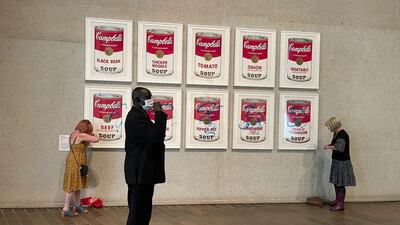
'Campbell's Soup Cans' by Andy Warhol was been targeted by climate activists at the National Gallery of Australia. Photo: Stop Fossil Fuel Subsidies -
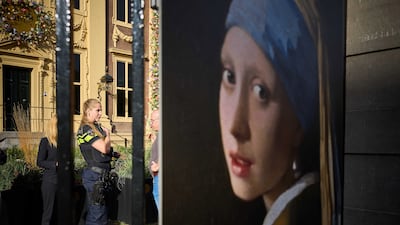
A police officer stands outside the Mauritshuis museum, where three people were arrested for attempting to smudge Vermeer's painting 'Girl with a Pearl Earring', currently exhibited there, in The Hague, Netherlands on October 27, 2022. EPA -
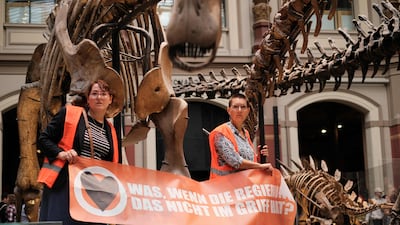
Two environmental activists of Last Generation glue themselves to metal bars around a display of dinosaur skeletons and holding a banner reading "what if the government does not have it under control" in the Berlin's Natural History Museum, in Berlin on October 30. AFP -
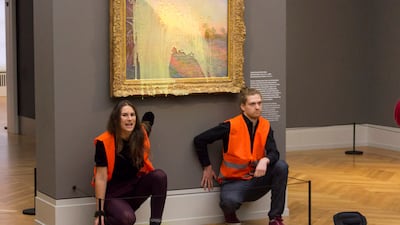
Climate protesters of Last Generation after throwing mashed potatoes at the Claude Monet painting 'Les Meules' at Potsdam’s Barberini Museum on October 24. AP -
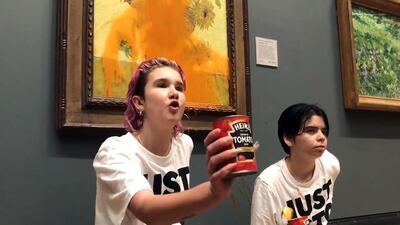
Protesters throw two tins of Heinz tomato soup at Vincent van Gogh’s famous 1888 work Sunflowers at the National Gallery in London on October 14. Photo: Just Stop Oil -
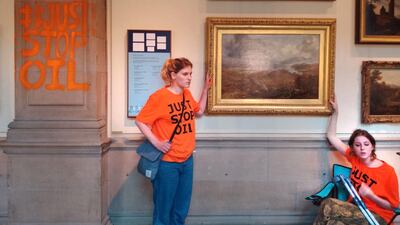
Three young supporters of Just Stop Oil spray-painted around the Kelvingrove Art Gallery and Museum in Glasgow. Two also glued themselves to the frame of Horatio McCulloch's painting 'My Heart’s in the Highlands' on June 29 this year. Photo: Just Stop Oil -
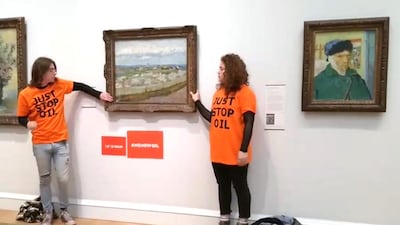
Two activists glued themselves to the frame of Vincent van Gogh’s 'Peach Trees in Blossom' (1889) at The Courtauld Gallery in London on June 30. Photo: Just Stop Oil -
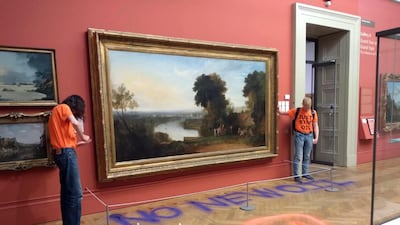
On July 1, two activists glued themselves to the frame of 'Tomson’s Aeolian Harp' (1809), a painting by JMW Turner, at the Manchester Art Gallery. Photo: Just Stop Oil -
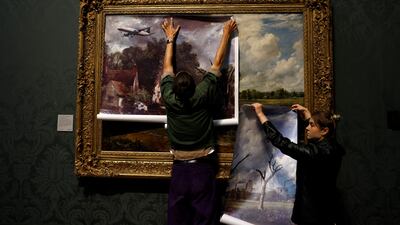
Activists from the 'Just Stop Oil' campaign group cover 'The Hay Wain' painting by English artist John Constable, in a mock 'undated' version including roads and aircraft, before glueing their hands to the frame in protest against the use of fossil fuels, at The National Gallery in London on July 4. AFP -
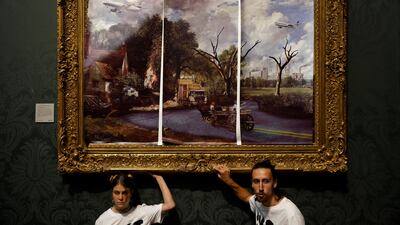
Activists glue their hands to the frame of the painting 'The Hay Wain' on July 4. AFP -

Five Just Stop Oil activists spray paint the wall and glue themselves to the frame of the painting the 'Last Supper' by Leonardo da Vinci on July 5, at the Royal Academy of Arts, London. Photo: In Pictures via Getty Images -
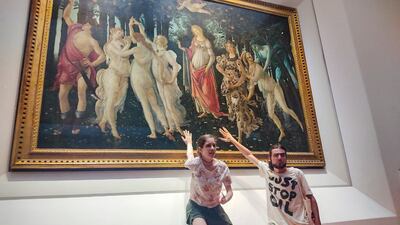
Two activists of the Ultima Generazione (Last Generation) environmentalist group glue themselves to the glass protecting Italian Renaissance painter Sandro Botticelli's 'Primavera (Spring)' in Florence's Uffizi Galleries on July 22. Photo: Ultima Generation via AP -
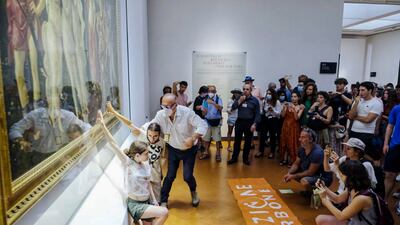
A museum official tries to block two activists of Ultima Generazione (Last Generation). Photo: Ultima Generation via AP -

Visitors take pictures and video of the 'Mona Lisa' after cake was smeared on its protective glass at the Louvre Museum in Paris on May 29. Photo: Twitter / @klevisl007 via Reuters



