


The Rosetta Stone has temporarily moved to a new exhibition in the British Museum to celebrate 200 years since hieroglyphs were decoded.
The move marks the first time the ancient object has been relocated since it was installed in the Egyptian Sculpture Gallery 18 years ago.
The inscribed slab was stumbled on by a group of soldiers in 1799 and later went on to become the key that unlocked the mysterious hieroglyphic script of ancient Egypt.
The stone will be at the heart of the British Museum’s Hieroglyphs: Unlocking Ancient Egypt exhibition which will be on display from October 13 until February 19.
“We are telling the story of the decipherment of Egyptian hieroglyphs, which happened 200 years ago, so that’s what we’re celebrating," exhibition curator Ilona Regulski told PA.
“The Rosetta Stone is crucial to the story of decipherment because it provided the key to decipher hieroglyphs.
“We wouldn’t be able really to tell the story of the decipherment of hieroglyphs without the Rosetta Stone, so we decided that it would have a good place in the exhibition.
“Also, it provides us with an opportunity to contextualise the story a bit better and to tell more complete stories about the role of the stone in the decipherment, but also how it came to the British Museum.”
British Museum Egyptian hieroglyphs exhibition - in pictures
-

An exhibition by the British Museum, scheduled to open to the public on October 13, will mark 200 years since the decipherment of ancient Egyptian hieroglyphs. Photo: The Trustees of the British Museum -

The Rosetta Stone provided the key to decoding hieroglyphs and expanding modern knowledge of Egypt’s history. Photo: The Trustees of the British Museum -

The temple lintel of Amenemhat III, a pharoah from ancient Egypt and the sixth king of the 12th Dynasty of the Middle Kingdom of Egypt. Photo: The Trustees of the British Museum -

The exhibition will feature 'The Enchanted Basin', a large black granite sarcophagus covered with hieroglyphs from about 600 BC. The hieroglyphs were believed to have magical powers, and bathing in the basin was expected to offer relief from the torments of love. Photo: Trustees of the British Museum -

The outer coffin containing the mummified remains of a woman called Baktenhor, who lived between 1070 and 713 BC in Thebes, now called Luxor. Photo: The Trustees of the British Museum -

An image of Dr Thomas Young (1773-1829) on a copper medal. Young was instrumental in the decipherment of Egyptian hieroglyphs, specifically the Rosetta Stone. Photo: The Trustees of the British Museum -
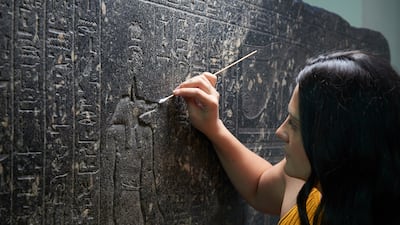
Senior conservator Stephanie Vasiliou cleans ‘The Enchanted Basin’ in preparation for the exhibition. Photo: The Trustees of the British Museum -

The mummy bandage of Aberuait from the Ptolemaic period, which has never been displayed in the UK, will also be on show. Photo: Musee du Louvre -

A 19th century portrait of Jean-François Champollion (1790–1832). Champollion was able to decipher the hieroglyphs through the oval shapes found in the hieroglyphic text, which are known as Kharratis and include the names of kings and queens. Photo: Musee Champollion -

Ms Vasiliou and conservation student Shoun Obana clean ‘The Enchanted Basin’. The reused ritual bath was discovered near a mosque in Cairo. Photo: The Trustees of the British Museum -
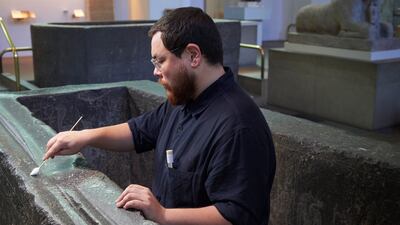
Mr Obana cleans ‘The Enchanted Basin’, which was later identified as the sarcophagus of Hapmen, a nobleman of the 26th Dynasty. Photo: The Trustees of the British Museum -

The limestone statue of a scribe dating back to ancient Egypt's Sixth Dynasty will also be on display. Photo: Musee du Louvre -

Queen Nedjmet's 3,000-year-old 'Book of the Dead' will feature alongside a set of canopic vessels that preserved the organs of the deceased. Photo: The Trustees of the British Museum -
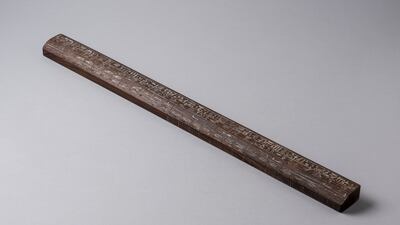
A royal cubit rod belonging to Amenemope, a scribe from ancient Egypt. The exhibition explores the inscriptions and objects that helped academics unlock an 'ancient civilisation' two centuries ago. -
Visitors looking at the Rosetta Stone. Photo: The Trustees of the British Museum -
Installation of an amulet in front of The Book of the Dead. Photo: The Trustees of the British Museum -
A visitor views Egyptian sculptures of cats. Photo: The Trustees of the British Museum


Ms Regulski said the Rosetta Stone was in Paris’s Louvre Museum “for a very brief period” in 1972 and was also moved during the Second World War for its protection.
Speaking about how long the exhibition took to curate, she said: “I think about three years. I think I started doing research in 2019.
“You build the story in your head as a curator and then at a certain point, I think a bit more than a year out, we kind of got the core team together.
“Now it’s quite a big team because we’re building the exhibition. I am very excited.”
Ms Regulski, who is also the curator of written culture at the British Museum, said they were replacing the Rosetta Stone with a temporary display.
“We are, of course, using this opportunity of the empty showcase to make a new display and it is almost ready,” she said.
“It’s an opportunity to rethink that whole display and that area, which is really a crossroads between different cultures of the ancient world.
“We’re using this as a kind of pilot to look at how we can address the story of the different cultures of the ancient world being interconnected.”
Last month, a renowned Egyptian archaeologist told The National he was about to launch a new push to bring the Rosetta Stone back to its homeland from the British Museum, tapping into a changing mood in Europe about the rightful home of colonial-era trophies.
Dr Zahi Hawass, a larger-than-life Egyptologist and former antiquities minister who once escorted Barack Obama around the pyramids, believes people in Europe “are really awakening” to his cause. “I believe those three items are unique and their home should be in Egypt. We collected all the evidence that proves that these three items are stolen from Egypt,” he told The National.
“The Rosetta Stone is the icon of Egyptian identity. The British Museum has no right to show this artefact to the public.”
British Museum's Girsu Project - in pictures
-
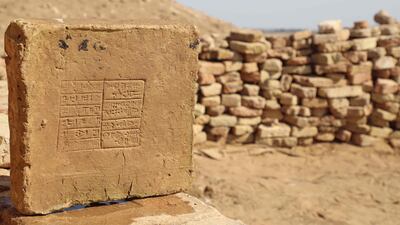
A mud brick bearing a cuneiform inscription found during the Girsu Project's excavation at the ancient Sumerian city, now known as Tello, in Iraq in 2021. Recent excavations of the ancient complex have shed new light on the history and development of the city. AFP -
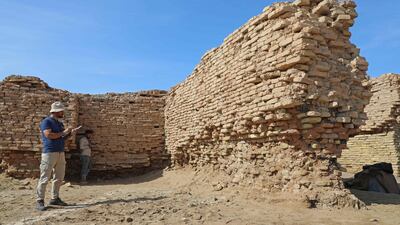
For decades, historians have believed that the Sumerians' mastery of irrigation led to their development. Now, the Girsu Project's discoveries suggest that irrigation was not the cause of these changes after all. AFP -

A partial view shows the bridge in the city of Girsu. AFP -
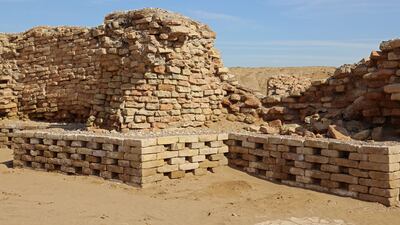
Archaeologists used new technologies to understand the development of the city, flying drones over the vast, 250-hectare site. AFP -

The images they gathered show the extent to which the irrigation system was embedded throughout the city and its surrounds. AFP -
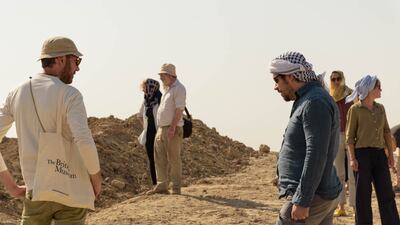
Members of the archaeological team at Girsu, southern Iraq, in autumn 2021. Photo: British Museum -

A statue of King Gudea found in Girsu, dating from circa 2130 BC. The statue and other items from Iraq are currently on show as part of the Ancient Iraq: New Discoveries exhibition in Nottingham in the UK. Photo: British Museum -
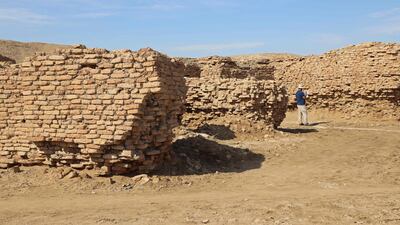
The new discovery indicates that the largest irrigation canals date to the prehistory of Mesopotamia. That means they are much older than the birth of the city, by about 1,000 years. AFP -
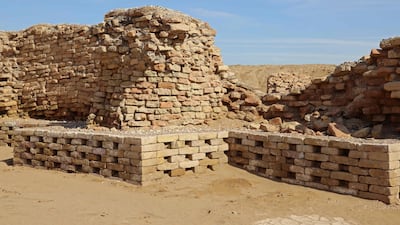
Archaeologists believed that once the ancient Sumerians learnt to irrigate their crops, they were able to move from subsistence farming to building elaborate temples. But the Girsu Project’s discoveries show that they were living with well-watered plains for a full millennium before they began to build the temple complexes. AFP -

Cuneiform inscription is found during excavation at the ancient Sumerian city of Girsu. AFP -
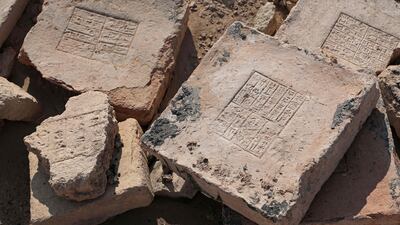
Mud bricks bearing cuneiform inscriptions. AFP -

A cone bearing a cuneiform inscription. AFP -
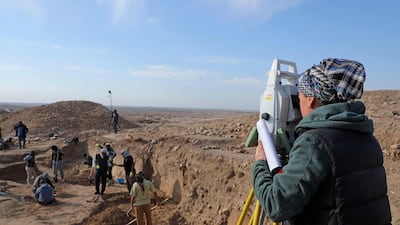
Archaeologists and workers excavate the ancient Sumerian city of Girsu. AFP -

Working with archaeologists from five universities in Iraq, the British Museum team dug out shells and other material from the bottom level of the canals to be carbon-dated. AFP -
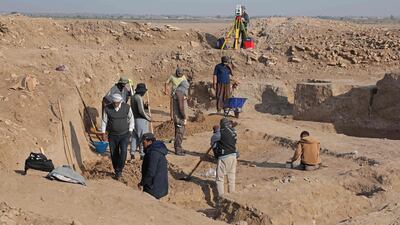
The last time Girsu was excavated was in the 1960s, when now-standard technologies and archaeological practices were not in place. AFP -
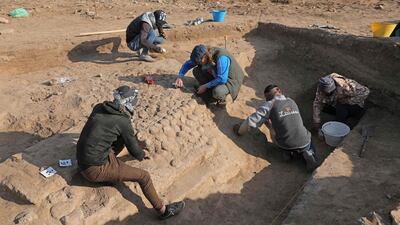
Sumerian scholars have been working off that era’s imperfect knowledge since then, as the US invasion in the 1990s and the ensuing unrest have stalled any archaeological excavation of the site. AFP -

When the archaeological team arrived in 2021, they found Girsu pockmarked, with depressions in the soil where looters dug up items. AFP -
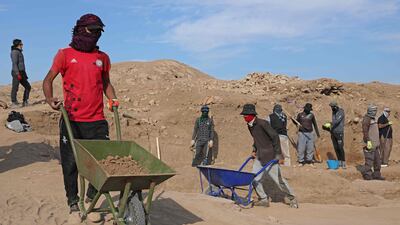
The archaeologists' goals were to research the site but also to practice what they call 'forensic archaeology', treating the dig like a crime scene. AFP -
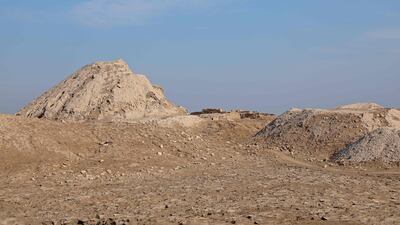
A general view shows the excavation site at the ancient Sumerian city of Girsu, known as Tello, in Iraq. AFP -

Young Iraqi archaeologists received training as part of the Girsu Project, headed by Sebastien Rey of the British Museum, centre. Photo: British Museum -
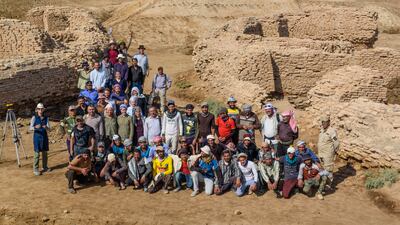
The British Museum excavation team in the ancient city of Girsu. Photo: British Museum


The immersive display, which will include digital media and audio, will bring together more than 240 objects charting the race to decipherment.
A star object in the display will be “the enchanted basin” – a large black granite sarcophagus covered with hieroglyphs from about 600BC.
The hieroglyphs were believed to have magical powers and bathing in the basin could offer relief from the torments of love.
Similarly, the 3,000-year-old illustrated Book of the Dead of Queen Nedjmet will be featured alongside a set of canopic vessels that preserved the organs of the deceased.
It will be the first time a set of jars have been reunited since the 1700s, the museum said.
The mummy bandage of Aberuait from the Musee du Louvre in Paris, which has never been displayed in the UK, will also be on show.
“I hope visitors will, of course, learn about ancient Egypt," Ms Regulski said. "It’s always a wonderful opportunity to show new research about one of the most amazing ancient civilisations.
Return of Parthenon fragment to Greece reignites campaign for UK to hand over marbles - video
“I hope they understand that ancient Egypt was a distant culture but also is relevant to understand human practices today. We have a lot in common with the ancient people.
“I tried to show that by deciphering hieroglyphs, we really get an insight into ancient Egypt that wasn’t possible before.
“We understand much better now how common people lived, how they enjoyed writing, because most people couldn’t read and write of course, so they would have enjoyed written culture by listening to it, by performances and citations.
“I hope to really bring the message across that behind hieroglyphs there is a spoken language. It was a means to communicate with each other.”

