Royal Canadian Mounted Police during the state funeral of Queen Elizabeth II. Getty Images

Four horses from the Mounties to lead the queen's funeral procession


Gillian Duncan
  • English
  • Arabic

Four horses from the Royal Canadian Mounted Police will lead the ceremonial parade for Queen Elizabeth II’s funeral procession.

The quartet, which will by ridden by officers wearing red tunics and Stetsons, will ride from Westminster Abbey to Hyde Park Corner.

The horses, called Elizabeth, George, Sir John, and Darby, are trained for special occasions and expected to cope well with the hundreds of people packing the route.

Sgt Maj Scott Williamson, who will be riding Darby, said it was “incredibly humbling’” to lead the funeral procession.

“We are in what we would call a “no-fail mission” right now, and that is to represent the force and the great people of this country during this ceremony," he said.

The tribute will honour the queen’s love of Royal Canadian Mounted Police horses, which stretched back more than five decades.

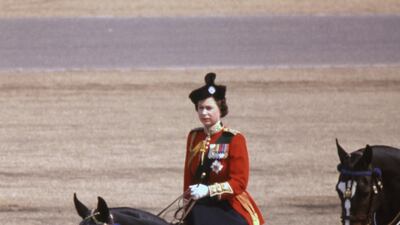
She received a coal black mare called Burmese from the Mounties in 1969. She appeared on the horse at 18 consecutive Trooping the Colour parades.

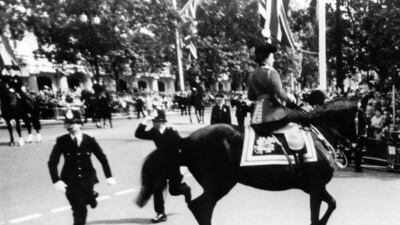
During the 1981 ceremony, a teenager fired six blanks from a gun, startling Burmese. The queen, an accomplished rider, coolly regained control of the horse, raising cheers from the crowd. Scots Guardsman Alec Galloway sprang into action to apprehend the attacker and told The National he would not forget that day as long as he lived.

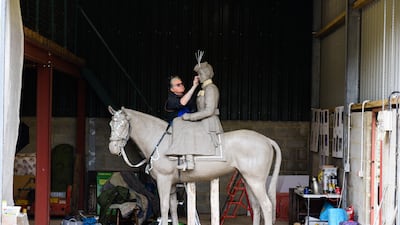
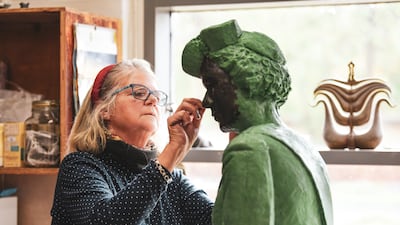
  • Sculptor Caroline Wallace works on a sculpture of Queen Elizabeth II riding the horse Burmese, which will be installed at the Royal Military Academy Sandhurst. Photo: Miranda Meiklejohn
    Sculptor Caroline Wallace works on a sculpture of Queen Elizabeth II riding the horse Burmese, which will be installed at the Royal Military Academy Sandhurst. Photo: Miranda Meiklejohn
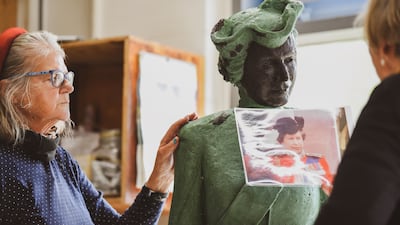
  • Ms Wallace was commissioned for the project 18 months ago and has spent the time since researching every aspect of the monarch’s uniform and the horse’s tack. Photo: Miranda Meiklejohn
    Ms Wallace was commissioned for the project 18 months ago and has spent the time since researching every aspect of the monarch’s uniform and the horse’s tack. Photo: Miranda Meiklejohn
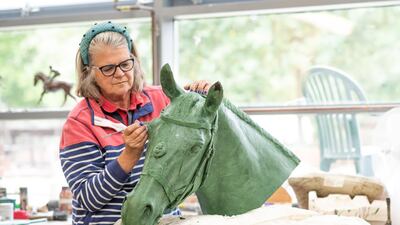
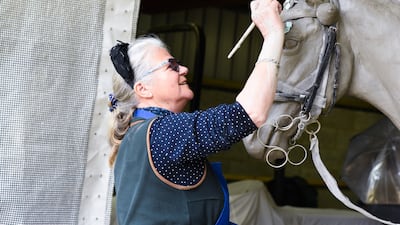
  • Ms Wallace works on the head of Burmese - Queen Elizabeth's favourite ceremonial steed. Photo: Miranda Meiklejohn
    Ms Wallace works on the head of Burmese - Queen Elizabeth's favourite ceremonial steed. Photo: Miranda Meiklejohn
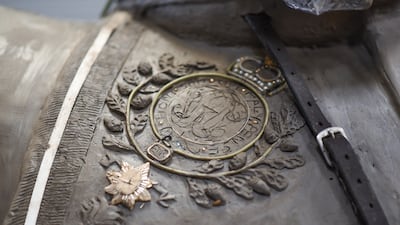
  • A view of the intricate details on the sculpture. Photo: Miranda Meiklejohn
    A view of the intricate details on the sculpture. Photo: Miranda Meiklejohn
  • The sculpture depicts the queen in full parade regalia. Photo: Miranda Meiklejohn
    The sculpture depicts the queen in full parade regalia. Photo: Miranda Meiklejohn
  • The life-sized bronze statue will be unveiled at the Royal Military Academy Sandhurst before a long weekend of platinum jubilee celebrations. Photo: Miranda Meiklejohn
    The life-sized bronze statue will be unveiled at the Royal Military Academy Sandhurst before a long weekend of platinum jubilee celebrations. Photo: Miranda Meiklejohn
  • Queen Elizabeth riding her horse Burmese during the Trooping the Colour ceremony at the Horse Guards Parade in 1969. PA
    Queen Elizabeth riding her horse Burmese during the Trooping the Colour ceremony at the Horse Guards Parade in 1969. PA
  • Queen Elizabeth calms her horse Burmese while policemen spring to action after shots were heard as she rode down the Mall in 1981. PA
    Queen Elizabeth calms her horse Burmese while policemen spring to action after shots were heard as she rode down the Mall in 1981. PA
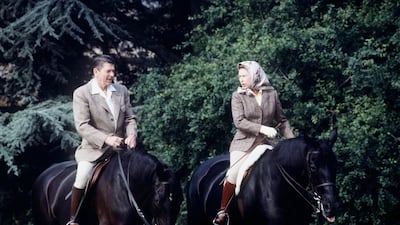
  • Queen Elizabeth riding Burmese alongside US President Ronald Reagan in the grounds of Windsor Castle during his state visit in 1982. Getty Images
    Queen Elizabeth riding Burmese alongside US President Ronald Reagan in the grounds of Windsor Castle during his state visit in 1982. Getty Images

The mare's last appearance at the Horse Guards Parade was in 1986, after which she was put out to pasture in the grounds of Windsor Castle within easy sight of the queen. She died of a stroke four years later and was buried in the grounds.

The queen did not ride on a horse again at Trooping the Colour, opting to take part in the parade from a carriage instead.


What is blockchain?

Blockchain is a form of distributed ledger technology, a digital system in which data is recorded across multiple places at the same time. Unlike traditional databases, DLTs have no central administrator or centralised data storage. They are transparent because the data is visible and, because they are automatically replicated and impossible to be tampered with, they are secure.

The main difference between blockchain and other forms of DLT is the way data is stored as ‘blocks’ – new transactions are added to the existing ‘chain’ of past transactions, hence the name ‘blockchain’. It is impossible to delete or modify information on the chain due to the replication of blocks across various locations.

Blockchain is mostly associated with cryptocurrency Bitcoin. Due to the inability to tamper with transactions, advocates say this makes the currency more secure and safer than traditional systems. It is maintained by a network of people referred to as ‘miners’, who receive rewards for solving complex mathematical equations that enable transactions to go through.

However, one of the major problems that has come to light has been the presence of illicit material buried in the Bitcoin blockchain, linking it to the dark web.

Other blockchain platforms can offer things like smart contracts, which are automatically implemented when specific conditions from all interested parties are reached, cutting the time involved and the risk of mistakes. Another use could be storing medical records, as patients can be confident their information cannot be changed. The technology can also be used in supply chains, voting and has the potential to used for storing property records.

Infobox

Western Region Asia Cup Qualifier, Al Amerat, Oman

The two finalists advance to the next stage of qualifying, in Malaysia in August

Results

UAE beat Iran by 10 wickets

Kuwait beat Saudi Arabia by eight wickets

Oman beat Bahrain by nine wickets

Qatar beat Maldives by 106 runs

Monday fixtures

UAE v Kuwait, Iran v Saudi Arabia, Oman v Qatar, Maldives v Bahrain

Updated: September 19, 2022, 11:26 AM