


Sunflowers have been one of the most common tributes left at Buckingham Palace, Windsor Castle, Balmoral and Sandringham after Queen Elizabeth II's death.
Social media users have been sharing their reasons for honouring the queen with the yellow flower. Some said “she had the most amazing smile” and that they wanted “to highlight the affection that the people of Ukraine have for the queen”.
Speaking after laying sunflowers near the walls of Windsor Castle, Sue Sharma, 71, said she chose them because they were among the queen’s favourite blooms.
“They were all close to granny, and at a time like this, you have to get together and be there for each other,” she said, touching on Prince William and Prince Harry's recent joint appearance outside the castle with their wives to view the flowers. “I hope the family keep supporting each other and their wives, too.”
Lloyd Rees, a London-based lawyer, 32, said he left sunflowers near Buckingham Palace to highlight the queen’s legacy of delighting people.
“Her Majesty the Queen gave a lifetime of service to our country,” he said. “I felt I must visit the palace and pay my respects to the queen. I decided to leave a bouquet of sunflowers as she had brought so much joy and happiness to so many people for so long.”
As well as the bouquet, Mr Rees left a note at a floral tribute garden in Green Park saying: “Thank you for your service to our nation. A constant in a changing world. We will miss you. With love.”
The managing director of L&D Flowers, in Pinchbeck, south Lincolnshire, said the summer heatwave in many parts of the UK could also be behind the legions of sunflowers.
“This is the longest heatwave we’ve had for about five years and, based on current weather predictions, we calculate a harvest of around 13 million stems this season”, James Lacey said.

Florists near the palace have been inundated with orders for bunches of garden-style flowers and bespoke arrangements to pay tribute to the queen. This is evidenced by the mass rows of bouquets laid outside the late monarch’s central London home.
As well as sunflowers, roses and carnations have featured heavily in the sea of tributes outside the palace walls and in nearby Green Park since the queen's death aged 96 on Thursday.
Orders for flowers have flooded in from as far afield as Paris and New York.
Some mourners have bucked tradition and opted instead to lay Paddington Bear teddy bears and even marmalade sandwiches outside the palace and other royal residences. This has prompted the Royal Parks charity to ask people to stop bringing non-floral tributes.
Erik Carlsen, owner of Pullbrook and Gould Flowers on Buckingham Palace Road, said there had been a noticeable shift in requests from customers.
“Of course we have had a lot more people visiting our shop,” Mr Carlsen told The National. “People are asking for English garden-type flowers.
“They ask for lilies, roses, carnations, passion flowers.”
Louise Bermingham, a florist at Wild Things Flowers in Mayfair, said requests for floral arrangements had poured in from as far away as the US at the weekend.
“I think people just want to show that they care and putting flowers down is just a nice way of doing that,” she told The National.
“We had calls from people in Paris and New York asking for us to lay the arrangements for them.
“From Friday, people have been just walking in and buying flowers and walking down to the palace. We sold out of white and green flowers on Friday and Saturday but people are not too fussy.”
Katie, who works at Tanikas Flowers, a stone’s throw from Green Park, said the shop had been extra busy since the queen’s passing. She questioned why customers had sought sunflowers over other flowers.
“I have no idea why people are asking for sunflowers — maybe it’s because they’re cheery,” she told The National. “There’s just been an influx of people.”
In an attempt to reduce waste and the clean-up effort that lies ahead, the Royal Parks issued a statement on its website for people wishing to lay tributes.
“Unfortunately, no gifts and artefacts will be accepted and the public will be asked not to bring these to the parks,” the charity responsible for the upkeep of some of London’s largest parks said.
“Non-floral objects/artefacts such as teddy bears or balloons should not be brought.”
Some royal watchers have turned to Paddington Bear to make their public tributes to Britain’s longest-reigning monarch. The fictional character in children’s storybooks enjoyed cream tea with the queen at Buckingham Palace to mark her platinum jubilee in June. The two-and-a-half-minute film involved the head of the royal family pulling a marmalade sandwich out of her signature Launer handbag. The production was seen as a playful nod to the queen’s sense of humour, which did not dim in her final months.
Some well-wishers had sought to light candles next to bunches of flowers surrounding ancient trees in Green Park. However, the Royal Parks has banned the practice over safety concerns.
“It will not be possible to light candles in the parks,” the charity said. “Lit candles will be extinguished and periodically removed.”
The UK mourns the death of Queen Elizabeth II — in pictures
-
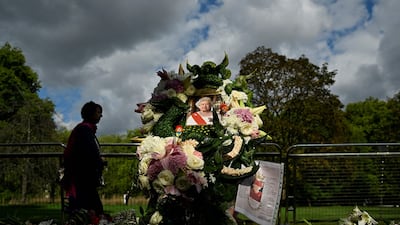
A tribute altar for Queen Elizabeth II in Green Park in London. AFP -
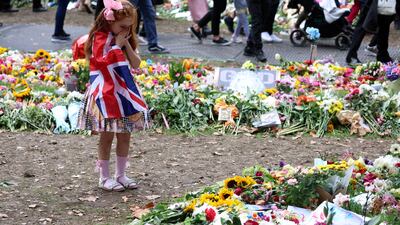
Ann Doran, 6, looks at floral tributes left in Green Park. Reuters -
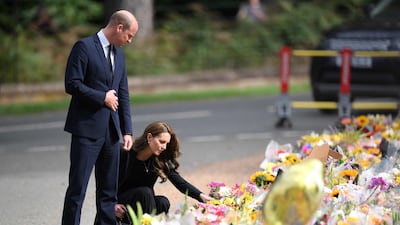
Britain's Prince William, Prince of Wales, and Catherine, Princess of Wales, look at floral tributes on the Sandringham Estate. AFP -
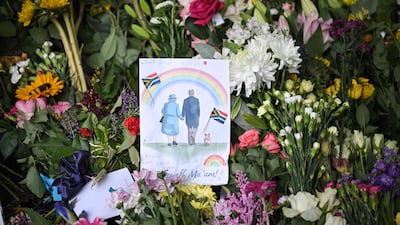
A drawing of the queen and her husband Prince Philip among flowers outside Windsor Castle. AFP -

Members of the public view floral tributes in Green Park, near Buckingham Palace. PA -
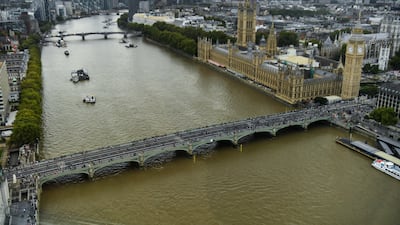
People queue on a bridge over the river Thames to pay their respects to Queen Elizabeth in London. Reuters -
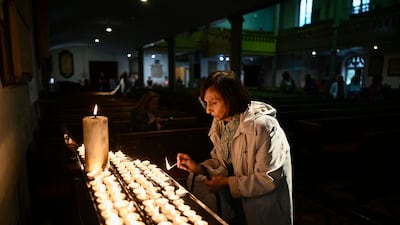
A member of the public lights a candle at Windsor Parish Church. AFP -
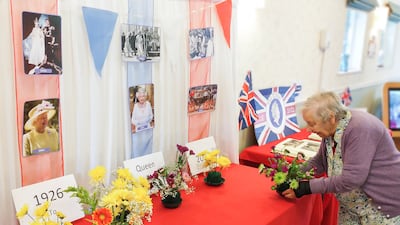
Residents of the Lawn care home in Alton, Hampshire, decorate an area with photographs of Queen Elizabeth, bunting and their own flower arrangements. PA -

Lloyd's of London chief John Neal delivers remarks honouring the life of Queen Elizabeth during a remembrance ceremony in the atrium of the company's offices in London. Getty Images -
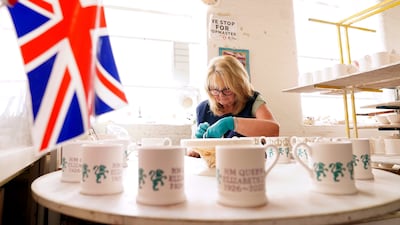
Joyce Buckley, a sponge decorator at Emma Bridgewater pottery in Stoke-on-Trent, Staffordshire, paints a commemorative mug. PA -
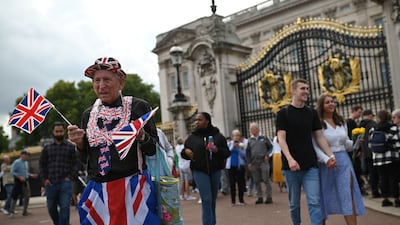
A royalist standing in front of Buckingham Palace. AFP -
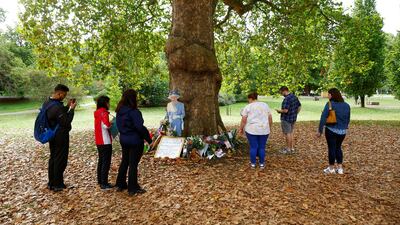
Tributes to Queen Elizabeth are viewed at St James's Park in London. Reuters -
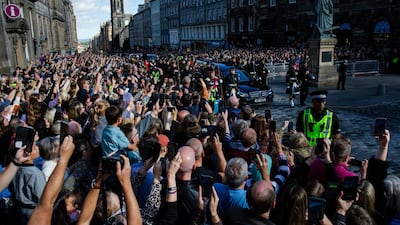
Crowds gather outside St. Giles' Cathedral on the Royal Mile as the queen's coffin passes in Edinburgh. Bloomberg -
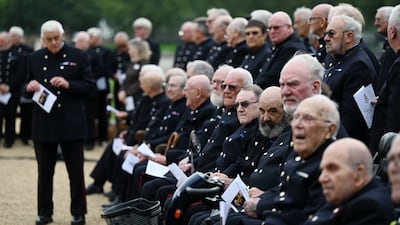
Chelsea Pensioners attend a Drumhead service of remembrance, with readings and prayers, in London. Getty Images -
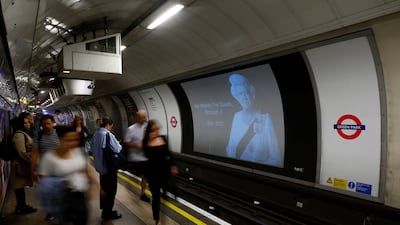
An image of Queen Elizabeth at Green Park Tube station. Reuters -
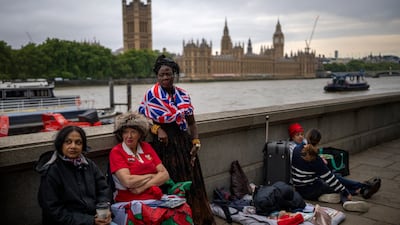
Vanessa, Anne and Grace, from left to right, wait opposite the Palace of Westminster to be first in line bidding farewell to Queen Elizabeth in London. AP -
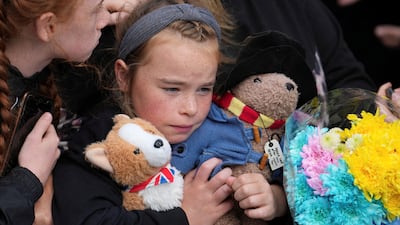
A young girl holds Paddington Bear and Corgi stuffed toys while waiting to watch the procession of Queen Elizabeth's coffin from the Palace of Holyroodhouse to the Royal Mile in Edinburgh. Reuters -
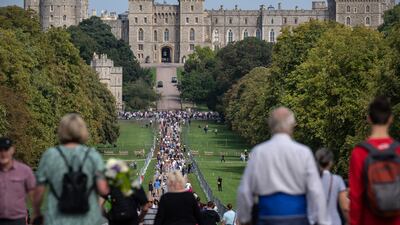
Well-wishers outside Windsor Castle. Getty Images -
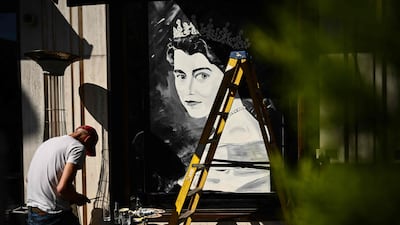
Lloyd Smith paints a portrait of Queen Elizabeth in London. AFP -
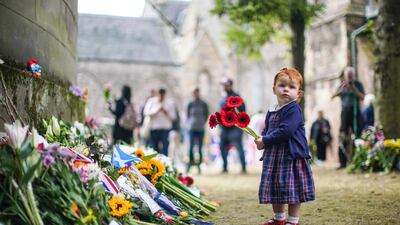
A child lays flowers outside the Palace of Holyroodhouse in Edinburgh. AP -
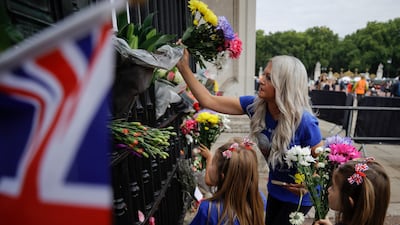
A family leaves flowers outside Buckingham Palace. EPA -
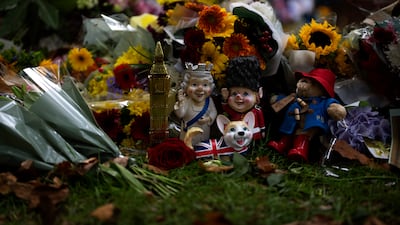
Flowers and tributes, including sunflowers and a Paddington Bear, are left for Queen Elizabeth at the Green Park memorial in London. AP -
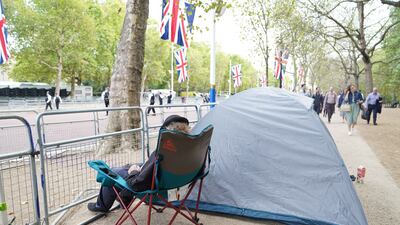
People start to camp on The Mall ahead of Queen Elizabeth's coffin being taken from Buckingham Palace on Wednesday afternoon by procession on a Gun Carriage to the Palace of Westminster. PA -
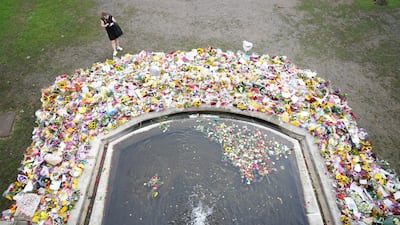
Flowers left in St James's Park, London. PA -
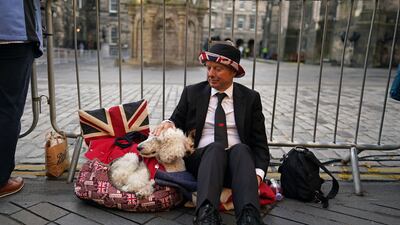
A man with his dog arrive early as they wait to view the cortege carrying the coffin of Queen Elizabeth in Edinburgh. Getty Images -
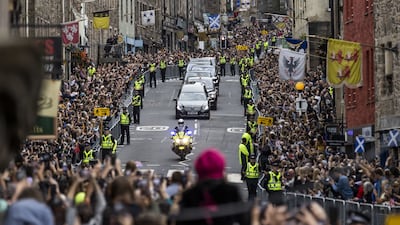
Members of the public gather on the Royal Mile in Edinburgh to watch the hearse carrying the coffin of Queen Elizabeth to the Palace of Holyroodhouse. PA -

Crowds watch as the hearse continues its journey to the Palace of Holyroodhouse from Balmoral. PA -
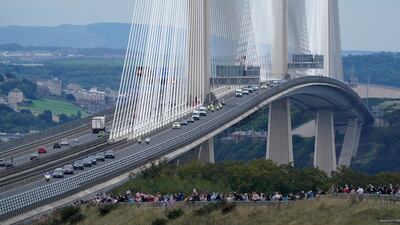
The hearse passing over Queensferry Crossing on its way to Edinburgh. PA -

Flowers left at the Sandringham Estate, one of the queen's residences. EPA -
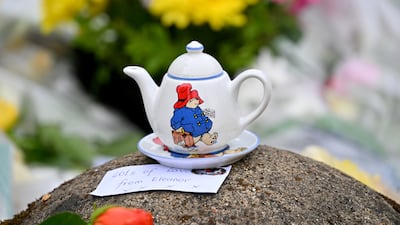
A Paddington Bear teapot at the Sandringham Estate. EPA -
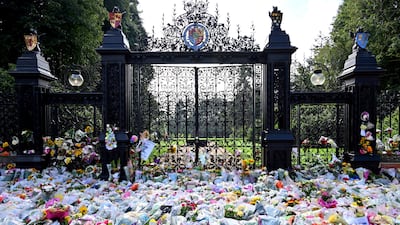
Flowers left at the gates of the Sandringham Estate. EPA -

Flowers, cards and messages left in St James's Park in London. EPA -
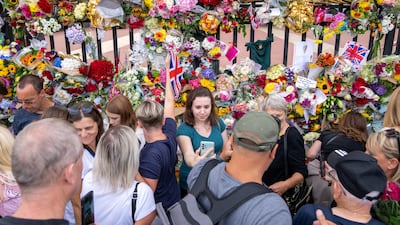
People lay flowers at Buckingham Palace in London. Reuters



