


Widespread travel disruption at UK airports such as Heathrow and Gatwick cost holiday company Tui £63 million ($76.1 million) in the third quarter ended June 30.
Customers were affected by about 200 cancelled flights in May and June as the industry struggled to cope with a steep increase in demand for travel amid a shortage of staff.
Tui remained loss-making in the three months to the end of June due to the costs of the airport disruption, reporting underlying pre-tax losses of £23 million in its third quarter.
While the costs of the airport troubles kept the holiday company in the red over its third quarter, the result still marked a significant improvement on the £566 million underlying loss suffered a year earlier, thanks to the recent rebound in demand for travel.
Putting aside the costs of the airport disruption, the company said it would have reported underlying earnings of £41 million in the three months to June 30 — its first quarterly profit since the Covid-19 crisis struck.
Europe's largest tour operator was particularly hard hit by the chaos at Manchester Airport, caused by a chronic lack of staff such as baggage handlers, which resulted in dozens of flights being scrapped.
Passengers were also hit by lengthy delays that left people, including children, stranded in terminals for hours.
There were mass redundancies at airports and bosses during the coronavirus-induced slowdown and bosses are now scrambling to hire more air traffic control personnel, security guards and baggage handlers.
Sebastian Ebel, Tui’s chief financial officer and incoming boss, said he would hold “intensive” talks with airports and airlines, as well as resorts, as he looks to improve the customer experience.
Mr Ebel said the “entire European airline sector" continued to face challenges.
“We are consistently tackling the operational challenges of the restart,” he said. “We want to offer our guests the usual high Tui standards of quality and service.
“The topics of quality and customer experience are therefore at the top of my agenda.
“To this end, I will engage in intensive dialogues with the destinations, retail, but also with system partners such as airports and airlines.”
Mr Ebel will take over as chief executive of Tui at the end of August when Fritz Joussen steps down.
Tui expects to bounce back close to pre-pandemic demand levels this summer, operating 82 per cent of its holiday programme in its third quarter, with customers at 84 per cent of 2019 levels.
The group also expects to report significant underlying earnings for the full year.
However, it issued a warning that surging inflation due to the Ukraine war was affecting its costs due to rising fuel prices while rising energy bills could knock demand for holidays as consumers cut back.
In a bid to reduce upheaval to passengers’ travel plans, Heathrow and Gatwick ordered airlines to cut their flight schedules, sparking a furious row.
Heathrow, the UK’s busiest airport, warned it did not have the capacity to cope with rising traveller numbers due to staff shortages.
Emirates slammed the west London airport’s decision, calling its terms “entirely unreasonable and unacceptable”.
The UAE airline later reached a deal with Heathrow bosses, winning the right to retain its scheduled flights but agreed not to sell any more tickets until the middle of August.
Travel disruption at Heathrow
-
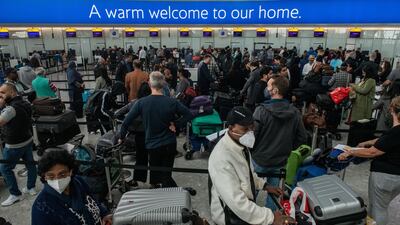
Long queues, cancellations and luggage problems have plagued Heathrow Airport since the travel sector’s comeback from coronavirus restrictions. Bloomberg -

The airport has struggled to cope with a volume of more than 100,000 departing passengers a day, with bags arriving late, queues snaking through terminals and flights being cancelled at the 11th hour. Reuters -
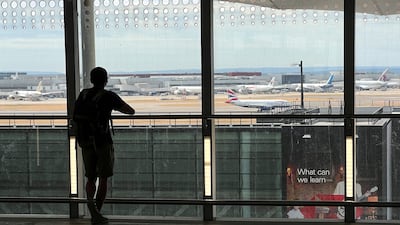
Travelling through Heathrow has been a dire experience for some of late. AP -
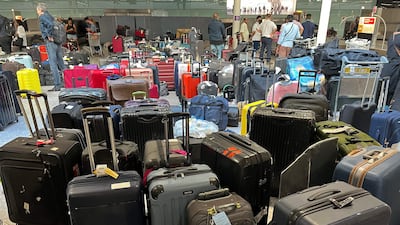
Suitcases uncollected at Heathrow's Terminal 3 baggage reclaim. AFP -
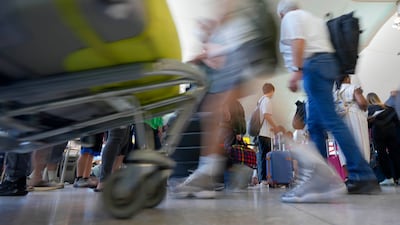
There is a shortage of staff after many people were laid off during the pandemic. AP -
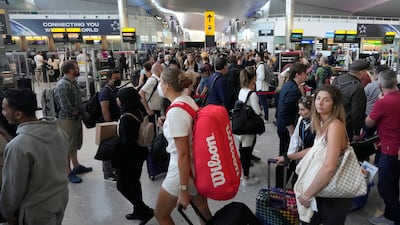
Heathrow rejects the accusation of having failed to prepare, saying it started recruiting extra staff last November. AP -
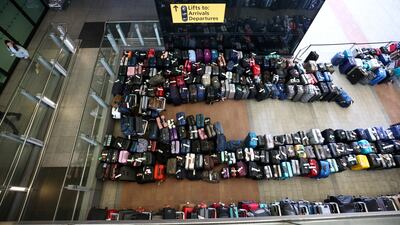
Baggage piles up outside Terminal 2 at Heathrow in June. Baggage issues have bedevilled the airport, with a combination of staff shortages and malfunctioning automated baggage handling systems contributing to the mayhem. Reuters -
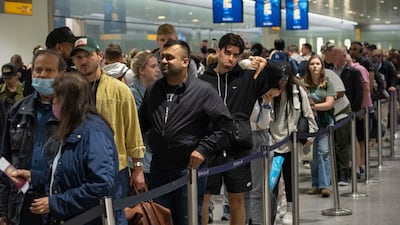
One traveller shows his disappointment while waiting in a long queue to pass through a security check in June. Getty Images -
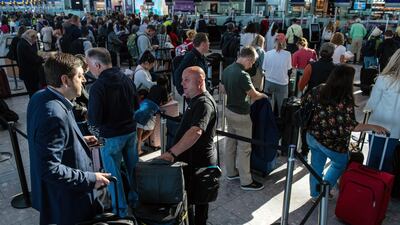
Passengers queue to check in at Terminal 5. Bloomberg -
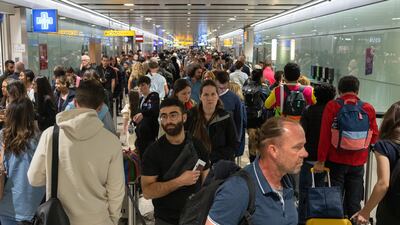
A queue snakes through the airport. Getty Images -
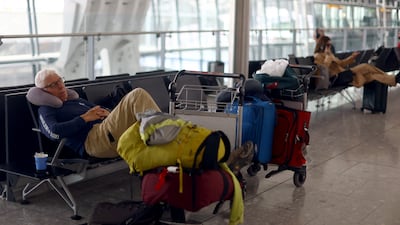
A waiting passenger decides to get some sleep in Terminal 5. Reuters -
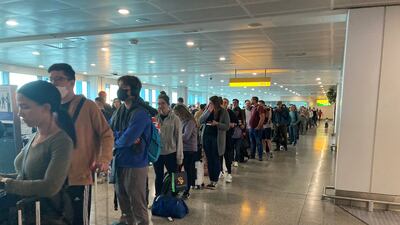
Long queues form through a terminal. PA -
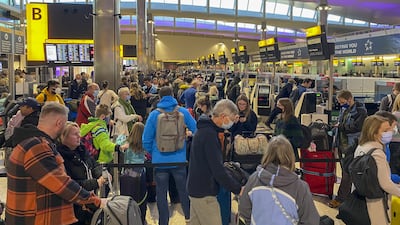
A crowded check in area in Terminal 2 in April. Heathrow rejects the accusation of having failed to prepare, saying it started recruiting months ago. PA -
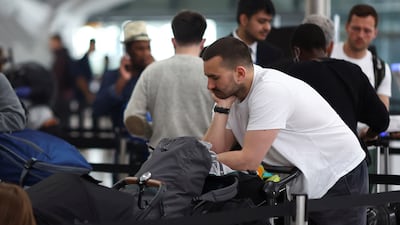
A dejected looking passenger queues for check-in ahead of the Easter Bank Holiday weekend at Heathrow in April. Reuters -
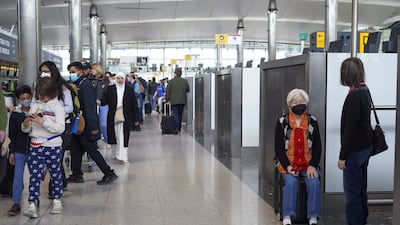
People queuing to go through security at Heathrow. PA -
Queues at arrivals in Heathrow in March. Photo: Sven Kili / Twitter



