

Iran must not be allowed to acquire nuclear weapons, British Prime Minister Boris Johnson and new Israeli leader Yair Lapid said in a call on Tuesday.
And Britain is encouraging Tehran to return to the deal that put limits on its nuclear programme as soon as possible.
Mr Lapid and Mr Johnson discussed the partnership between the two countries and agreed that negotiations over a free-trade agreement would take co-operation between the states to new heights.
The pair touched on Mr Johnson’s imminent departure as prime minister, with the British leader assuring Mr Lapid that the UK-Israel relationship would continue to be of huge importance to his successor.
-
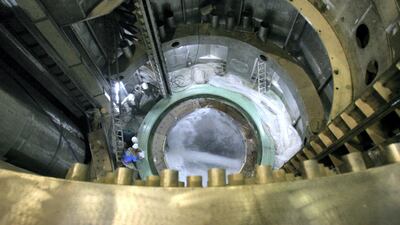
Russian contractors work at the Bushehr nuclear reactor site in 2007. The plant opened four years later. Bloomberg -
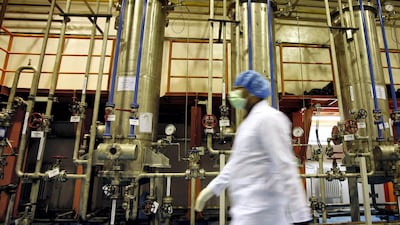
An Iranian technician at the International Atomic Energy Agency inspects the country's Isfahan plant in 2007. Tehran is no longer co-operating with the agency at nuclear sites across the country. EPA -

Workers wait to begin constructing a second reactor at the Bushehr nuclear power plant in 2019. AFP -
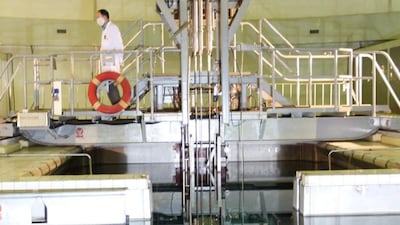
A metal-encased rod with 20 per cent enriched nuclear fuel is inserted into a reactor in Tehran in 2012. AFP -
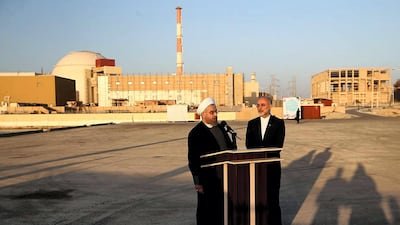
Fomer Iranian President Hassan Rouhani and the country's Atomic Energy Organisation chief Ali Akbar Salehi speak at the Bushehr nuclear site in 2015. AFP -
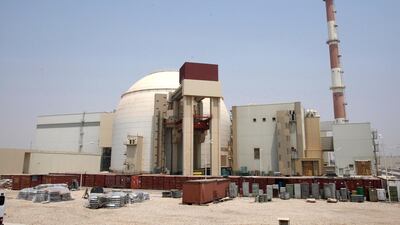
Iran's Bushehr nuclear plant has been restarted. EPA -
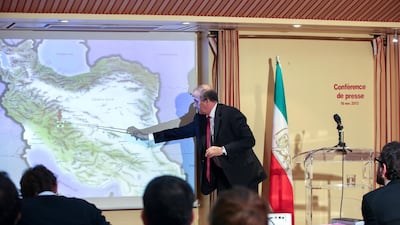
Mehdi Abrichamtchi, chairman of the Peace and Security Committee at the National Council of Resistance of Iran, shows journalists the location of a secret nuclear site in Iran in 2013. AFP -
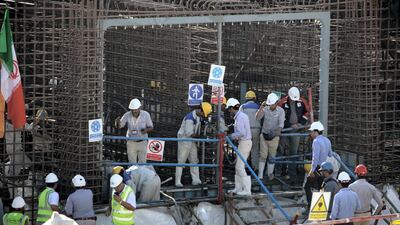
Workers prepare to begin the construction of a second reactor at the Bushehr site. AFP


Ukraine was also on the agenda during the call and the leaders underscored their support for the Ukrainian people, with Mr Johnson welcoming Israel’s humanitarian efforts towards the country.
He also stressed the need for all nations to continue to put pressure on Russian President Vladimir Putin’s regime, including through sanctions.
Also on Tuesday, EU foreign policy chief Josep Borrell said he had submitted a draft text of a deal on Iran's nuclear programme, urging parties to accept it or "risk a dangerous nuclear crisis".
Iran warned on Monday that it would not be rushed into a "quick" deal reviving its faltering 2015 nuclear accord with world powers, as negotiations in Vienna remain deadlocked.
"This text represents the best possible deal that I, as facilitator of the negotiations, see as feasible," Mr Borrell wrote in the Financial Times.
"It is not a perfect agreement, but it addresses all essential elements and includes hard-won compromises by all sides".
Iran's chief nuclear negotiator Ali Bagheri wrote on Twitter on Tuesday: "The co-ordinator has shared his ideas to conclude the negotiations.
"We, too, have our own ideas, both in substance and form, to conclude the negotiations which would be shared."
The 2015 deal gave Iran sanctions relief in exchange for curbs on its atomic programme to guarantee that it could not develop a nuclear weapon, an ambition which it has always denied.
But after then-US president Donald Trump withdrew from the accord in 2018 and Washington reimposed biting economic sanctions, Iran began to renege on its own commitments.
Talks in Vienna that started in April 2021 to restore the deal have stalled since March amid differences between Tehran and Washington.
The two sides negotiated indirectly through the EU co-ordinator.
Mr Borrell said the draft text "addresses, in precise detail, the sanctions lifting as well as the nuclear steps needed to restore" the deal.
He said it might not address all of the US concerns about Iran, and that there were serious reservations in Tehran about implementing a deal "after the negative experience of recent years".
But Mr Borrell said decisions must be made now.
"If the deal is rejected, we risk a dangerous nuclear crisis, set against the prospect of increased isolation for Iran and its people," he said.
"It is our joint responsibility to conclude the deal."

