


Margaret Thatcher had a penetrating stare that left colleagues unnerved and ready to do her bidding.
During conversations with fellow Tories or civil servants, Liz Truss can look into their eyes for several seconds, smiling without speaking. It can be awkward at times but it is said to have a similar effect as that achieved by her political idol.
Ms Truss - who hopes to become the UK's third female prime minister after Mrs Thatcher and Theresa May - was three when Mrs Thatcher entered office and 16 when she left in 1991. If she harboured secret teenage admiration for the effective but divisive Conservative leader, she hid it well.
The prime minister’s name would have been frequently mentioned in her household, but only in highly pejorative terms. Ms Truss’s parents, a math’s professor father and a nurse mother, were on the far left of politics, supporting the Campaign for Nuclear Disarmament and socialist causes.
Perhaps it was the contradictions of teenage rebellion that drew the teenage Liz to the Tory stalwart who her parents found so offensive.
If it did, then she made her move to the right in steady tacks, waiting until she got to the University of Oxford, where she studied PPE ― politics, philosophy and economics ― before joining the Liberal Democrats. An act, she later claimed, of rebellion and to annoy her parents and perhaps payback too, for the long hours spent on marches or demonstrations.
She rubbed it in by becoming president of the Oxford University Lib Dems and she was certainly committed, as recently unearthed television footage shows her at the annual conference, when she was 19, lambasting both the monarchy and the Conservative Party.
But graduating from Oxford and entering the business world with Shell oil appeared to have a salutary effect, witnessing the importance of the economy in shaping a country.

The Conservatives had been in power for 17 years when Ms Truss joined the party aged 21, five years after Mrs Thatcher had been ousted in another example of ruthless Tory defenestration.
Her parents’ reaction to her joining the party of Thatcher has not been fully recorded. There may well have been smug looks around the kitchen table when Tony Blair’s New Labour won the 1997 election in a landslide.
But Ms Truss was convinced the Conservatives were the natural party of government and economic management. Her conviction remained undimmed by personal election defeats as a councillor and then standing for parliament.
Her strong will caught David Cameron’s eye and she was put on the A list of candidates for the 2010 election and given a safe Tory seat. But she almost lost South West Norfolk by failing to disclose an extramarital affair that led to a vote to terminate her candidacy.
She won that and the seat and after just two years as a backbencher she was made education minister, having written some liberal-minded papers on the subject.

Ms Truss, who unlike the Tory elite was educated in a comprehensive school, entered Cabinet in 2014 and has remained there ever since.
She started as environment secretary, making her point by stating, unlike her predecessor, that climate change was largely man-made. She was a whole-hearted Remainer in the Brexit referendum but she quickly became a committed Brexiteer in Theresa May’s government.
It was her demotion from justice secretary to chief secretary to the treasury under Mrs May that is said to have provided a seminal political moment in which she stopped worrying what other people thought and got on with following her own path. “It marked a turning point for her,” a friend said. “Getting demoted made her realise that she had to start being herself and taking risks.”
On Ms May’s ousting she pledged allegiance to Boris Johnson and was made international trade secretary, striking a number of international free trade deals, including those with Japan and Australia.
Then in September 2021 she became foreign secretary, remaining in post while many around Mr Johnson resigned in early July.
-
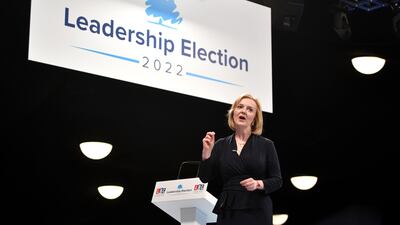
British Foreign Secretary Liz Truss is one of the candidates in the race to replace Boris Johnson as British Prime Minister. Bloomberg -
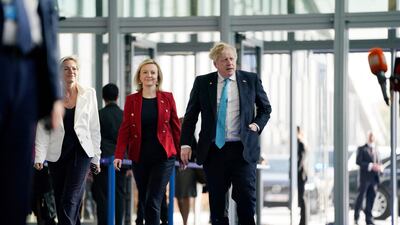
Boris Johnson and Liz Truss arrive for an extraordinary summit at Nato Headquarters in Brussels, in March this year. AFP -
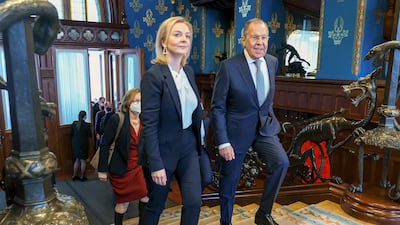
Russian Foreign Minister Sergey Lavrov and Liz Truss arrive for talks in Moscow in February. AP -
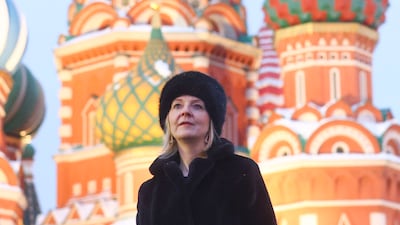
Liz Truss in Red Square during a visit to Moscow in February. Simon Dawson / No10 Downing Street -
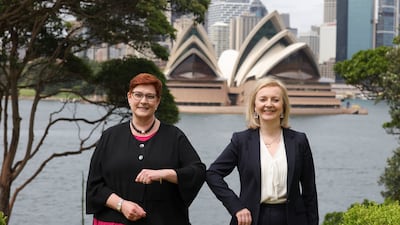
Liz Truss with Marise Payne, the Australian Minister of Foreign Affairs, at Government House in Sydney, Australia, in January. Simon Dawson / No10 Downing Street -
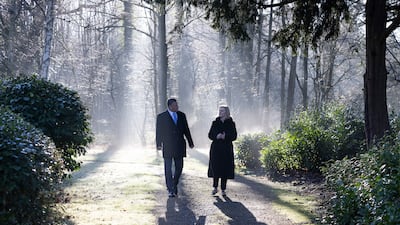
Liz Truss hosts Vice President of the European Commission Maros Sefcovic at Chevening House in January to discuss the Northern Ireland protocol. Simon Dawson / No10 Downing Street -
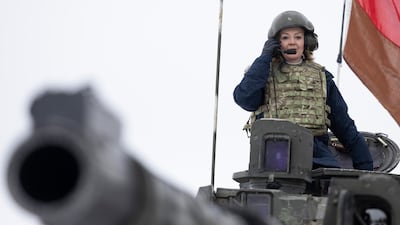
Liz Truss visits British troops in Estonia as they operate alongside other Nato troops in Tapa in November 2021. Simon Dawson / No10 Downing Street -

Liz Truss walks through the old town in Tallinn, Estonia, in November 2021. Simon Dawson / No10 Downing Street -
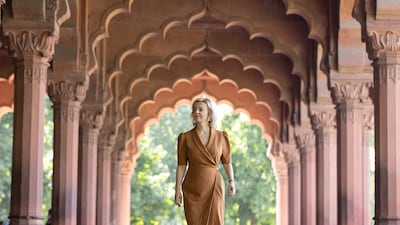
Ms Truss at the Red Fort in New Delhi during a trip to India in October 2021. Simon Dawson / No10 Downing Street -
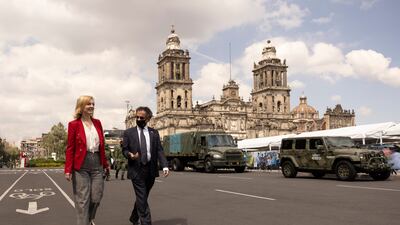
The British foreign secretary on the Plaza de la Constitucion in Mexico City, during a trip to Mexico in September 2021. Simon Dawson / No10 Downing Street -
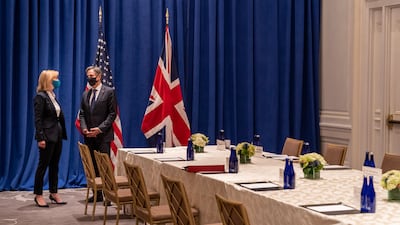
Liz Truss with Antony Blinken, the United States secretary of state, in New York, September 2021. Simon Dawson / No10 Downing Street -
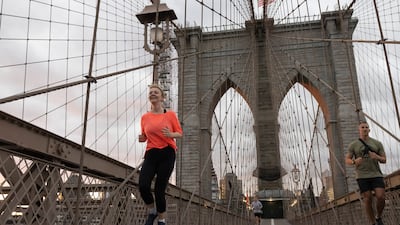
Liz Truss on a morning jog over Brooklyn Bridge in New York in September 2021. Simon Dawson / No10 Downing Street -
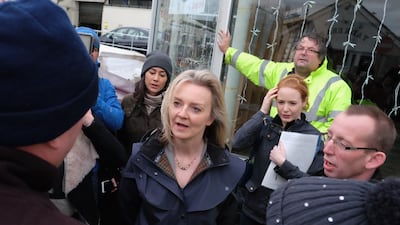
When she was environmental minister, Ms Truss visited the bridge over the River Wharfe in Tadcaster, which collapsed after heavy flooding in December 2015. Getty Images -
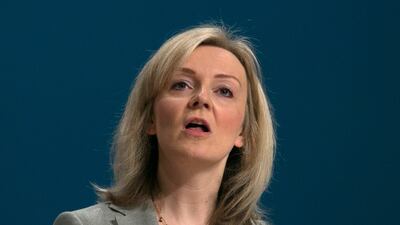
Addressing the Conservative party conference in Birmingham in 2014 when she was secretary of state for environment, food and rural affairs. Getty Images


The post has allowed her to be pictured riding a tank, again drawing parallels with Thatcher, who famously was also photographed in the turret of Challenger tank, giving rise to further newspaper headlines about the Iron Lady.
Joining the Conservatives also led to romance after she met her future husband, Hugh O’Leary, at the party conference. She gave birth to two daughters who are now teenagers, Frances, 16 and Liberty, 14.
They are largely kept out of the spotlight and their political views are unknown. That privacy will be challenged if, as the polls suggest, their mother gets the keys to Downing Street in early September.
With the energy crisis, war in Europe and recession looming, as prime minister Liz Truss will be thoroughly examined on whether she is the true inheritor of Thatcher’s iron will.

