


The UK government has set out a series of commitments to achieve what it calls “guilt-free flying” as it warned that aviation emissions should not return to pre-pandemic levels.
Under Boris Johnson’s administration’s Jet Zero strategy, domestic airlines in the UK and airports in England must meet a target of net zero for carbon emissions by 2040.
Airlines operating in Britain must ensure sustainable aviation fuel (SAF) makes up at least 10 per cent of their jet fuel by 2030. SAF production slashes carbon emissions by about 80 per cent compared with traditional jet fuel. It can be blended with standard aviation fuel at up to 50 per cent.
One of the challenges for the aviation sector is that producing SAF is more expensive than acquiring traditional fuel.
The Conservative-led government’s ambition is for construction on at least five commercial-scale SAF plants in the UK to have started by 2025. Projects pioneering eco-friendly fuel can apply for support from a new £165 million advanced fuels fund.
Air passengers should be given environmental information about specific flights at the time of booking from this autumn, the government has proposed, to help them make more sustainable choices.
Speaking at the Farnborough International Airshow on Tuesday, UK Transport Secretary Grant Shapps set out a series of commitments to achieve what the Department for Transport described as “guilt-free flying”.
“We want 2019 to be remembered as the peak year for aviation emissions,” he said. “From now on, it should all be downhill for carbon emissions – and steadily uphill for green flights.”
Mr Shapps said the UK was “setting an example of the ambition needed to tackle climate change”.
“Rather than clipping the sector’s wings, our pathway recognises that decarbonisation offers huge economic benefits, creating the jobs and industries of the future, making sure UK businesses are at the forefront of this green revolution,” he said.
-

Visitors watch a RAF F-35 aircraft at the Farnborough International Airshow in Hampshire, southern England. Reuters -
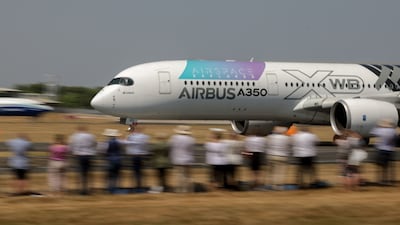
An Airbus SE A350 aircraft lands after an aerial display. Bloomberg -

An Embraer C-390 Millennium military transport aircraft, used by Brazil's Airforce, on display. AFP -

A detailed view of a Pratt & Whitney PW123 engine. Reuters -

The RAF's Red Arrows aerobatics team perform. AP -

Visitors shelter from the sun as they look around the show. AP -

An Embraer E190-E2 aircraft. AFP -

Visitors look at a model of the Wisk Aero autonomous aircraft. AP -
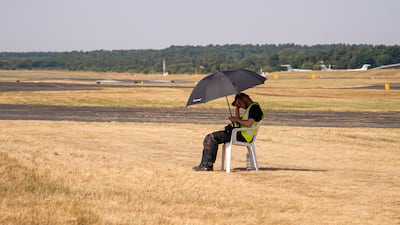
A member of staff shelters from the sun. AP -

Attendees walk past a poster of a Boom Supersonic concept Overture aircraft. AFP -

A US Air Force F-35A fighter jet on display. Bloomberg -

A model of proposed jet fighter aircraft Tempest, a joint programme by a consortium known as 'Team Tempest', which includes Britain's Ministry of Defence, BAE Systems, Rolls-Royce, Leonardo SPA, MBDA and Saab. AFP -

Visitors watch the Embraer E2 Profit Hunter plane taking off. AFP -

An Aksungur drone, manufactured by Turkish Aerospace Industries, on display. Bloomberg -

An Airbus A350 plane flying over the crowds at Farnborough. AFP -

Soldiers pose beside a Leonardo helicopter. AP -
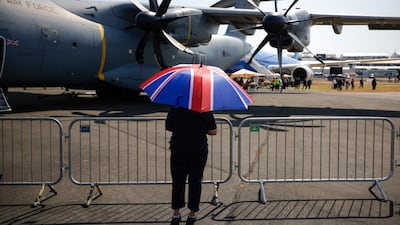
An aviation enthusiast shelters from the sun at the show. Temperatures were forecast to reach 40°C in parts of England. Bloomberg -

A model of a Pratt & Whitney GTF engine. This is the first Farnborough in four years, due to the pandemic. Bloomberg -
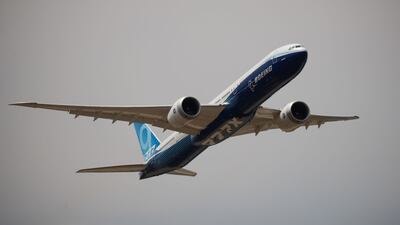
A Boeing 737-9 puts on a display at Farnborough. Bloomberg -
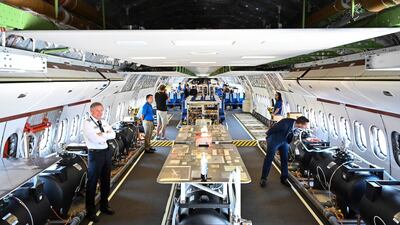
Visitors examine water barrels in a Boeing 777X, in an experiment on weight distribution. AFP -

An aviation fan uses a fan to keep cool amid soaring temperatures. Bloomberg -

A worker keeps a GulfStream Aerospace Corp G650 business jet gleaming. Bloomberg -

Britain's Prime Minister Boris Johnson tours Farnborough, a vital marketplace for the country's aviation industry. AP -
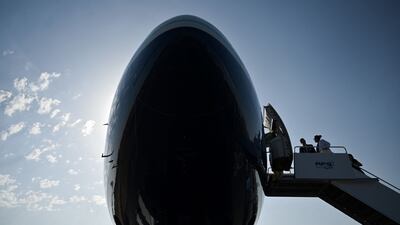
Visitors board a Boeing 777X. Deals worth £161 billion ($192bn) were agreed the last time Farnborough was held, organisers said. AFP -

Boris Johnson views the display by SaxaVord, the UK Spaceport. PA -

More than 80,000 visitors from 96 countries are expected to attend this week's five-day event. Bloomberg


The aviation sector accounts for 2.5 per cent of global carbon dioxide (CO2) emissions.
The Jet Zero policy includes a six-point plan for the industry to stay below pre-pandemic levels of carbon emissions.
The six priority areas are:
- Improving efficiency of existing aircraft, airports and airspace
- Increasing support for SAF by starting domestic production
- Supporting development of zero-emission aircraft
- Developing carbon markets and greenhouse gas-removal technology
- Providing consumers with better information so they can make sustainable travel choices
- Working with experts to increase understanding about climate effects of aviation, other than CO2 emissions
Farnborough, a week-long airshow in Hampshire, England, brings together tens of thousands of delegates from the aerospace, aviation and defence industries and marks the first major gathering of leaders in those sectors since before the Covid-19 pandemic.
Kevin Craven, chief executive of aerospace trade body ADS, described the Jet Zero strategy as “a welcome step forward towards net zero aviation by 2050”.
“The UK aerospace community is committed and ready to deliver on the promise of sustainable aviation,” he said.
Environmental campaign group Greenpeace dismissed the government’s strategy, saying it suggests ministers are “hoping someone else will solve the problem with some shiny new technology, and that any residual carbon can be offset.”
“Vague aspirations to technological innovation will do nothing significant to cut emissions in the short to medium term, so what this strategy amounts to is letting aviation pollute as much as they want and then doing a lot of offsetting,” Emily Armistead, programme director for Greenpeace UK, said.
“As the industry, the government and everyone involved already know, this won’t work.”
Willie Walsh, director of the International Air Transport Association (IATA), said the industry’s target of achieving net zero by 2050 rests “by a large extent” on the mass production of SAFs.
“We’re committed to achieving net zero in 2050. To a large degree that will be achieved through sustainable aviation fuels (SAFs),” the former chief executive of British Airways said during a panel discussion at Farnborough.
“The science is clear: we believe we’re aligned now with the ambition of the Paris Agreement,” he added.
The former pilot said despite the major challenges weathered by the sector over the past two years it remains committed to a greener future and said the buzz around Farnborough centres on ways to achieve that.
“You can see that despite the deepest crisis that this industry has gone through the focus on the environment remains front and centre and I think we should be optimistic that we have a credible pathway to achieving net zero in 2050 and we should be ambitious to try and do even better than that.”
Meanwhile, the government has joined forces with Australia, Canada, New Zealand and the US in a new partnership which aims to tackle challenges facing aviation.
The National Aviation Authority (NAA) aims to improve collaboration with bodies from different countries on integrating and regulating new technology, as the international industry comes under growing pressure to slash emission rates.
Launching the NAA at Farnborough, Mr Shapps said the partnership was a “huge step forward in supporting this work – helping the sector safely meet the challenges of tomorrow and improve lives for the better”.
The British Airline Pilots’ Association (Balpa) responded to the Jet Zero strategy launch by issuing a “red warning” over what it perceived as missed steps on the challenging road to make the industry more sustainable.
The group, which represents over 10,000 pilots, argued the policy relies too heavily on “unproven and uncosted technologies for removing greenhouse gasses from the atmosphere”, posing “a major risk to success”.
“With the same narrow clique of advice, the same CEOs who provided the chaos seen in aviation’s spring ‘recovery’ from Covid advising the government, I am not surprised there is so much missing from the Jet Zero strategy,” Martin Chalk, Balpa's general secretary, said.
“Aspiration heavy and action light ‘strategies’ risk failing our industry, the economy and our society.
“Major risks remain to Jet Zero’s chances of success, and until organisations like Balpa are involved – providing practical and outcome-orientated solutions – our red warning will remain valid.”

