


There is “no clear evidence” that the government’s plan to send migrants to Rwanda would deter English Channel crossings, a panel of MPs says.
The House of Commons home affairs committee accused ministers of hunting for “radical new policies that might make good headlines” but do little to stem the flow of people trying to make the dangerous journey.
It said that “quick-fix solutions” was not an answer for the crossings and called for an asylum system that “deals with reality”.
“Much more clarity is required on the new plan to relocate some migrants from the UK to Rwanda," the committee's report said.
It called on the government to prove the deal would deter crossings and to disclose “detailed costings” to support suggestions that the move would reduce the current £1.5 billion ($1.8bn) asylum system bill.
“Some claim that the UK also runs the reputational risk of appearing to wash its hands of its international obligations,” the report said.
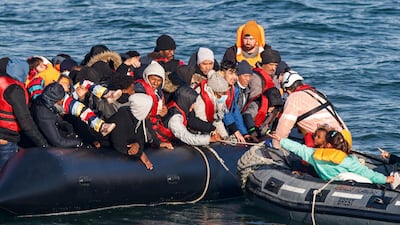
More than 14,000 migrants have made the 32-kilometre journey so far this year, crossing the world’s busiest shipping lanes from France in small boats, provisional government figures show.
The total for 2022 is anticipated to be 60,000.
At least 166 people have died or gone missing during crossings, including 27 in a single day last year.
Since April, the military has been in control of the Channel operation but this is due to be reviewed in January.
-
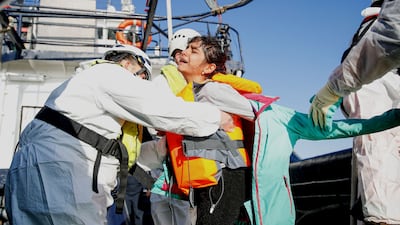
Migrants are rescued by crew members of the 'Abeille Languedoc' ship after their boat's generator broke down in French waters as they were trying to cross the Channel illegally to Britain. All photos: AFP -
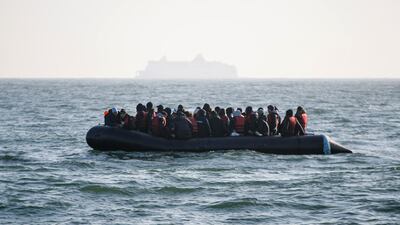
Migrants wait for help in the Channel. -
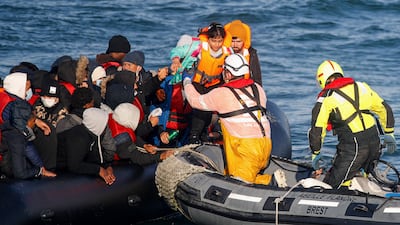
A child is rescued by crew members of the 'Abeille Languedoc'. -
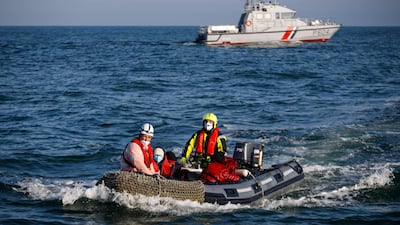
The 'Abeille Languedoc' is an ocean-going tug specialising in the rescue of vessels in distress. -

Migrant children on the rescue boat. -
The 'Abeille Languedoc' has been moored in Cherbourg for 26 years, monitoring the Channel between the Cotentin and the Pas-de-Calais. -

Migrants sit on board the 'Abeille Languedoc' after being rescued. -
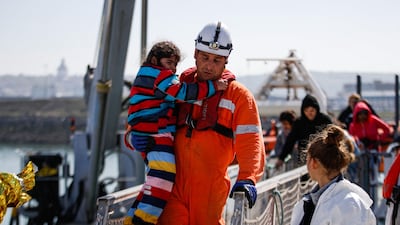
A rescuer carries a child as they disembark from the 'Abeille Languedoc'.


The inquiry found that the government’s response to the crisis, a result of “inattention and poor decision making”, had exacerbated problems and “undermined public confidence” in the asylum system and border control.
The “perceived reluctance” of the French government to find a solution had not helped the situation, the report found.
It found the government was right to drop plans to push back migrants at sea as it was hard to see how its benefits could outweigh “its potential costs in the form of risk to migrants’ and officials’ lives, and damage to the UK’s reputation”.
The “greatest deterrent” to Channel crossings would be to prevent them “ever leaving France”, the committee said.
It said attempts to forge return agreements with EU states to send migrants back to safe countries have “entirely failed” after the UK left the Dublin Regulation arrangements when freedom of movement ended.
The report also found a “worrying trend” in Home Office announcements being made before “detailed policy has been worked through, tested or even agreed between government departments”.
The inquiry recommended that the government negotiate with France on more preventive measures on the continent and set up UK asylum assessment centres there so that there is a “safe and legal route for those who might successfully seek asylum in the UK.
It said “urgent” measures were needed to address the unknown number of lone migrant children who have gone missing, sometimes disappearing permanently, from hotels.
The Home Office should detail what steps it will take to protect those sent to Rwanda and carry out research to help with future policy on why migrants make the dangerous crossing, because there is “no reliable data”.
Ministers and officials should “refocus” their efforts on work to establish return agreements with EU countries, the report recommended.
“[The government’s] deterrent policy of sending asylum applicants to Rwanda appears to have gone unnoticed by those who attempt to cross the Channel,” said Ccommittee chairwoman Dame Diana Johnson.
Policy development has “moved away from evidence-based, tested and cost-effective solutions reacting to the changing demands placed on it”, she said.
“Instead, we have a search for radical new policies that might make good headlines but do little to stem the flow of people prepared to put their lives at risk to reach the UK by any means necessary.
“The UK needs an asylum system that deals with reality. It must be fair, efficient and acknowledge the UK’s international obligations.”
Enver Solomon, chief executive of the Refugee Council, welcomed the report and urged the next British prime minister to “immediately rethink and focus on the workable alternatives that are – contrary to rhetoric – readily available".
The Home Office has been contacted for comment.

