


A Daily Mail reporter, annoyed that The Times had been given exclusive access to the discovery of Tutankhamun’s tomb, made up the story of the curse, a new documentary has claimed.
The Channel 4 documentary names Arthur Weigall, an Egyptologist-turned-reporter, as the man who may have created a myth.
Tutankhamun: Secrets of The Tomb airs on Sunday in the UK and talks to experts on the curse, the pharaoh and the Howard Carter-Lord Carnarvon expedition.
One of them, Bob Bianchi, said: “Arthur Weigall is a very interesting person. He has credentials as an Egyptologist. He switched gears, in a sense, and became a journalist.
“He was working for the Daily Mail, which was a rival of the London Times, and he was not able to get the scientific information from Carter on a daily basis because The Times had the exclusive, so he had to be able to tell his readers a parallel story.”
-

The statue of the Ka of the King Wearing the Nemes Headcloth has “magic eyes” made of volcanic obsidian. The king’s sandals and uraeus (cobra) on the guardian’s forehead are made of bronze. It is one of the 60 works in the exhibition that have left Egypt for the first time.. EPA -
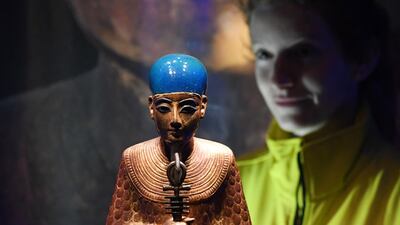
A gallery employee poses for photographers next to a statue of Ptah, dated 1336-1326 BC, from the reign of Tutankhamun, during the press preview for the 'Tutankhamun: Treasures of the Golden Phaorah' exhibition at the Saatchi Gallery in Chelsea in London, Britain, 01 November 2019. EPA -
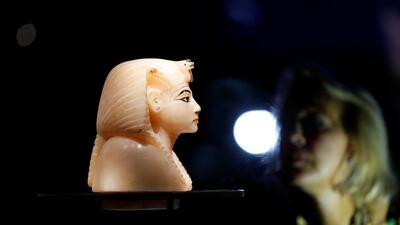
A woman looks at alabaster King's Head during the media preview of "Tutankhamun: Treasures of the Golden Pharaoh" exhibition set to open at the Saatchi Gallery in London, Britain November 1, 2019. Reuters -
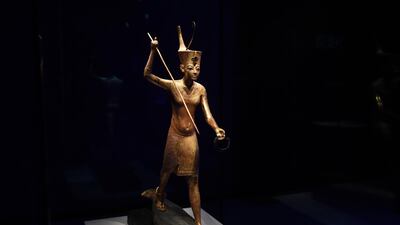
A gilded wooden figure of Tutankhamun throwing a harpoon, dated 1336-1326 BC. EPA -

A view of a gilded wooden ostrich hunt fan during a press preview for the exhibition 'Tutankhamun: Treasures of the Golden Pharaoh' at the Saatchi Gallery in Chelsea in London, Britain, 01 November 2019. EPA -
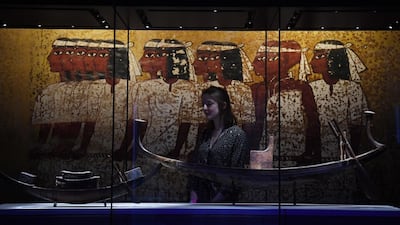
A visitor looks at a painted wooden model solar boat with throne and steering paddles (R) during a press preview for the exhibition 'Tutankhamun: Treasures of the Golden Pharaoh' at the Saatchi Gallery in Chelsea in London, Britain, 01 November 2019. EPA -

A gallery employee poses for photographers next to gold objects found on the mummy of Tutankhamum during the press preview for the 'Tutankhamun: Treasures of the Golden Phaorah' exhibition at the Saatchi Gallery in Chelsea in London, Britain, 01 November 2019. EPA -

A visitor takes a photograph of a calcite stopper for a canopic jar of the King's Head during the press preview for the 'Tutankhamun: Treasures of the Golden Phaorah' exhibition at the Saatchi Gallery in Chelsea in London, Britain, 01 November 2019. EPA -
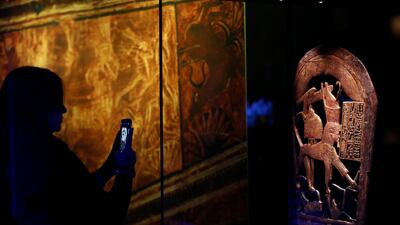
A woman takes a picture of a wooden Traveling Chest of Tutankhamun during the media preview of "Tutankhamun: Treasures of the Golden Pharaoh" exhibition set to open at the Saatchi Gallery in London, Britain November 1, 2019. Reuters -

A gallery employee poses for photographers next to a calcite stopper for a canopic jar of the King's Head, and a gold inlaid canopic coffinette of Tutankhamum, dated 1336-1326 BC, at a press preview for the exhibition 'Tutankhamun: Treasures of the Golden Phaorah' at the Saatchi Gallery in Chelsea in London, Britain, 01 November. EPA -

A gilded wooden statuette of Tutankhamun is seen during the media preview of "Tutankhamun: Treasures of the Golden Pharaoh" exhibition set to open at the Saatchi Gallery in London, Britain November 1, 2019. Reuters -
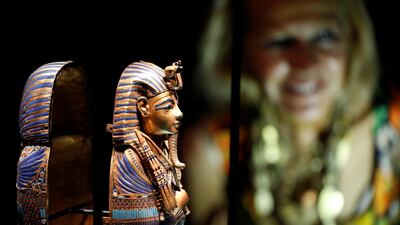
A woman looks at miniature canopic coffin during the media preview of "Tutankhamun: Treasures of the Golden Pharaoh" exhibition set to open at the Saatchi Gallery in London, Britain November 1, 2019. Reuters -
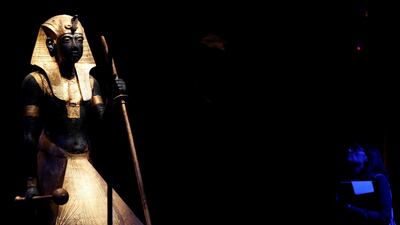
A wooden Guardian Statue of the King is seen during the "Tutankhamun: Treasures of the Golden Pharaoh" exhibition set to open at the Saatchi Gallery in London, Britain November 1, 2019. Reuters


The idea of a mummy’s curse is something that has never gone away.
In the 1820s, the idea was popularised when Egyptian hieroglyphs were first properly decoded.
The dire warnings on the walls of Egyptian tombs were intended to deter robbers — but usually without success.
About a century later, the tomb of Tutankhamun was found in an expedition funded by the British aristocrat Lord Carnarvon. Four months later, Carnarvon was found dead in a Cairo hotel — and the idea of the curse snowballed.
The documentary describes the day the tomb was opened in February 16, 1923, with Carnarvon telling jokes to the assembled spectators and media.
“I think what Weigall was suggesting was that Carnarvon was too happy, [which was] maybe a bit of hubris on his part, and Weigall allegedly said: ‘If Lord Carnarvon goes into the tomb in that spirit, he’ll be dead within six weeks’,” Mr Bianchi said.
Within six weeks, Carnarvon and a number of people who had worked on the excavation, were dead.
“For the newspapers, these exotic deaths were a gold mine and they started to splash stories of a curse of Tutankhamun," said Ella Al Shamahi, an archaeologist and documentary presenter. "Hungry for stories, reporters added ever more names to the list.”

