


Lord Christopher Geidt, the British prime minister’s independent ethics adviser, has suggested that Boris Johnson's partygate fine may have breached the Ministerial Code.
Mr Geidt said there was a “legitimate question” as to whether the case of the fixed penalty notice might have constituted a breach of the code.
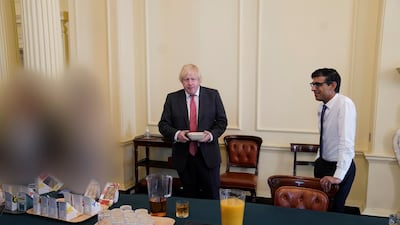
Mr Johnson attended a birthday party thrown in his honour in the Cabinet Room in June 2020 at a time when indoor socialising was banned. He received the fine from police.
Mr Geidt also questioned the prime minister's willingness to “take responsibility for his own conduct” in relation to the ministerial rules.
He gave a withering assessment of exchanges with Downing Street officials.
Mr Geidt advised them that Mr Johnson should be “ready to offer public comment” on his obligations under the code, but that this had “not been heeded”.
Mr Johnson responded in writing to Mr Geidt by claiming the fine “did not breach” the Ministerial Code as there was “no intent to break the law”.
He said there had been “past precedents of ministers who have unwittingly breached regulations where there was no intent to break the law”.
-
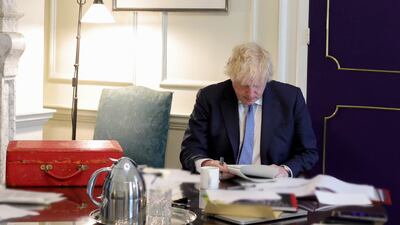
British Prime Minister Boris Johnson reads the report by senior civil servant Sue Gray, at his Downing Street office. Photo: Andrew Parsons / No 10 Downing Street -
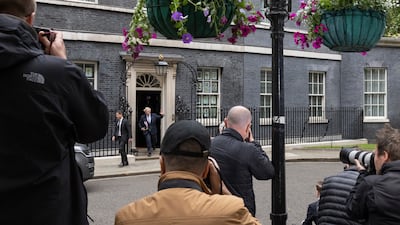
Photographers surround No 10 Downing Street as Mr Johnson departs for the Prime Minister's Questions session in the House of Commons, on Wednesday morning. Getty Images -
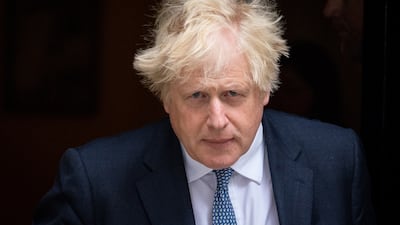
The long-awaited report into the Partygate scandal has blamed Mr Johnson and senior officials for failures of leadership at the heart of the British government. EPA -
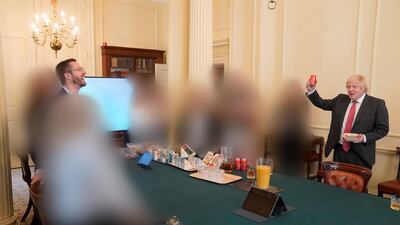
June 19, 2020: A gathering in the Cabinet Room at No 10 Downing Street, on the prime minister's birthday. Photo: Cabinet Office -
June 19, 2020: The prime minister during the gathering, which was held while lockdown rules were in force across the UK. Photo: Cabinet Office -
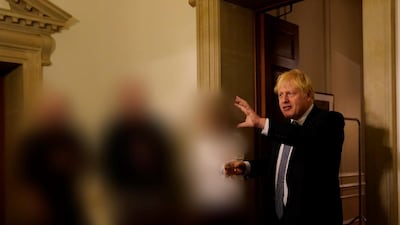
November 13, 2020: A gathering at No 10 Downing Street, on the departure of a special adviser. Photo: Cabinet Office -

Mr Johnson apologises to MPs in the House of Commons in London, in April, having been fined after a police probe for attending a party during coronavirus lockdowns imposed by his own government. AFP -
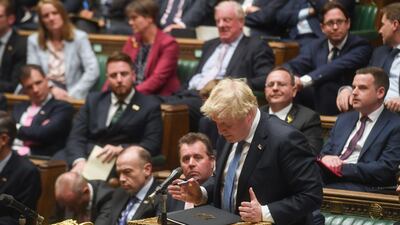
The prime minister was no more than 30 seconds into his speech when the first shout of 'resign' was heard from the opposition benches, followed by 'you’re an embarrassment' and 'just go'. Reuters -
'I take this opportunity on the first available sitting day to repeat my wholehearted apology to the House,' he said, admitting that 'people had a right to expect better of their prime minister'. AFP -
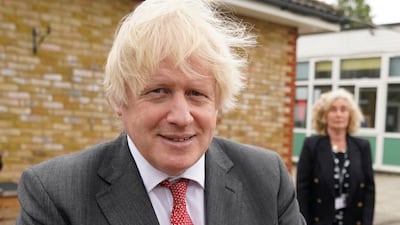
The prime minister, pictured with a birthday cake baked for him by school staff at Bovingdon Primary Academy in Hemel Hempstead, said it ‘didn't occur’ to him that a gathering on June 19, 2020, to mark his 56th birthday broke coronavirus rules. AFP -
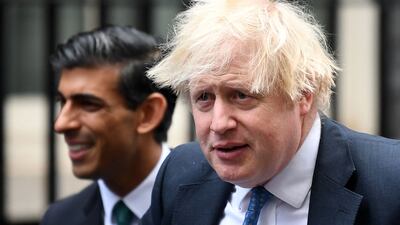
Chancellor Rishi Sunak, left, was also fined for attending lockdown parties held in and around Downing Street. AFP -
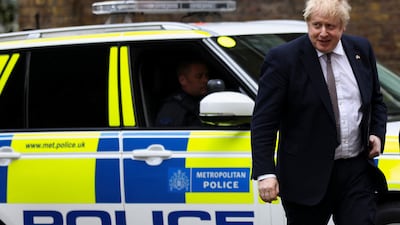
Mr Johnson is the first sitting prime minister to be censured for breaking the law, sparking calls from all sides of Parliament, including some in his own party, to step down. Reuters -

A lone protester demonstrates outside No 10 Downing Street in London. EPA -
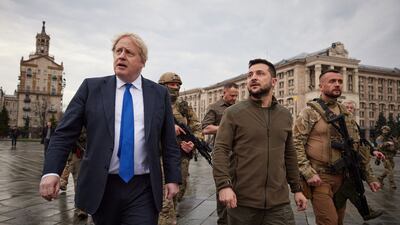
Before the war broke out in Ukraine, Mr Johnson appeared vulnerable to the partygate controversy. He has been praised for his response to the conflict, which may offer him some protection from critics, and he visited Kyiv last weekend in what he called a show of support for the country. AFP -
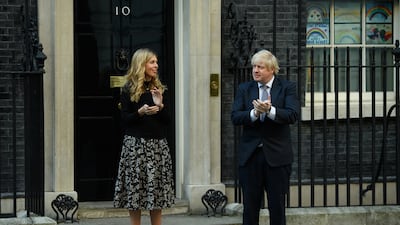
Mr Johnson and his wife Carrie applaud for key health workers outside No 10 Downing Street in May 2020. Getty Images -
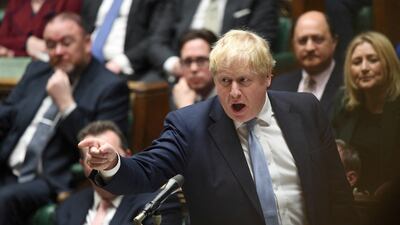
The prime minister makes a statement in the House of Commons in January, on Ms Gray's report regarding the Downing Street parties during lockdown. Reuters -
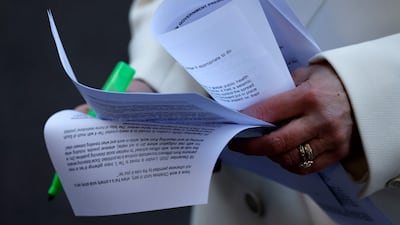
A journalist highlights sections of the report by civil servant Sue Gray into parties held at Downing Street. AFP -
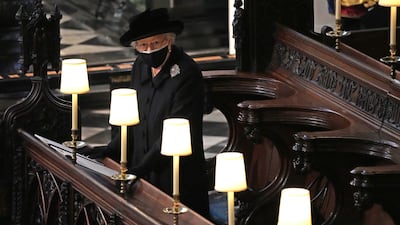
Mr Johnson is understood to have been present at six of at least 12 events being investigated. One occurred on the eve of Prince Philip’s funeral, at which Queen Elizabeth II had to grieve away from other mourners because of social distancing protocols. Getty Images


Labour deputy leader Angela Rayner said of the exchanges: “The prime minister’s second ethics adviser has now threatened to quit, in the latest sign of the rampant sleaze engulfing Downing Street.”
Mr Geidt, in his preface to his latest annual report, warned that it may be “especially difficult to inspire that trust” in the rules for ministers “if any prime minister, whose code it is, declines to refer to it”.
“In the case of the fixed penalty notice recently issued to and paid by the prime minister, a legitimate question has arisen as to whether those facts alone might have constituted a breach of the overarching duty within the Ministerial Code of complying with the law," he said.
“It may be that the prime minister considers that no such breach of his Ministerial Code has occurred. In that case, I believe a prime minister should respond accordingly, setting out his case in public.
"This matters to the integrity of the independent adviser who otherwise might until recently have had to seek a prime minister’s consent to make inquiries into a prime minister’s conduct.
“In the present circumstances, I have attempted to avoid the independent adviser offering advice to a prime minister about a prime minister’s obligations under his own Ministerial Code.
“If a prime minister’s judgment is that there is nothing to investigate or no case to answer, he would be bound to reject any such advice, thus forcing the resignation of the independent adviser.
“Such a circular process could only risk placing the Ministerial Code in a place of ridicule.”
Mr Geidt said he had repeatedly advised the prime minister's officials that Mr Johnson should be “ready to offer public comment” on his obligations under the code, even if he judged himself not to be in breach.
“Its purpose has simply been to ensure that the prime minister should publicly be seen to take responsibility for his own conduct under his own Ministerial Code," he said.
“That advice has not been heeded and, in relation to the allegations about unlawful gatherings in Downing Street, the prime minister has made not a single public reference to the Ministerial Code.”
-
British Prime Minister Boris Johnson apologises to MPs at the House of Commons in London, having been fined after a police probe for attending a party during coronavirus lockdowns imposed by his own government. AFP -
The prime minister was no more than 30 seconds into his speech when the first shout of 'resign' was heard from the opposition benches, followed by 'you’re an embarrassment' and 'just go'. Reuters -
'I take this opportunity on the first available sitting day to repeat my wholehearted apology to the House,' he said, admitting that 'people had a right to expect better of their prime minister'. AFP -

Members of the media gather on Downing Street after police in London issued 50 fines in relation to parties and gatherings held at government buildings during Covid lockdowns. Getty Images -
The prime minister, pictured with a birthday cake baked for him by school staff at Bovingdon Primary Academy in Hemel Hempstead, said it ‘didn't occur’ to him that a gathering on June 19, 2020 to mark his 56th birthday broke coronavirus rules. AFP -
Chancellor Rishi Sunak (L) was also fined for attending lockdown parties held in and around Downing Street. AFP -
Mr Johnson is the first sitting prime minister to be censured for breaking the law, sparking calls from all sides of Parliament, including some in his own party, to step down. Reuters -
A lone protester demonstrates outside No 10 Downing Street in London. EPA -
Before the war broke out in Ukraine, Mr Johnson appeared vulnerable to the partygate controversy. He has been praised for his response to the conflict, which may offer him some protection from critics, and he visited Kyiv last weekend in what he called a show of support for the country. AFP -
Boris Johnson and his wife Carrie applaud for key health workers outside No 10 Downing Street in May 2020. Getty Images -
Boris Johnson makes a statement in the House of Commons in January, on Sue Gray's report regarding the alleged Downing Street parties during lockdown. Reuters -
A journalist highlights sections of the report by civil servant Sue Gray into parties held at Downing Street. AFP -
Mr Johnson is understood to have been present at six of at least 12 events being investigated. One occurred on the eve of Prince Philip’s funeral, at which Queen Elizabeth II had to grieve away from other mourners because of social distancing protocols. Getty Images

Mr Johnson, in a letter of reply released on Tuesday evening, said he had taken “full responsibility for everything that took place on my watch” in light of lockdown-breaking gatherings in Downing Street, and pointed to his House of Commons apology.
He repeated that there was “no intent to break the regulations”, adding: “I did not consider that the circumstances in which I received a fixed penalty notice were contrary to the regulations.
“I have accepted the outcome and paid it in compliance with legal requirements. Paying a fixed penalty notice is not a criminal conviction.
“In relation to the fixed penalty notice for my attendance in the Cabinet Room on June 19, 2020, I believe that, taking account of all the circumstances, I did not breach the code.
“In coming to that conclusion, (a) I have duly considered past precedents of ministers who have unwittingly breached regulations where there was no intent to break the law; (b) I have been fully accountable to Parliament and the British people and rightly apologised for the mistake; (c) I have corrected the parliamentary record in relation to past statements; and (d) I have followed the principles of leadership and accountability in doing so.
“In my view, the same principles apply to the fixed penalty notice paid by the Chancellor of the Exchequer.”
Mr Johnson was last week accused of watering down the code after the government said it was being updated – making it clear that ministers will not necessarily have to resign for more minor breaches.
Instead, the prime minister will have the option of imposing a lesser sanction such as “some form of public apology, remedial action or removal of ministerial salary for a period”.

