


The world’s poorest are at growing risk from climate change as cities around the globe face increasing weather-related problems, a charity warned on Monday.
Christian Aid said that cities including London, Beijing and New Delhi face mounting risks from drought driven by climate change.
Without action, London could run out of water within 25 years and a severe drought could cost the capital’s economy £330 million ($404m) a day, the Christian Aid report warned.
Failure to meet promises on tackling climate change would be an “act of monstrous self-harm”, Cop26 president Alok Sharma said on Monday.
The plea from Mr Sharma came as Christian Aid warned it was the poorest, in places such as Harare in Zimbabwe and Kabul in Afghanistan, who would most feel the harmful effects of climate change.
London receives about half the rain that falls in New York City, and climate change will increase the frequency and intensity of droughts in the region, the report said.
“Drought is not new, but its intensity and frequency have increased over the last 30 years due to global warming,” said the report’s co-author, Nushrat Rahman Chowdhury, of Christian Aid.
“It is a real danger; it threatens lives and livelihoods of some of the poorest people in the world.
“These are communities which have done the least to cause the climate crisis. This is the reality known as loss and damage.
“To address this injustice, we not only need emissions cut, but also provide financial support for those losses which cannot be adapted to.
“That is why, at this year’s UN climate talks in Egypt, we are calling for the creation of a loss and damage finance facility to be a major priority.”
-

French glaciologist Pierre Rene makes ice height measurements at the Ossoue glacier on the Vignemale peak in the French Pyrenees last month. The glacier, the highest and the largest in the French Pyrenees, is expected to disappear by 2050 due to climate change. AFP -
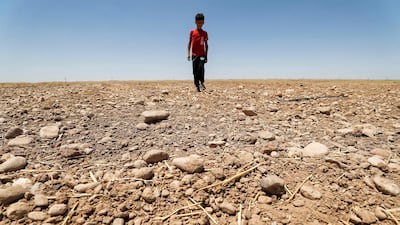
A boy walks through a dry field in eastern Iraq. Reduced agricultural production, water scarcity, rising sea levels and other adverse effects of climate change could force up to 216 million people to migrate within their own countries by 2050, the World Bank has said. AFP -

Cypriot marine ecologist Louis Hadjioannou takes pictures of coral as he monitors the effects of climate change in the crystal clear waters off the island's south-eastern shore. AFP -
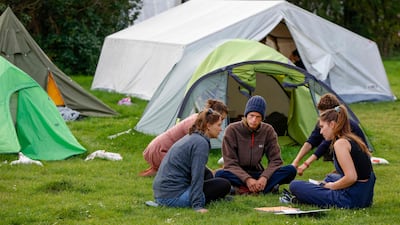
Climate activists at a protest camp in Berlin. The activists were involved in a weeks-long hunger strike as they demanded meetings with German party leaders to discuss the environment. AFP -
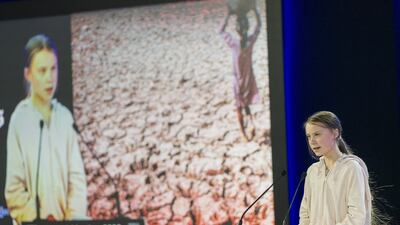
Swedish climate activist Greta Thunberg addresses a panel session during the 50th annual meeting of the World Economic Forum in Davos, Switzerland. EPA -

European Commissioner for Cohesion and Reforms Elisa Ferreira discusses the effects of natural disasters in Europe due to climate change, during a plenary session at the European Parliament in Strasbourg, France. AFP


Cape Town in South Africa came within days of becoming the first major city in the world to run out of water after extended drought in 2018. Four years on and people have been queuing for water in New Delhi amid a heatwave.
Dr Friederike Otto, from the Grantham Institute, Imperial College London, carried out a study into the 2018 drought in Cape Town, which found climate change made it about three times more likely to happen.
“Changing rainfall and higher temperatures — the result of greenhouse-gas emissions — are making drought more common and more severe in parts of the world," she said.
“Until net greenhouse-gas emissions are halted, the risk of drought threatening cities’ water supply will keep growing."

More than half the world’s population live in cities — with the figure expected to rise to 68 per cent by 2050 — and many are already feeling the strain of water shortages.
Only 0.01 per cent of the world’s water is easily available for human use in lakes, rivers, reservoirs and aquifers, but global water use grew at more than twice the rate of population increases over the 20th century, the charity said.
Christian Aid examined the future for water supplies for drinking, washing and growing crops to provide food for 10 major cities worldwide. It warned that without action to cut greenhouse-gas emissions and curb the rising risk of climate-related drought, the poor will be worst hit.

