

The scale of Covid infections across the UK has been revealed, with slightly more than 70 per cent of people in England likely to have had coronavirus since the early months of the pandemic, new figures suggest.
An estimated 38.5 million people in private households – or 70.7% of the population – have had at least one infection since the end of April 2020.
The figures have been compiled by the Office for National Statistics using data from its long-running Covid-19 infection survey.
The ONS said it takes all positive and negative tests in the survey and applies statistical modelling techniques to estimate the number of people who have had Covid-19 in the population.
Currently, 3.7 million people in England are estimated to have Covid, equating to one in 14.
Separately, UK researchers said a Covid-19 patient tested positive for 505 days before their death, making it the longest known coronavirus infection. The previous longest infection is thought to have lasted 335 days.
Most people who contract the virus are able to clear the infection naturally but the patient in question had a severely weakened immune system and many other conditions.
They first started showing symptoms and tested positive in early 2020, and tested positive many times until their death in 2021.
The researchers, who studied the virus from nine Covid patients in London, also provided evidence that new Covid variants may arise in immunocompromised people.
The survey began in England on April 27, 2020, which means the estimates do not cover most of the initial wave of the virus that began to spread in the country in early March.
But it is the first time an attempt has been made to calculate the cumulative number of people who have had Covid-19 over much of the pandemic.
The ONS figures run up to February 11, 2022, so do not include people who have been infected for the first time thereafter.
Separate estimates have been published for the other three UK nations, each of which covers a different time period according to when the infection survey began.
In Wales, 1.7 million people – or 56.0 per cent of the population – are likely to have had Covid-19 between June 30, 2020 and February 11, 2022.
In Scotland, 2.7 million people (51.5 per cent of the population) had the virus between September 22, 2020 and February 11 this year.
And in Northern Ireland, 1.3 million people, the equivalent of 72.2 per cent of the population, are estimated to have had Covid-19 between July 27, 2020 and February 11, 2022.
All figures are for people in private households and do not include those in hospitals, care homes and other communal establishments.
The data also shows how each wave of the virus has pushed up the cumulative number of people to have been infected.
By the start of the second wave in September 2020, the proportion of the population in England to have had Covid-19 since April 27 was still very low, at slightly fewer than 2 per cent.
-

A family member pays their respects to those who lost their lives to Covid-19, as the one year anniversary of the National Covid Memorial Wall is marked in London. PA -

A woman holds a photograph of a family member who died as she takes part in a march from the National Covid Memorial wall to Downing Street in London. AP Photo -

Bereaved families travelled to the wall from across the country to mark the day, with a petition to make the wall a permanent memorial. AP Photo -
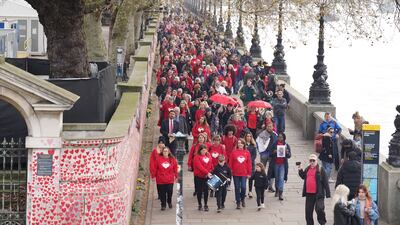
Bereaved families march alongside the wall. PA -

Families with MPs Sir Peter Bottomley, right, and Afzal Khan, left, deliver a petition to 10 Downing Street. PA -

Family members write a message to two sisters who died of Covid-19 on the National Covid Memorial wall. AP Photo -

Becca Slater, centre, receives a hug as she remembers her father Anthony Elward, who died in 2020. AP Photo -

A woman writes a message in a red heart on the wall. AP Photo -

Families marching through central London. PA


As the second wave took off, this jumped to 10 per cent by mid-December and 15 per cent by mid-January 2021.
The figure then rose slowly, reaching 25 per cent in early August and 40 per cent by the end of November.
But once the Omicron wave began, the rate of the increase quickened sharply, with the proportion reaching 50 per cent by late December, 60 per cent by mid-January 2022 and 70 per cent by early February.
The ONS Covid-19 infection survey is the most reliable measure of the prevalence of coronavirus across the country and of how many people have been infected at least once.
It is a nationally representative survey that tests a large sample of people each month. The same people are retested, regardless of whether they have symptoms, which means the survey can identify both infections and reinfections as well as asymptomatic cases.

