


Venus, Mars, Jupiter and Saturn will line up in the sky this week and could stay visible to the naked eye for a number of weeks.
Skygazers will be treated to the sight from Wednesday all the way through to early May. The four planets will be visible before sunrise.
Experts say the best viewing window is between 5am and 6am BST over the coming days, just after the planets rise above the horizon, but before the Sun follows them.
The Moon will also join the line-up on April 23, with a fifth planet — Mercury — becoming visible from June 24.
Despite appearing from Earth to be lined up, the planets will not actually be lined up in space.
“To view this event, all you require is a clear eastern horizon. No specialist viewing equipment is necessary,” said Jake Foster, an astronomy education officer at Royal Museums Greenwich.
“These types of alignments in our skies, sometimes known as planet parades, only occur from our perspective here on the Earth.
“The planets themselves are not physically aligned in space during these events, meaning that the perceived alignment is unique to our perspective as observers on the Earth.
“These events tend to happen once every few years, the last one taking place in 2020.
“This year, we are particularly lucky as we will witness an alignment of five planets visible to the unaided eye on June 24, with Mercury joining the other four visible planets as an added bonus.”
-

From launching the first Arab mission to the Moon to looking into the early universe using the world’s most powerful telescope – the new year is going to be a busy one for space exploration. The National looks at some of the most exciting missions scheduled for 2022. Photo: Nasa -
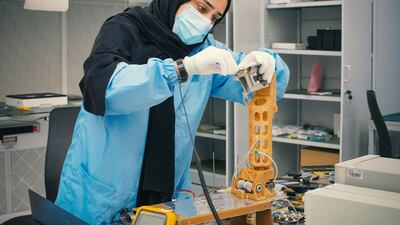
Engineers at the Mohammed bin Rashid Space Centre have been planning a Moon mission since 2017. They have built a 10-kilogram rover called Rashid that will study lunar soil and its properties. It is scheduled for a launch sometime between August to December 2022. Photo: Mohammed bin Rashid Space Centre -
The final prototype of the UAE's Rashid Moon rover. Photo: Mohammed bin Rashid Space Centre -

Two Emirati candidate astronauts are to begin training at Nasa’s Johnson Space Centre in Houston, Texas, in January. Mohammed Al Mulla, a Dubai Police helicopter pilot, and Nora Al Matrooshi, a mechanical engineer, will spend two years in training. Chris Whiteoak / The National -
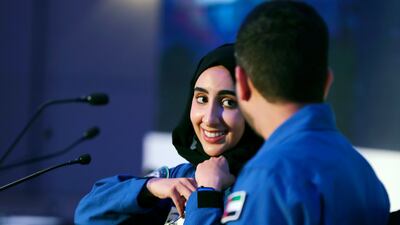
Nora Al Matrooshi and Mohammed Al Mulla will learn the systems of the International Space Station, the Russian language, robotics and how to perform spacewalks. Once they graduate, both astronauts would become eligible for space missions. AP -

Nora Al Matrooshi and Mohammed Al Mulla are the generation of astronauts that could go to the Moon one day. The UAE has its sights set on human missions to the lunar surface. Chris Whiteoak / The National -

US space agency Nasa is preparing the space launch system and Orion spacecraft for the Artemis 1 launch on March 12, which will involve a three-week, uncrewed test flight to the Moon. AFP / Nasa -
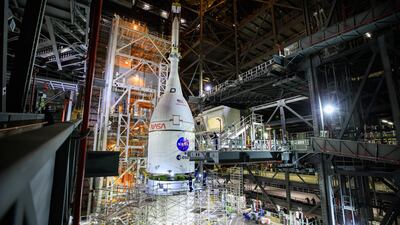
During the mission, the Orion spacecraft will fly 100 kilometres above the Moon’s surface and then use its gravitation force to become captured in an opposite orbit about 70,000 kilometres from the Moon. EPA / Nasa -
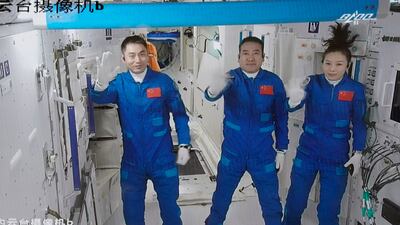
Completion of China’s space station is scheduled for the end of 2022. The Tiangong’s core module Tianhe is already in orbit and has been hosting astronauts, including Wang Yaping, its first female astronaut. Xinhua / AP -
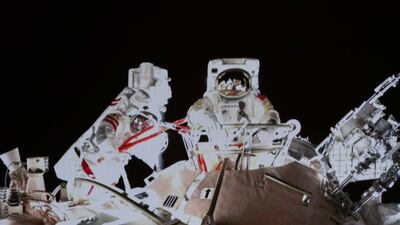
Wang Yaping was sent to the station earlier this year. On November 8, the 41-year-old also became the first Chinese female astronaut to perform a spacewalk. Xinhua / AP -
South Korea plans to launch its first lunar mission in 2022. The Korea Pathfinder orbiter will be launched on a SpaceX Falcon 9 rocket. Photo: Korea Aerospace Research Agency -
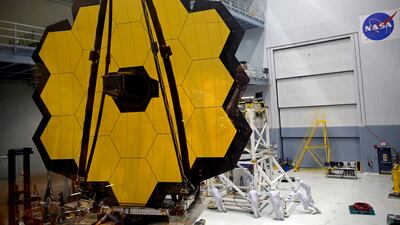
The James Webb Space Telescope will be capable of 'looking back' 13.5 billion years to see the first stars and galaxies of the universe and search for signs of life. It was launched on Saturday, December 25, 2021, and it is expected to make several discoveries when it becomes operational in 2022. Reuters


However, Dr Robert Massey, deputy executive director of the Royal Astronomical Society, said spotting Mars and Saturn in this line-up may be difficult.
“This is a nice conjunction, as the brightest naked eye planets are visible together in a line, with Jupiter, Venus, Mars and Saturn from east to west,” he said.
“The event is best viewed at dawn, but not too late, as the brightening sky will wash out Mars and Saturn in particular.
“From the UK and similar latitudes, and further north, this will be hard to see as the planets are very low down at sunrise and the sky will be very bright by then.
“I’m not confident that Mars and Saturn will be visible at all from here, at least to the naked eye.
“You can try to spot the planets with binoculars, using an online star chart to work out where to look. But you must only do that before sunrise, as looking at the Sun with binoculars or a telescope can cause serious damage to your eyes — as can looking at the Sun with your eyes alone.”

