


Nato forces are “100 per cent ready” to defend Europe should Russian President Vladimir Putin decide to invade, a British military commander has said.
Lt Col Ru Streatfeild, who is leading the organisation’s battle group in Estonia, said British troops were “buzzing” and immensely proud” to be helping to reinforce the country’s eastern border with Russia.
Troops led by the UK’s 1st Battalion The Royal Welsh, which he commands and have recently been stationed in the Baltic State, took part in a large-scale exercise at Tapa military base, about 112 kilometres (70 miles) from the Russian border, on Thursday.
Exercise Bold Dragon involved about 2,300 soldiers from the UK, French, Danish and Estonian ranks using tanks, including the British Challenger 2 tanks, armoured infantry, engineers, artillery and logistics.
The allied forces went head-to-head against the Estonians in the mud, snow and boggy conditions to further hone Nato’s war capabilities and tactics, and ensure the smooth running of working together.
Speaking during the exercise, Lt Col Streatfeild said the war in Ukraine had given his soldiers “a razor-like focus”.
“We are literally under Nato command right now. There are Nato plans in place, and whatever orders we are given under a Nato structure, we will execute them,” he said.
Asked if Nato forces were prepared in the event of a Russian invasion, he said: “100 per cent. There is swagger. They are on their game and they are ready.
“It is not that people revel in this. But soldiers want to do a job. They want to put their tradecraft into practice. This is what they join the army to do.

“Our soldiers are immensely proud to be here. It is an immense privilege. But it is also an immense responsibility,” he said.
He said Nato forces were not only in place to protect the security of the eastern flank but also the “freedoms we often take for granted”.
“It’s those western liberal values; it’s free speech, it’s the ability to be able to buy your own house or car, all those western norms, they are underpinned by security and that is what Nato is here for.”
The battle group commander said he “absolutely” knows how he would counter a Russian attack.
“We are getting to know this terrain really well. And for the Estonians, this is their terrain. They have defended it before and they will defend it again,” he said.
There are currently about 2,000 Nato troops in Estonia, including the Royal Danish Army Viking Company and the French 7th Alpine Hunter Battalion.
On Wednesday, Estonian officials called for Nato member states to double the number of soldiers in the country in order to deter Russia from advancing further into Europe.
-
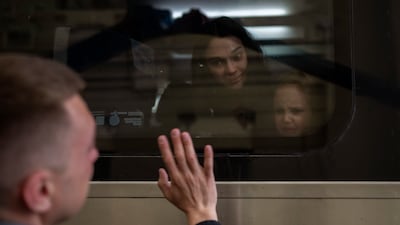
Ukrainian Nicolai, 41, says goodbye to his daughter Elina, 4, and his wife Lolita, on a train bound for Poland fleeing from the war at the train station in Lviv, western Ukraine. AP Photo -
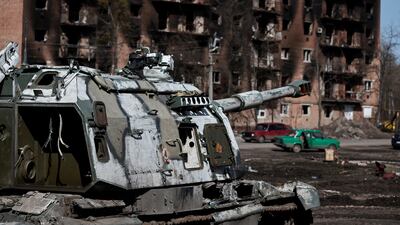
A damaged Russian artillery tank is seen, amid Russia's invasion of Ukraine, in Trostianets, Sumy region, Ukraine. Reuters -
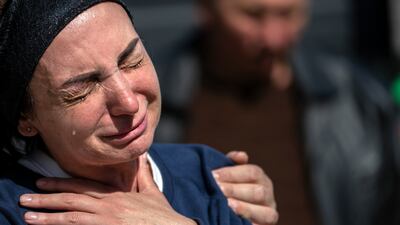
Oksana Kolesnikova cries during the funeral of her son Anatoliy Kolesnikov, 30, a territorial defense soldier who was killed by Russian soldiers in Irpin, in the outskirts of Kyiv, Ukraine. AP Photo -
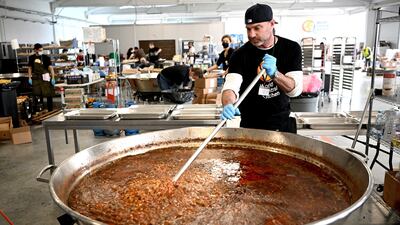
US actor and director Liev Schreiber prepares meals in the kitchen of the 'World Central Kitchen', for war refugees from Ukraine staying in Przemysl, Poland. EPA -

A Ukrainian boy musician plays his sax to entertain citizens in a square, amid Russia's invasion of Ukraine, in Dinipro, Ukraine. Reuters -
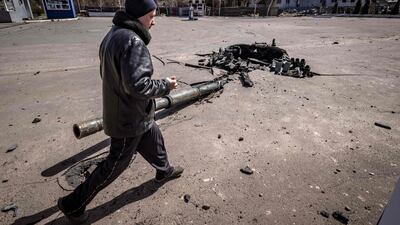
The turret of a destroyed tank near the village of Zalissya, north-east of Kyiv. AFP -
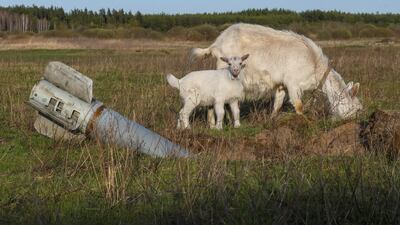
An unexploded shell in a field in Teterivka, near Kyiv. Reuters -
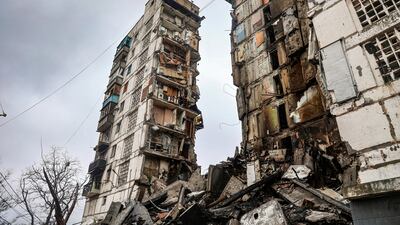
A building damaged during fighting in Mariupol, which is holding out against the Russian invasion. AP Photo -

A soldier from the self-proclaimed Donetsk People's Republic during fighting in Mariupol. AP Photo -

A tank destroyed in the village of Termakhivka, Kyiv region. Reuters -
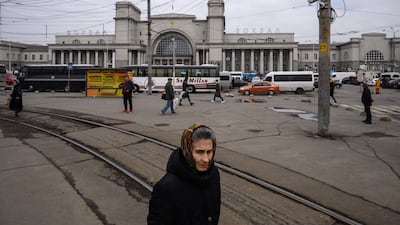
The main station in Dnipro, central Ukraine, where a city official said the remains of more than 1,500 Russian soldiers were being kept in its morgues. AFP -
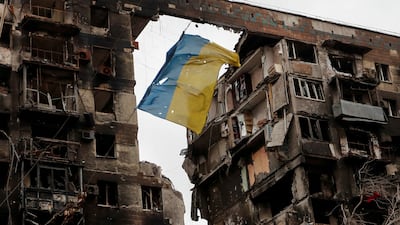
A torn Ukrainian flag hangs in front a damaged apartment building in Mariupol. Reuters -
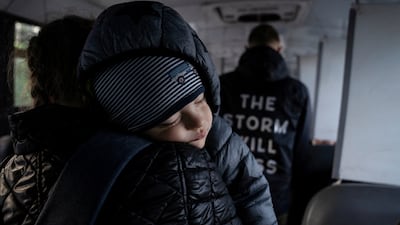
A Ukrainian child seeking asylum in the US is driven on a bus to the border from Tijuana, Mexico. Reuters -
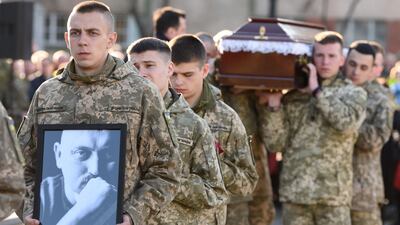
Brothers in arms of serviceman Taras Bobanych, who was killed during the fighting with Russia, carry his portrait and coffin at his funeral in the western Ukrainian city of Lviv. AFP -

From left to right; Lithuanian President Gitanas Nauseda, Polish President Andrzej Duda, Ukrainian President Volodymyr Zelenskyy, Latvian President Egils Levits and Estonian President Alar Karis pose for a picture before a meeting in Kyiv. Reuters -
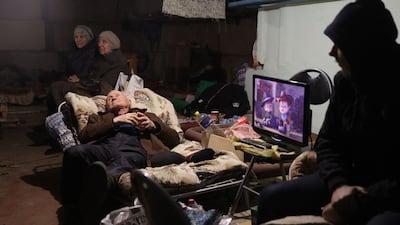
Local residents shelter in the basement of a residential building amid shelling in Lysychansk, in the Luhansk region. AFP -
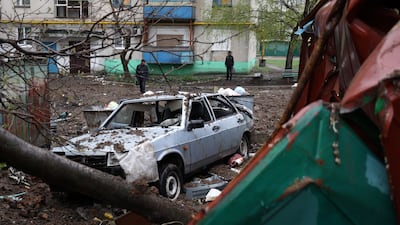
Local residents view a destroyed car next to a multi-storey building in Lysychansk. AFP -
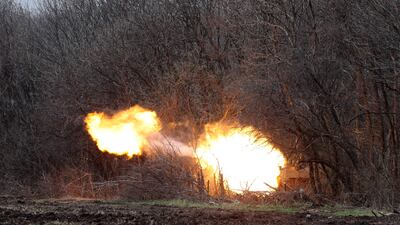
Ukrainian artillery shells Russian troops' position on the front line near Lysychansk. AFP -
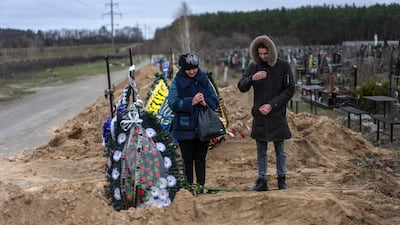
Natalya Verbova, 49, and her son attend the funeral of her husband Andriy Verbovyi, 55, who was killed by Russian soldiers while defending Bucha on the outskirts of Kyiv. AP -

The father and a friend of Anatoliy Kolesnikov, 30, who was killed by Russian soldiers in his car trying to leave Irpin, mourn his death outside the morgue in Bucha. AP -
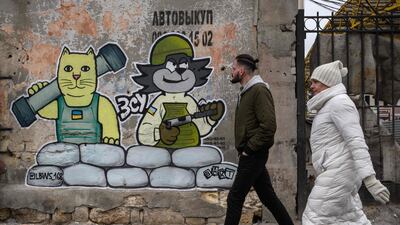
Pedestrians walk past artwork by the LBWS street art collective on a street in Odesa. AFP -

Engineers inspect damage to the bridge that connects Kyiv with Irpin. AP -

The mark of a shell is seen on a street in Irpin. AP -
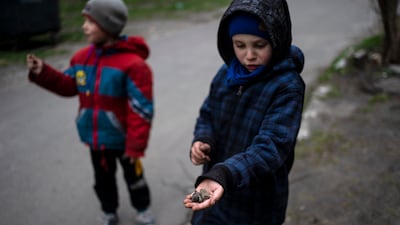
A boy shows the shell of a bullet in Bucha. AP -
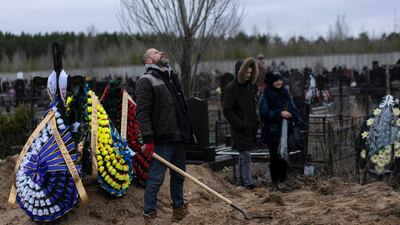
Cemetery worker Artem, exhausted, looks at the sky while working on the grave of Andriy Verbovyi, who was killed by Russian soldiers while serving in Bucha territorial defense. AP -
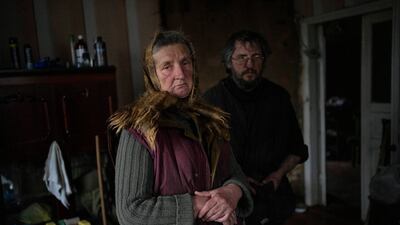
Nadiya Trubchaninova, 70, with her son Oleg Trubchaninov, 46, inside the room of her son Vadym, 48, who was killed by Russian soldiers on March 30 in Bucha. AP -
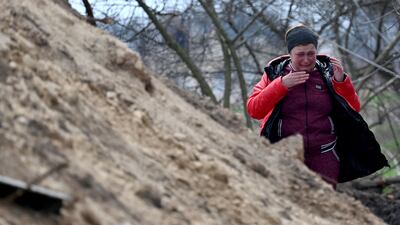
A relative cries after the body of a civilian was exhumed from a shallow grave near his home in the village of Andriivka, in Kyiv region. AFP


Gunner Joe Watson, 19, from Wakefield said he is not concerned about the prospect of war.
“It doesn’t really concern me. We did join the army for a reason. You have always got to be prepared for it,” he said.
“And as a gunner, you don’t really think about it. You just do your job and try to do it well.
“Everyone understands that if we do go, it will be big. But we are focusing on defending Estonia. That is exactly what this is.
“I am proud to be here. I think a lot of the Estonians are very grateful that lots of the British Army are here, especially the armoured units. And this makes you quite proud to be in this job.
“I have got quite a small family, they are dealing with it quite well. My dad is obviously proud. They are all quite proud to be fair.”
Lance Cpl Rhydian Stephens, from Ammanford in Carmarthenshire, who is attached to the Royal Welsh as a B-company medic said: “We heard the news about the war when we were out doing training exercises in Germany and obviously people got excited. It is what we joined the army to do.
“We joined the army to help. But, for now, we are just watching what is happening at the moment on the news and doing what we need to do here in Estonia first.”

