Chief of the National Centre for State Defence Control, Colonel General Mikhail Mizintsev, is a new addition to the UK sanction list. Getty Images

Russian general sanctioned by UK for the crimes against civilians in Mariupol


Nicky Harley
  • English
  • Arabic

Britain has sanctioned a Russian general who is believed to have ordered the attack on a theatre in the Ukrainian city of Mariupol, where 300 mainly women and children died despite warning signs on the building that civilians were sheltering.

Gen Mikhail Mizintsev is among 14 new individuals or organisations to be sanctioned by the UK on Thursday.

They include a well-known television presenter and two Kremlin-funded media operations accused of spreading "lies and deceit" about the invasion of Ukraine.

The 14 latest sanctions follow several previous rounds of penalties against more than 1,200 Russian and Belarusian individuals and entities in response to Russia's military operations against Ukraine.

"Britain has helped lead the world in exposing Kremlin disinformation, and this latest batch of sanctions hits the shameless propagandists who push out [Vladimir] Putin's fake news and narratives," UK Foreign Secretary Liz Truss said.

"We will keep on going with more sanctions to ramp up the pressure on Russia and ensure Putin loses in Ukraine. Nothing and no one is off the table."

Prime Minister Boris Johnson's official spokesman said the UK will continue to pursue more sanctions.

"Countries can adapt to sanctions over time so it's right that we continue to move forward on this," he said.

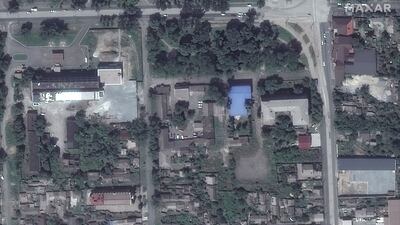
  • A satellite image shows homes and buildings in Mariupol, Ukraine, in February, before Russia's invasion. Maxar Technologies via Reuters
    A satellite image shows homes and buildings in Mariupol, Ukraine, in February, before Russia's invasion. Maxar Technologies via Reuters
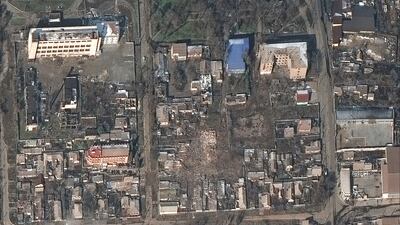
  • A satellite image shows destroyed homes and buildings in Mariupol on March 9. Maxar Technologies via Reuters
    A satellite image shows destroyed homes and buildings in Mariupol on March 9. Maxar Technologies via Reuters
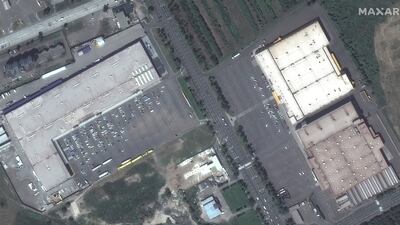
  • Grocery stores and shopping malls in Mariupol in February before Russia's invasion. Maxar Technologies via Reuters
    Grocery stores and shopping malls in Mariupol in February before Russia's invasion. Maxar Technologies via Reuters
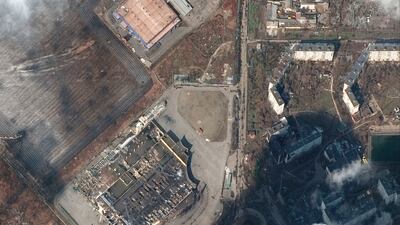
  • A satellite image shows destroyed grocery stores and shopping malls in Mariupol on March 9 amid Russia's ongoing invasion of Ukraine. Maxar Technologies via Reuters
    A satellite image shows destroyed grocery stores and shopping malls in Mariupol on March 9 amid Russia's ongoing invasion of Ukraine. Maxar Technologies via Reuters
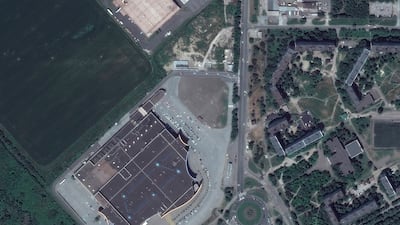
  • The Portcity shopping mall and other stores in Mariupol in February before the Russian invasion. Maxar Technologies via AP
    The Portcity shopping mall and other stores in Mariupol in February before the Russian invasion. Maxar Technologies via AP
  • The heavily damaged Portcity shopping mall and other stores in Mariupol on March 9. Maxar Technologies via AP
    The heavily damaged Portcity shopping mall and other stores in Mariupol on March 9. Maxar Technologies via AP

"It is equally right to impose sanctions on those who are seeking to disinform people at a mass scale."

London has targeted Col-Gen Mizintsev, head of the Russian National Defence Control Centre, who the UK foreign ministry said was responsible for the "Mariupol" assault over Russia's actions in the besieged Ukrainian city.

He has been linked to the planning and execution of the bombardment of Mariupol, among other key Russian military operations against Ukraine.

He was also heavily implicated in Russia’s military activity in Syria, including the destruction of the city of Aleppo.

Mr Johnson's spokesman said "on the face of it there does appear to be evidence of war crimes" in Mariupol.

TV-Novosti, which owns the global television channel RT – formerly Russia Today – was also sanctioned, as was Rossiya Segodnya, which controls the news agency Sputnik.

The UK broadcasting regulator Ofcom this month revoked RT's licence with immediate effect, saying it was not "fit and proper" to broadcast in the country.

In reaction, Margarita Simonyan, editor-in-chief of RT told RIA Novosti state news agency, that she would "add this insult to the total count".

Television presenter Sergey Brilyov, known for his interviews with high-profile political figures, has been sanctioned with the UK describing him as a "propagandist for Putin".

Nurse Svetlana Savchenko, 56, next to her apartment building, destroyed by Russia attacks on the besieged southern port city of Mariupol, Ukraine. March 30, 2022. Reuters

"Having previously lived in the UK, [he] will no longer be able to access any of his UK assets or continue business dealings," the ministry said.

Alexander Zharov, chief executive officer of Gazprom-Media, Alexei Nikolov, the managing director of RT, and Anton Anisimov, head of Sputnik International Broadcasting, were also targeted.

"These sanctions will ensure RT will not be able to find its way back on UK televisions, and will prevent companies and individuals operating in the UK from doing business with Russian state propaganda vehicles," the foreign ministry said.

Britain said it had also fast-tracked sanctions against another seven individuals connected to the Strategic Culture Foundation, which it described as an online journal registered in Russia.

The Foundation has recently been sanctioned by Australia for its role in spreading disinformation.

"The UK is operating closely with allies to target Russia's oligarchs, banks and businesses," it said.

The UK government has designated more than 1,200 individuals and organisations close to Mr Putin – including 76 oligarchs and 16 banks with a global net worth of £150 billion ($197.04bn) and £500bn respectively.


Ten tax points to be aware of in 2026

1. Domestic VAT refund amendments: request your refund within five years

If a business does not apply for the refund on time, they lose their credit.

2. E-invoicing in the UAE

Businesses should continue preparing for the implementation of e-invoicing in the UAE, with 2026 a preparation and transition period ahead of phased mandatory adoption. 

3. More tax audits

Tax authorities are increasingly using data already available across multiple filings to identify audit risks. 

4. More beneficial VAT and excise tax penalty regime

Tax disputes are expected to become more frequent and more structured, with clearer administrative objection and appeal processes. The UAE has adopted a new penalty regime for VAT and excise disputes, which now mirrors the penalty regime for corporate tax.

5. Greater emphasis on statutory audit

There is a greater need for the accuracy of financial statements. The International Financial Reporting Standards standards need to be strictly adhered to and, as a result, the quality of the audits will need to increase.

6. Further transfer pricing enforcement

Transfer pricing enforcement, which refers to the practice of establishing prices for internal transactions between related entities, is expected to broaden in scope. The UAE will shortly open the possibility to negotiate advance pricing agreements, or essentially rulings for transfer pricing purposes. 

7. Limited time periods for audits

Recent amendments also introduce a default five-year limitation period for tax audits and assessments, subject to specific statutory exceptions. While the standard audit and assessment period is five years, this may be extended to up to 15 years in cases involving fraud or tax evasion. 

8. Pillar 2 implementation 

Many multinational groups will begin to feel the practical effect of the Domestic Minimum Top-Up Tax (DMTT), the UAE's implementation of the OECD’s global minimum tax under Pillar 2. While the rules apply for financial years starting on or after January 1, 2025, it is 2026 that marks the transition to an operational phase.

9. Reduced compliance obligations for imported goods and services

Businesses that apply the reverse-charge mechanism for VAT purposes in the UAE may benefit from reduced compliance obligations. 

10. Substance and CbC reporting focus

Tax authorities are expected to continue strengthening the enforcement of economic substance and Country-by-Country (CbC) reporting frameworks. In the UAE, these regimes are increasingly being used as risk-assessment tools, providing tax authorities with a comprehensive view of multinational groups’ global footprints and enabling them to assess whether profits are aligned with real economic activity. 

Contributed by Thomas Vanhee and Hend Rashwan, Aurifer

Updated: March 31, 2022, 2:38 PM