


Subsidies to British wind farms and other green technology break trading rules designed to encourage equality for international business, the European Union has said.
According to the European Commission, new criteria introduced by the UK breach existing rules on subsidies - a claim the UK Government has said it will “rigorously contest”.
It is the first trade dispute since Brexit and therefore becomes the first case to be subjected to the World Trade Organisation rules.
“The EU is requesting consultations with the UK at the WTO on the UK’s discriminatory practices when granting support for green energy projects,” the EC said.
“The criteria used by the UK government in awarding subsidies for offshore wind energy projects favour UK over imported content.
“This violates the WTO’s core tenet that imports must be able to compete on an equal footing with domestic products and harms EU suppliers … in the green energy sector.”

Since December, UK bidders in the contracts for difference programme have been asked to detail how much of a contract’s value will be produced in the UK.
“This incentivises operators to favour UK content in their applications, to the detriment of imported inputs,” the EC said.
“The EU considers this to be a breach of the WTO’s national treatment principle, which prohibits WTO members from discriminating against imports in favour of domestic products.
“Moreover, such local content criteria lead to losses in efficiency and raise prices for consumers, ultimately making the transition to a secure supply of renewable energy more difficult and costly.”
-
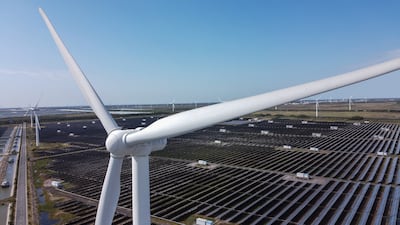
Solar panels and wind turbines work in an integrated power station in Yancheng city in Jiangsu province, China. AFP -
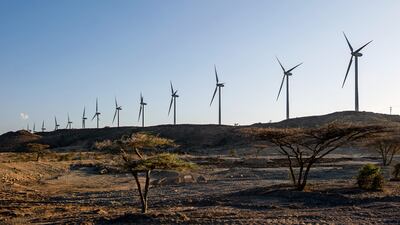
V52-850 kW wind turbines in Lake Turkana, Kenya. Courtesy Vestas Wind Systems A/S -

The Dabancheng wind power plant in Urumqi in China's western Xinjiang region. AFP -
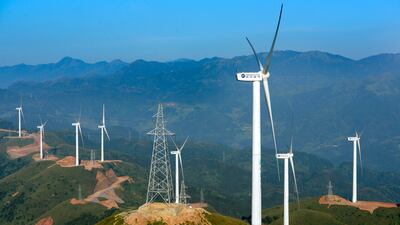
Wind turbines manufactured by Mingyang Electric whirl to generate electricity at a wind farm on the outskirts of Xinyi city, south China's Guangdong province. AP -
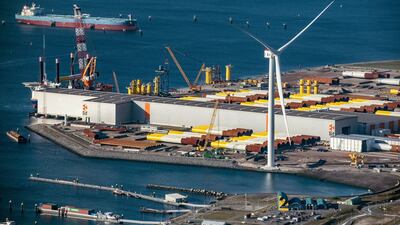
GE's Haliade-X offshore turbine prototype. Courtesy GE Renewable Energy -

Rotor-blades are pictured at Siemens Wind Power's port of export in Esbjerg. Reuters -

An aerial view shows power-generating windmill turbines in a wind farm in Graincourt-les-Havrincourt, France. Reuters -

A model of a wind turbine with the Siemens Gamesa logo is displayed outside the annual general shareholders meeting in Zamudio, Spain. Reuters -
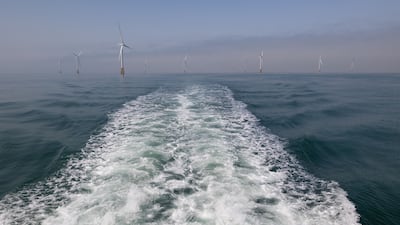
Wind turbines at an offshore wind farm in China. Bloomberg -
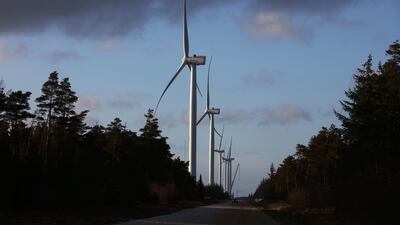
Prototype wind turbines made by different manufacturers operate during testing at the Danish National Test Centre for Large Wind Turbines in Osterild, Denmark. Bloomberg


The UK has the second largest number of installed wind farms but there has not been a rise in sector manufacturing jobs
“We are disappointed that the commission has taken this course of action at a time when we are focused on increasing our energy security and supply of home-grown renewable energy,” the UK government said.
“The UK abides by WTO law and will rigorously contest the EU’s challenge."
UK wind farms generated a record amount of electricity when Storm Malik hit in January.
With wind speeds hitting as much as 161 kilometres an hour in Scotland, 19.6 gigawatts entered the system on one afternoon, the National Grid said. The previous record was 17.7 gigawatts in May 2021.
UK Business Secretary Kwasi Kwarteng on Tuesday said he was putting forward plans to triple the country's solar power capacity by 2030 and double onshore wind power.

