


Live updates: follow the latest news on Russia-Ukraine
Ukrainian troops have completed training in the fastest anti-aircraft missile in the world that will present a severe threat to Russian aircraft, the British defence secretary has confirmed.
Ben Wallace said the advanced Starstreak weapon that travels at more than 5,000kph and is made in Belfast had been deployed into the war zone for the first time and would be used imminently against the Russian offensive.
Britain’s defence industry is benefitting significantly from the Ukraine conflict with shares soaring among companies supplying missiles and other hardware.

“One of the biggest challenges is that the more you go up in sophistication of weapons systems, the more training you require to use them,” he told The Mail on Sunday. With Britain providing more than 10,000 anti-tank and anti-aircraft missiles, it was “doing more than pretty much anyone else” to help Ukraine's military, he said.
Ukraine’s troops are understood to have been trained in the more challenging Starstreak system via remote online learning and potentially by British instructors operating in Eastern Europe.
Unlike other surface-to-air missiles (SAMs), Starstreak, built in Northern Ireland, follows a laser beam-guidance system rather than heat-seeking that can be deterred by magnesium flares.
It is incredibly fast, reaching a maximum velocity of three times the speed of sound, or Mach 4, much faster than the top speed of a Stinger anti-aircraft missile which can travel at Mach 2.5. It also has a range of seven kilometres, with each missile carrying three tungsten-alloy darts each weighing 450g.
Ukraine’s medium range SAM threat has largely forced Russian jets to fly low and fast, which will make them vulnerable to the shoulder-launched weapon. Starstreak will prove particularly deadly for helicopters, giving pilots little time to react.

The weapon that is proving decisive in hitting Russian armour is the British-made Next Generation Anti-Tank Weapon (NLAW). A Ukraine army official has said up to 40 per cent of all Russian tanks destroyed in the conflict have been hit by NLAWs.
Defence minister James Heappey argued in the Commons on Monday that small detachments of Ukrainian troops armed with NLAWs had proven highly capable at attacking the large, slow-moving Russian armoured formations.
“We have seen on the footage of Ukrainians, interrupting activities of fast armoured columns, that small bands of determined people with the right missile technology are far more lethal than any opposing armoured force might prove to be,” he said.
Britain has sent more than 4,000 of the advanced but easy-to-use missiles, which at £20,000 ($26,170) each are significantly cheaper than US-made Javelin, estimated at £156,000.
-

A woman walks past a poster depicting Russian President Vladimir Putin holding his own body, as Russia's invasion of Ukraine continues, in Sofia, Bulgaria. Reuters -
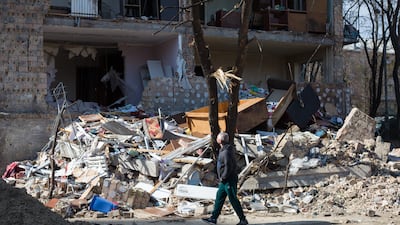
A man walks past a residential area destroyed by a rocket strike in Kyiv. Getty Images -
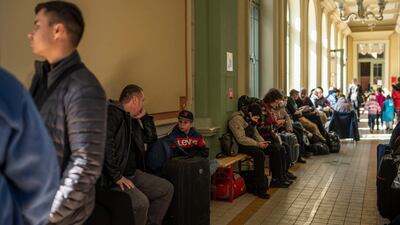
Ukraine refugees wait in the train station in Przemysl, near the Polish-Ukrainian border. More than 3.8 million have fled Ukraine since Russia's invasion. AFP -
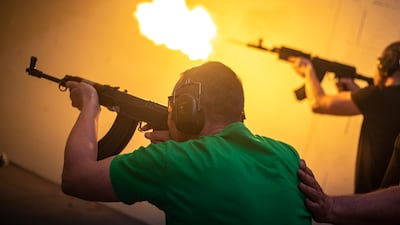
Ukrainian civilians receive weapons training at a shooting range in Brno, Czech Republic. EPA -
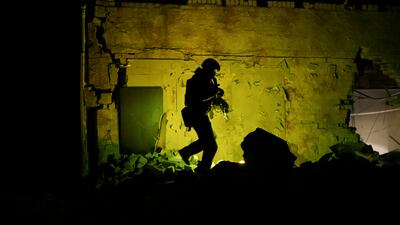
A Ukrainian special police officer patrols near a destroyed building during the night curfew in Kharkiv. AP Photo -

A Ukrainian serviceman walks past the wreck of a Russian tank in Lukyanivka, Kyiv. Reuters -

Ukrainian Air Force jets take part in a defence drill over an unidentified location. Reuters -
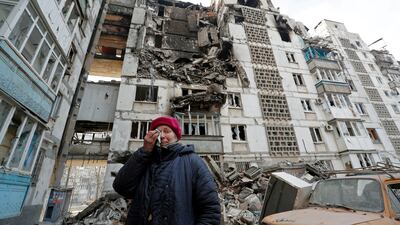
Valentina Demura, 70, near the ruins of her home in apartment block in the besieged southern port city of Mariupol. Reuters -

A message of support for Ukraine at the 94th Academy Awards in Hollywood, Los Angeles, California. Reuters -
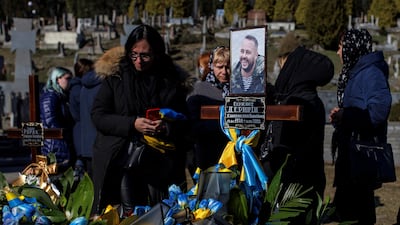
The widow of sergeant Kostiantyn Deriuhin stands at her husband's grave after his funeral at Lychakiv cemetery in Lviv, Ukraine. Reuters -
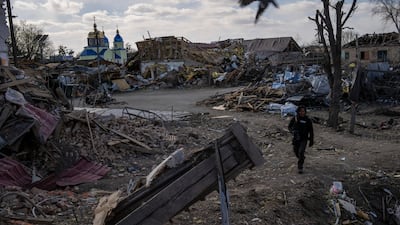
A walk amid the ruins after a Russian attack in Byshiv on the outskirts of Kyiv, Ukraine. AP -
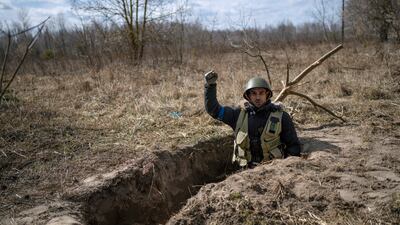
A soldier of the Ukrainian territorial defence forces gives a salute during a break in digging a foxhole at Kalynivka, on the outskirts of Kyiv, Ukraine. AP -
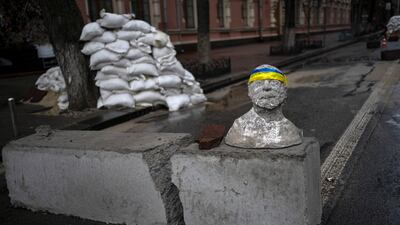
A bust adorned with a headband in the colours of the Ukraine flag at a checkpoint in Kyiv, Ukraine. AP -
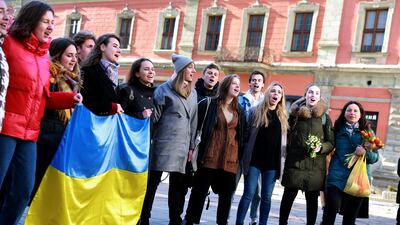
The Cheremosh Folk Song and Dance Ensemble performs in the streets of the Old Town in Lviv, Ukraine. Getty -
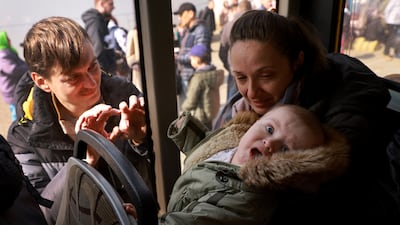
Eugene Grigorash says goodbye to his wife Victoria Grigorash and their seven-month-old son Roman as their bus leaves Lviv on its way to Poland. Getty -
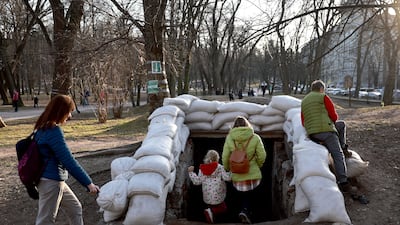
People head for an air raid shelter after sirens sound across Lviv in Ukraine. Getty -
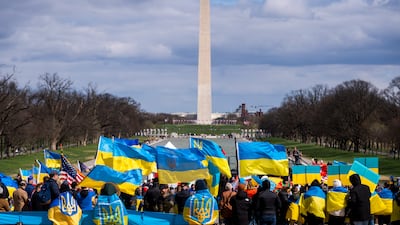
A pro-Ukraine rally at the Lincoln Memorial in Washington. EPA -
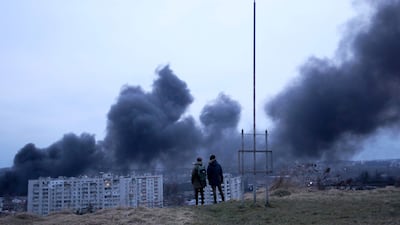
The aftermath of an air strike on the western Ukrainian city of Lviv. AFP -

A protester weeps as she takes part in a 'mothers' march' for Ukraine, in New York. AFP -
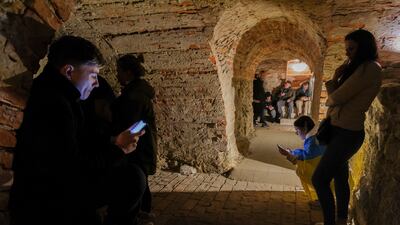
Local people share a basement of a historical building which is being used as a bomb shelter during an air raid warning in Lviv. EPA -
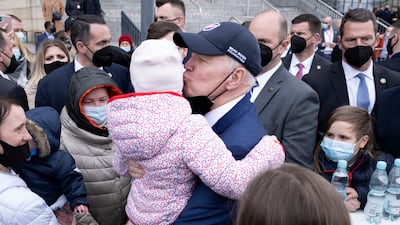
US President Joe Biden kisses a child while meeting refugees of Russia's war with Ukraine at PGE Narodowy Stadium in Warsaw, Poland. AFP -
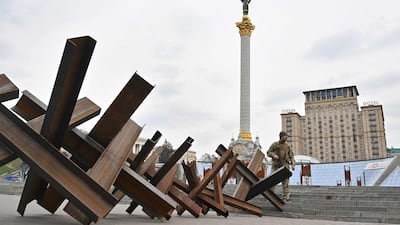
A Ukrainian soldier stands guard at Independence Square in Kyiv. AFP -
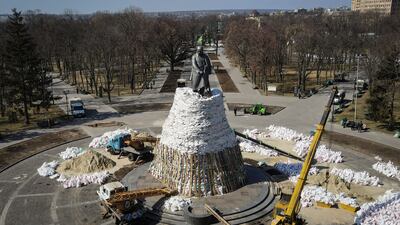
Municipal employees cover the city's monuments with sand bags to protect them from strikes in Kharkiv. AFP -
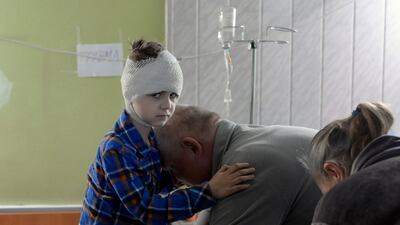
Misha, 5, who lost his mother some weeks ago and got injured during a Russian strike, is helped by his grandfather to dress up in the basement of a hospital in Mykolaiv. AFP -
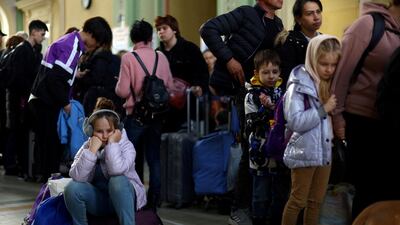
Ukrainian refugees rest in the ticket hall of Przemysl Glowny train station. Reuters -
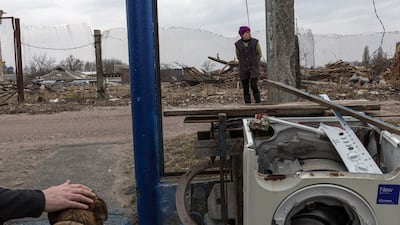
A woman walks past destroyed houses in the village of Krasylivka outside Kyiv. Reuters -
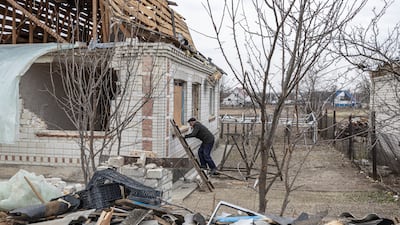
A man climbs up a ladder to examine his destroyed house in the village of Krasylivka outside Kyiv. Reuters -

Damage inside an Orthodox Church building in Yasnohorodka, on the outskirts of Kyiv. AP -
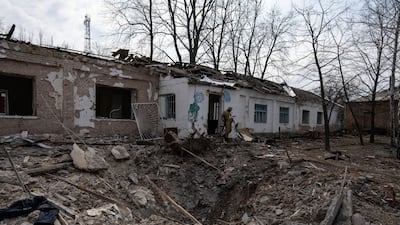
A Ukrainian soldier at a psychiatric hospital damaged by a Russian bombing, in Mykolaiv. AP -
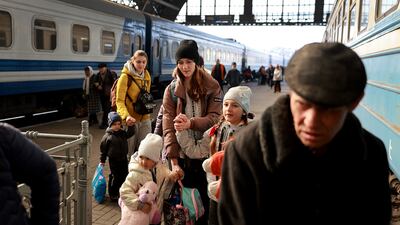
Displaced people from Dnipro arrive in Lviv, in western Ukraine. Millions are internally displaced. Getty Images -
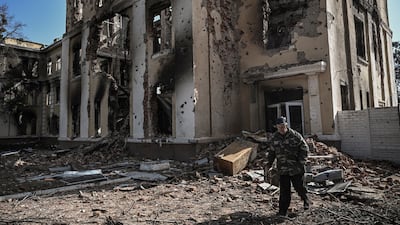
A destroyed school in Kharkiv. AFP -
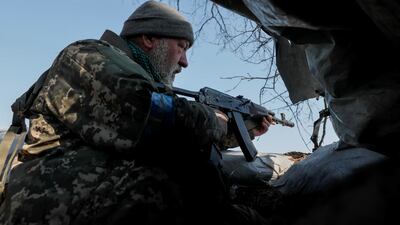
A Ukrainian fighter on the front line in the north Kyiv region. Reuters -
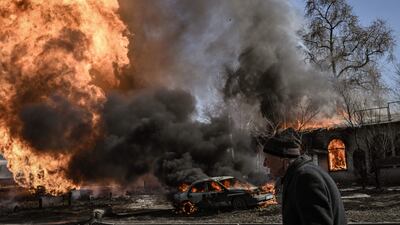
A resident walks past blazing buildings and vehicles after a Russian artillery strike in Kharkiv. AFP -

Black smoke billows from a fuel depot near Kyiv that was used by the Ukrainian Army before it was hit by during a Russian strike. AP -
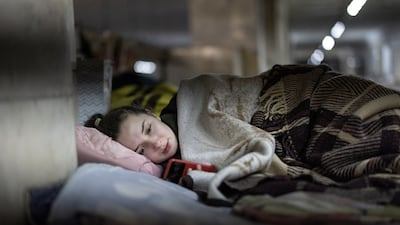
Masha, 26, checks her mobile phone at an air raid shelter inside a Kyiv metro station. Reuters -
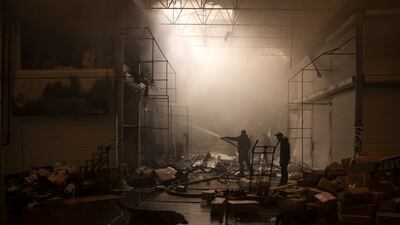
A market on fire in Kharkiv after a Russian attack. AP -
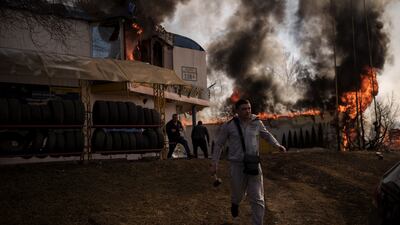
People try to recover items from a shop set on fire during a Russian attack in Kharkiv. AP -

Nastya Kuzyk, 20, who was injured in an attack on Chernihiv, is comforted by her mother Svitlana, 50, as she recovers in a Kyiv hospital. AP


The NLAWs and Starstreaks are both made at the former Shorts factory in Belfast that is now owned by Thales, a French company.
With the company advertising 22 jobs, including one for a “missile architect”, it is clearly experiencing a post-pandemic boon in which share prices for some defence companies have increased by up to 72 per cent in a day. Thales’s share price has risen by 42 per cent in the past month.
With the German defence budget leaping to $100 billion a year, it is expected that more military items will be bought from British companies, including the Eurofighter Typhoon and meteor air-to-air missiles, which are made in Bolton, Greater Manchester.

