


Vladimir Putin’s forces are abducting Ukrainian politicians, activists and journalists as Russia is failing to meet its military objectives, the UK's Foreign Secretary Liz Truss has said.
On Monday she condemned the “abhorrent tactic” after Ukrainian human rights group ZMINA claimed to have identified dozens of people who had been abducted, with thousands more deported to Russia.
Ms Truss said Mr Putin was resorting to “desperate measures” as British military analysts said Russia’s invasion was suffering from a lack of momentum, poor logistics and low morale.
“Putin continues to use abhorrent tactics against the Ukrainian people, including abducting innocent civilians," the foreign secretary said.
“He is not achieving his objectives and is resorting to desperate measures. Putin must fail in Ukraine.”
Ms Truss, in a statement to the House of Commons, later told MPs: “We know that Putin is not serious about talks, he is still wantonly bombing innocent citizens across Ukraine and that is why we need to do more to ensure that he loses and we force him to think again.
“We must not just stop Putin in Ukraine but we must also look to the long term. We need to ensure that any future talks don’t end up selling Ukraine out or repeating the mistakes of the past.”
ZMINA chief Tetiana Pechonchyk said: “Russia is detaining and disappearing civilians in an attempt to break the spirit of the Ukrainian people.
“Today we are publishing our first list of those who have been taken so the Kremlin knows the world is watching and will not allow them to come to harm.
“In total we have so far documented 39 cases of enforced disappearances and arbitrary detentions in the Ukrainian territories newly occupied by Russia.”
-

A woman walks past a poster depicting Russian President Vladimir Putin holding his own body, as Russia's invasion of Ukraine continues, in Sofia, Bulgaria. Reuters -
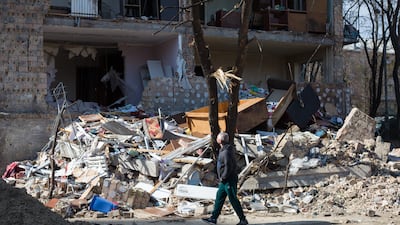
A man walks past a residential area destroyed by a rocket strike in Kyiv. Getty Images -
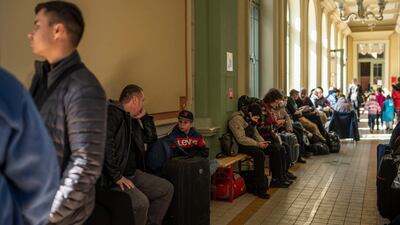
Ukraine refugees wait in the train station in Przemysl, near the Polish-Ukrainian border. More than 3.8 million have fled Ukraine since Russia's invasion. AFP -
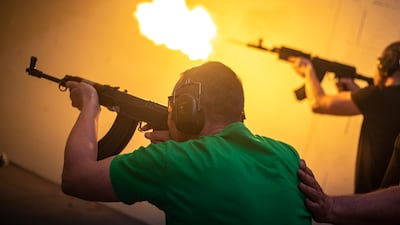
Ukrainian civilians receive weapons training at a shooting range in Brno, Czech Republic. EPA -
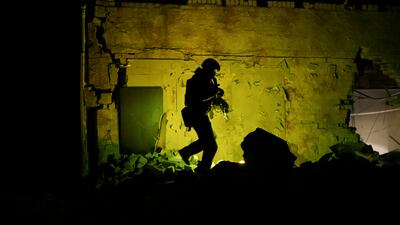
A Ukrainian special police officer patrols near a destroyed building during the night curfew in Kharkiv. AP Photo -

A Ukrainian serviceman walks past the wreck of a Russian tank in Lukyanivka, Kyiv. Reuters -

Ukrainian Air Force jets take part in a defence drill over an unidentified location. Reuters -
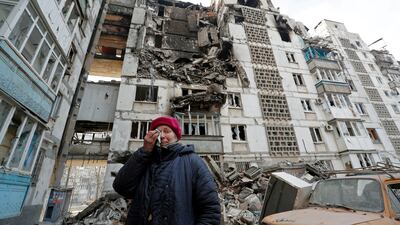
Valentina Demura, 70, near the ruins of her home in apartment block in the besieged southern port city of Mariupol. Reuters -

A message of support for Ukraine at the 94th Academy Awards in Hollywood, Los Angeles, California. Reuters -
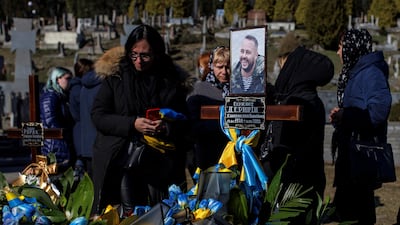
The widow of sergeant Kostiantyn Deriuhin stands at her husband's grave after his funeral at Lychakiv cemetery in Lviv, Ukraine. Reuters -
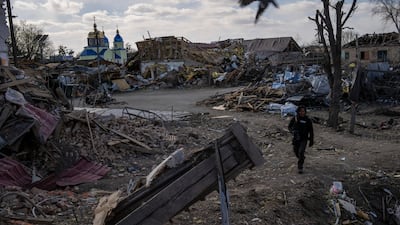
A walk amid the ruins after a Russian attack in Byshiv on the outskirts of Kyiv, Ukraine. AP -
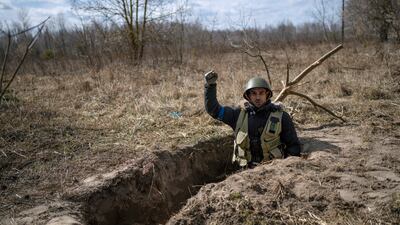
A soldier of the Ukrainian territorial defence forces gives a salute during a break in digging a foxhole at Kalynivka, on the outskirts of Kyiv, Ukraine. AP -
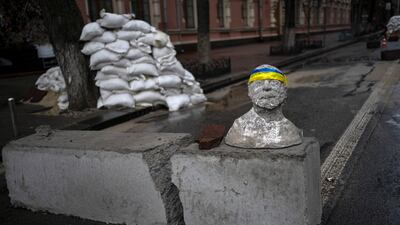
A bust adorned with a headband in the colours of the Ukraine flag at a checkpoint in Kyiv, Ukraine. AP -
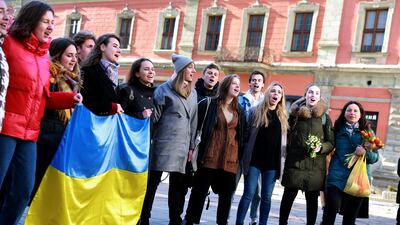
The Cheremosh Folk Song and Dance Ensemble performs in the streets of the Old Town in Lviv, Ukraine. Getty -
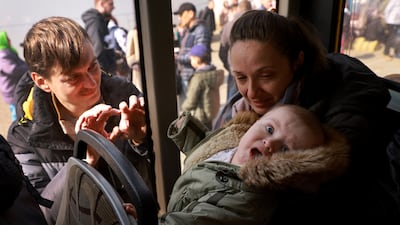
Eugene Grigorash says goodbye to his wife Victoria Grigorash and their seven-month-old son Roman as their bus leaves Lviv on its way to Poland. Getty -
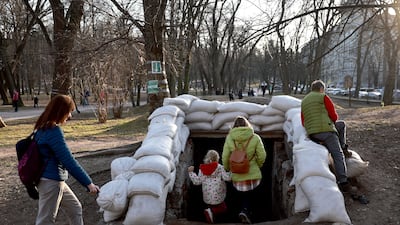
People head for an air raid shelter after sirens sound across Lviv in Ukraine. Getty -
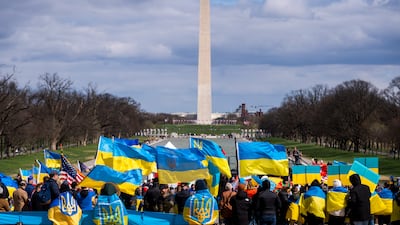
A pro-Ukraine rally at the Lincoln Memorial in Washington. EPA -
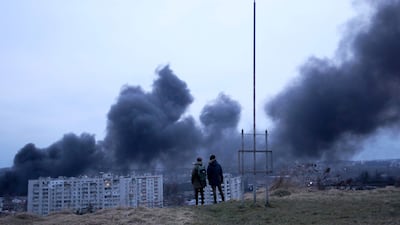
The aftermath of an air strike on the western Ukrainian city of Lviv. AFP -
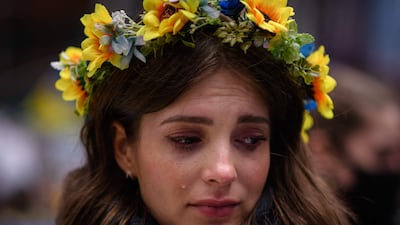
A protester weeps as she takes part in a 'mothers' march' for Ukraine, in New York. AFP -
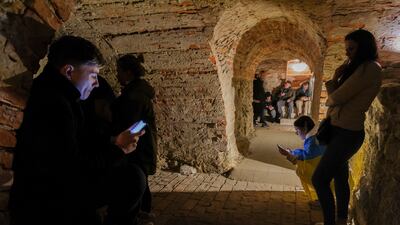
Local people share a basement of a historical building which is being used as a bomb shelter during an air raid warning in Lviv. EPA -
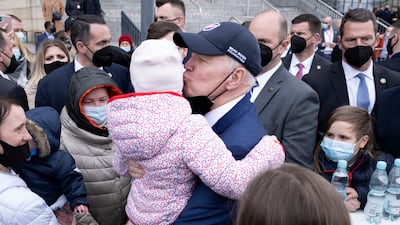
US President Joe Biden kisses a child while meeting refugees of Russia's war with Ukraine at PGE Narodowy Stadium in Warsaw, Poland. AFP -
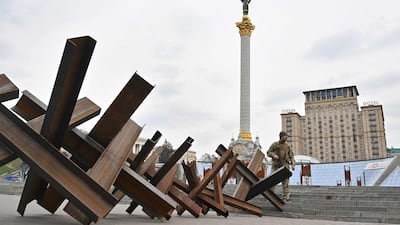
A Ukrainian soldier stands guard at Independence Square in Kyiv. AFP -
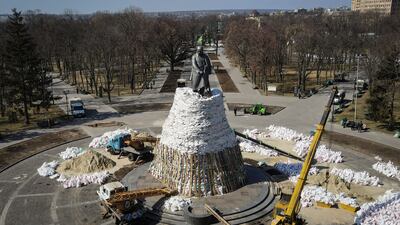
Municipal employees cover the city's monuments with sand bags to protect them from strikes in Kharkiv. AFP -
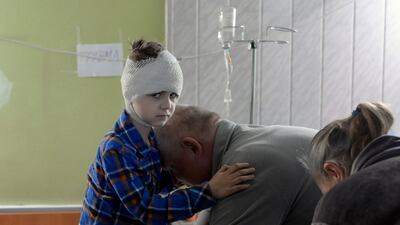
Misha, 5, who lost his mother some weeks ago and got injured during a Russian strike, is helped by his grandfather to dress up in the basement of a hospital in Mykolaiv. AFP -
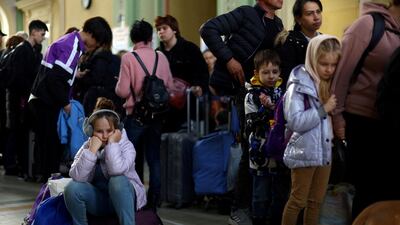
Ukrainian refugees rest in the ticket hall of Przemysl Glowny train station. Reuters -
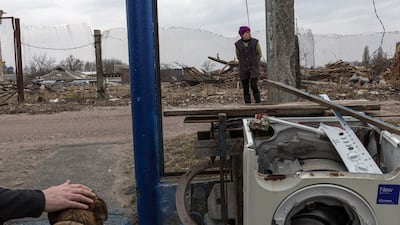
A woman walks past destroyed houses in the village of Krasylivka outside Kyiv. Reuters -
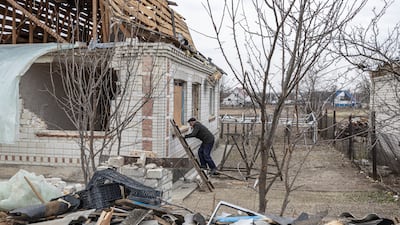
A man climbs up a ladder to examine his destroyed house in the village of Krasylivka outside Kyiv. Reuters -

Damage inside an Orthodox Church building in Yasnohorodka, on the outskirts of Kyiv. AP -
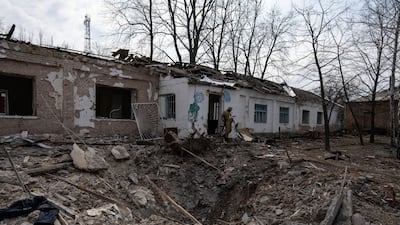
A Ukrainian soldier at a psychiatric hospital damaged by a Russian bombing, in Mykolaiv. AP -
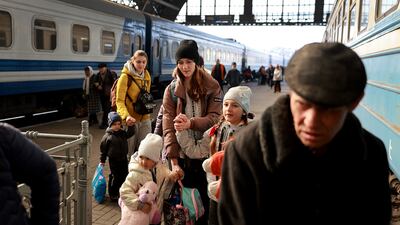
Displaced people from Dnipro arrive in Lviv, in western Ukraine. Millions are internally displaced. Getty Images -
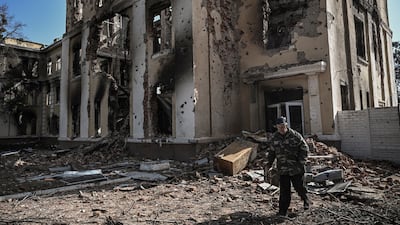
A destroyed school in Kharkiv. AFP -
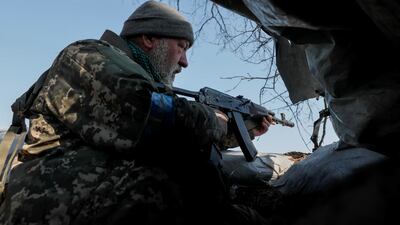
A Ukrainian fighter on the front line in the north Kyiv region. Reuters -
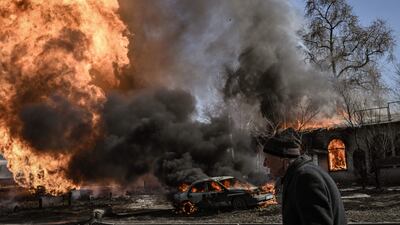
A resident walks past blazing buildings and vehicles after a Russian artillery strike in Kharkiv. AFP -

Black smoke billows from a fuel depot near Kyiv that was used by the Ukrainian Army before it was hit by during a Russian strike. AP -
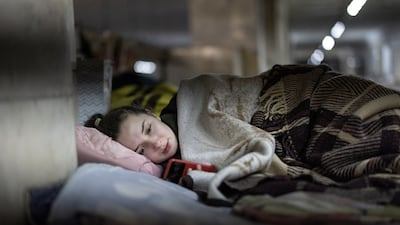
Masha, 26, checks her mobile phone at an air raid shelter inside a Kyiv metro station. Reuters -
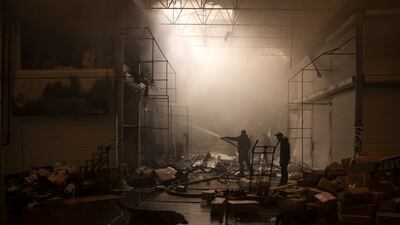
A market on fire in Kharkiv after a Russian attack. AP -
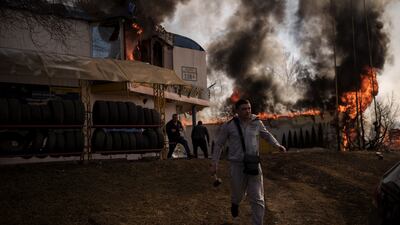
People try to recover items from a shop set on fire during a Russian attack in Kharkiv. AP -

Nastya Kuzyk, 20, who was injured in an attack on Chernihiv, is comforted by her mother Svitlana, 50, as she recovers in a Kyiv hospital. AP


Ukraine’s president Volodymyr Zelenskyy has signalled he is prepared to offer a series of concessions to Russia to end the fighting.
Ukraine could declare neutrality and offer guarantees about its non-nuclear status as part of a peace deal, Mr Zelenskyy suggested, but he stressed the desire to ensure the country’s “territorial integrity” – stopping the Kremlin from carving it up.
Downing Street said the UK would support Ukraine’s negotiating position but Boris Johnson firmly believes that Mr Putin “must fail”.
Mr Johnson and Mr Zelenskyy “shared information about the peace talks” in a phone call on Monday.
The two leaders also “discussed strengthening sanctions against Russia” and defence co-operation between the UK and Ukraine, Mr Zelenskyy said.
The Government distanced itself from US President Joe Biden’s suggestion that Mr Putin “cannot remain in power” – an unscripted comment the White House was forced to row back on, insisting he was not calling for regime change in the Kremlin.
The Prime Minister’s official spokesman said Mr Johnson “believes that Putin must fail in Ukraine and the sovereignty of Ukraine must be restored” ahead of the latest round of scheduled talks between the two sides’ negotiators on Tuesday.
“Obviously it would be for President Zelenskyy and the Ukrainian government to decide on the right approach to negotiations. We will support them in that,” the spokesman said.
“But it is not for the UK or any other country to seek to impose its will on the Ukrainian government as to what it should accept in those negotiations.”
British defence intelligence analysts said on Monday that Russia has gained most ground in southern Ukraine, in the vicinity of Mariupol where heavy fighting continued as Mr Putin’s forces attempt to capture the port.
But the Ministry of Defence “aggressive fighting by the Ukrainians” was keeping the Russians at bay.

