


Live updates: follow the latest news on Russia-Ukraine
British MPs are set to pass a new law to toughen sanctions on Russia after criticisms that the UK was lagging behind other economies in targeting the allies of Russian President Vladimir Putin.
Prime Minister Boris Johnson said the Economic Crime Bill would allow the UK to “pursue Putin’s allies in the UK with the full backing of the law, beyond doubt or legal challenge”.
Critics said the crisis in Ukraine had caused a belated response to the issue of dirty money passing through the British financial system, aided by well-funded and skilled advisers, fixers and lawyers able to disguise the source.
Prominent Russian businessmen call London home, sending their children to public schools and being protected from questions about the source of their money by the UK’s strict libel laws.
In a 2020 report, Parliament’s Intelligence and Security Committee said that Britain since the 1990s had welcomed Russian money with few questions asked.
The UK says it has imposed sanctions on businesses that have stopped £250 billion ($328bn) of Russian economic activity but has sanctioned fewer Kremlin-linked officials than the US or EU.
France and Italy have already seized the yachts of sanctioned oligarchs.
The opposition has backed the bill and Mr Johnson said this weekend that it would be pushed through this week.
The bill demands reforms of property registration to unravel the secrecy over the true ownership of luxury homes in the UK.
The anti-corruption group Transparency International says Russians linked to the Kremlin or accused of corruption own £1.5bn worth of London property.
The bill also prepares the ground for a new kleptocracy unit within the National Crime Agency, the body charged with tackling the most serious and organised criminals.
Experts told MPs on Monday that the unit needed to be well-resourced to be effective.
The NCA has estimated that more than £100bn is believed to be laundered through the UK from all criminal sources every year.
The government says the new law will also make it easier to impose sanctions on people and firms who have already been sanctioned by allies including the US, Canada and the EU.
The UK has targeted 11 wealthy Russians, as well as Mr Putin and Foreign Minister Sergey Lavrov, since the invasion.
But financial experts told MPs on Monday that the rules needed to be clear for the banks and other bodies responsible for policing the sanctions
“You can’t make sanctions up on the hoof because you are relying on the private sector to implement them,” said Tom Keatinge, the director of the London-based Centre for Financial Crime and Security Studies.
He said the system was paralysed because banking staff were not sure what to do and were halting transactions to ensure they were not breaching any sanctions.
Mr Keatinge said the sanctions — unprecedented in their scale and ambition — could leave Mr Putin with a question of whether he wanted to “fund his country or fund his military”.
But he said it was a “very long shot” that sanctions could create sufficient hardship and discontent in Russia to imperil the political leadership in Russia.
-
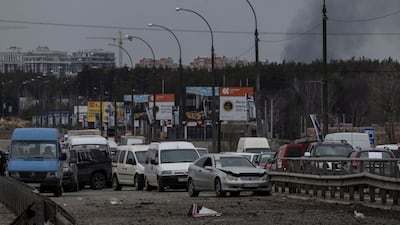
Cars are left abandoned on a road as residents flee the town of Irpin, Ukraine after days of heavy shelling. Reuters -
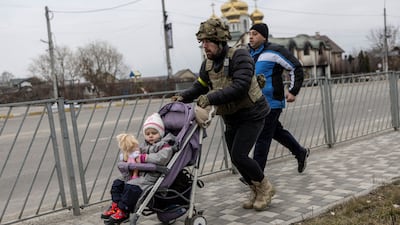
A Ukrainian soldier helps a family fleeing from Irpin. Reuters -

A bus passes the Duke of Wellington statue, which has a traffic cone in the colours of the flag of Ukraine placed on top of it, in Glasgow, Scotland. AP -
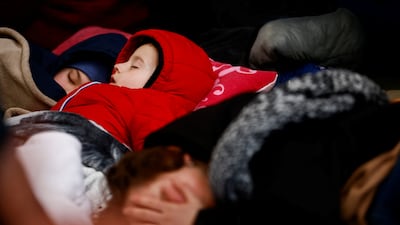
Ukrainian children sleep at the reception point at the train station in Przemysl, Poland. Reuters -
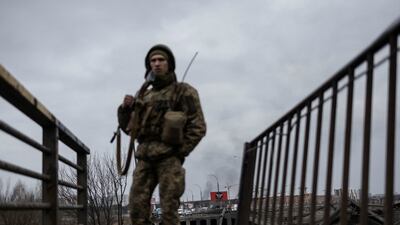
Smoke rises as a Ukrainian soldier stands by the only escape route used by locals to flee from the town of Irpin. Reuters -
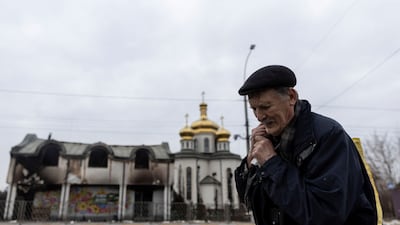
A man flees from Irpin. Reuters -
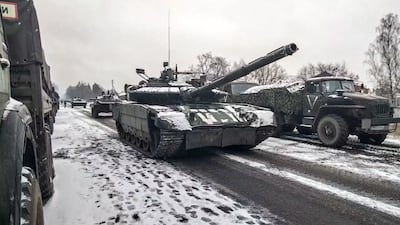
A screengrab from footage released by the Russian Defence Ministry shows a purported Russian tank unit advancement in the Kyiv region. AFP -
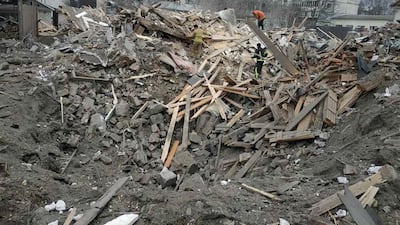
People walk on debris of residential buildings damaged by shelling in the Zhytomyr region. Reuters -

A damaged residential building after Russian multiple rocket launchers shelled the area in the southern city of Mykolaiv. AFP -
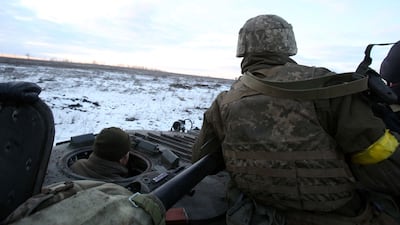
Ukrainian soldiers sit in their armoured vehicle after fighting against Russian troops and Russia-backed separatists near Zolote village, Luhansk region. AFP -
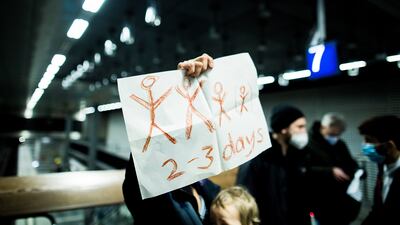
A woman offers accommodation for people fleeing Ukraine at the main railway station in Berlin, Germany. Getty Images -
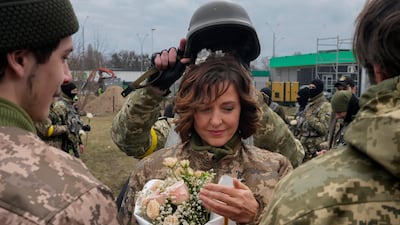
A soldier holds a helmet as a wedding crown during the ceremony for members of the Ukrainian Territorial Defence Forces Lesia Ivashchenko and Valerii Fylymonov, at a checkpoint in Kyiv. AP -
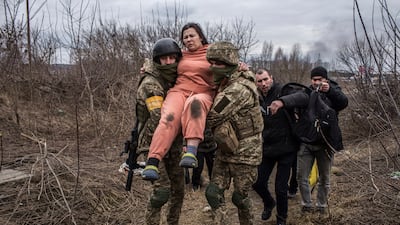
Ukrainian soldiers carry a woman fleeing the town of Irpin. AP -
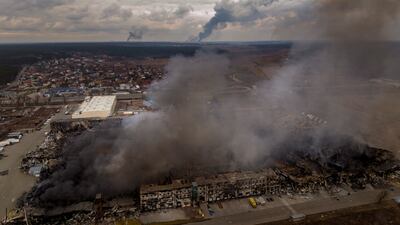
A factory and warehouse burn after being bombarded in Irpin. AP -
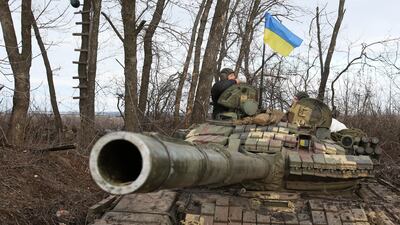
Ukrainian soldiers near Zolote. AFP -
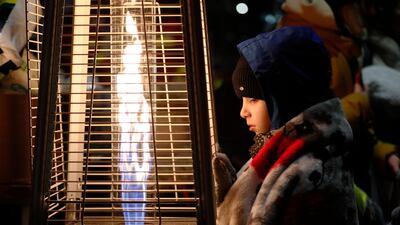
A Ukrainian refugee boy, wearing a blanket on his shoulders, warms his hands with a gas heater shortly after crossing the Siret border into northern Romania. EPA -

People demonstrate against the Russian military operation in Ukraine in Buenos Aires, Argentina. EPA -
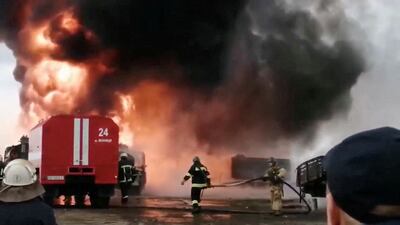
First responders work at the scene after a missile hit a building at Havryshivka Vinnytsia International Airport in Vinnytsia, Ukraine. Reuters -
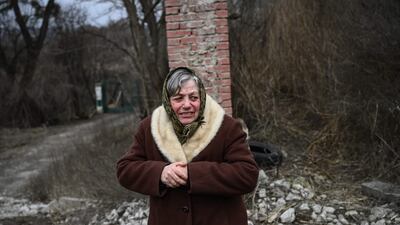
A woman at a checkpoint on the road to Kyiv after her evacuation from a nearby town. AFP -
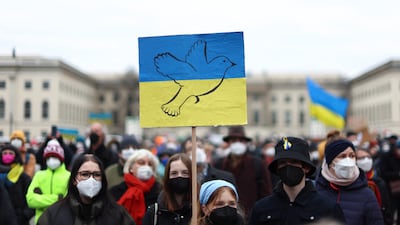
A placard in the Ukrainian colours is held up at an anti-war demonstration the Bebelplatz square in Berlin, Germany. Reuters -
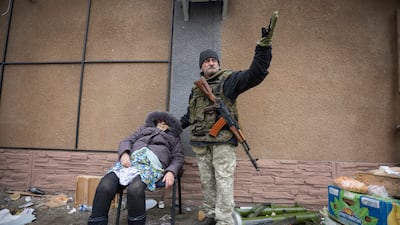
A Ukrainian serviceman helps an elderly woman in Irpin, 20 kilometres north-west of the capital Kyiv. AP Photo -
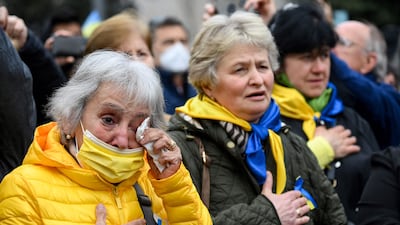
Protesters cry during a demonstration in support of Ukraine at the Plaza Catalunya square in Barcelona. AFP -
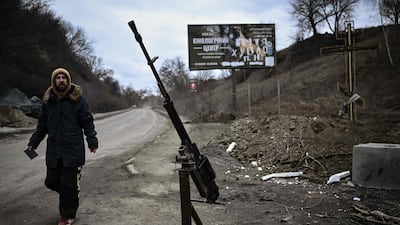
A man walks past a machine gun at a checkpoint next to the last bridge on the road that connects the town of Stoyanka to the outskirts of Ukraine's capital Kyiv. AFP -
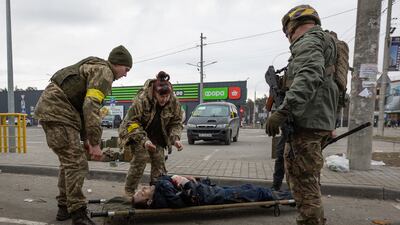
Ukrainian servicemen put a wounded man on a stretcher in Irpin. AP Photo -

People board a train to return to Ukraine after getting supplies in Zahony, Hungary. AP Photo -
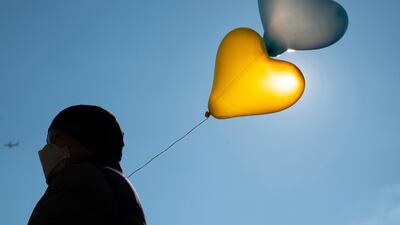
Balloons in the colors of Ukraine during a demonstration against the Russian attack on Ukraine, in Mainz, Germany. AP -
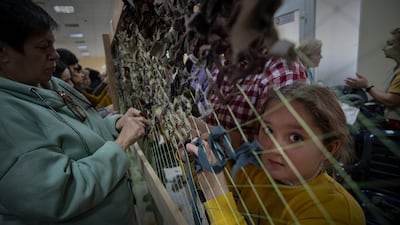
A Ukrainian girl helps to weave a camouflage net for the Ukrainian army, in Odesa. EPA -
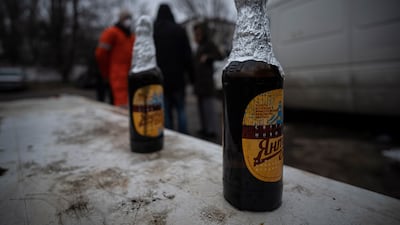
Molotov cocktails prepared by a group of volunteers in Odesa. Hundreds are made every day. EPA -

Ukrainian servicemen assist people fleeing the town of Irpin after crossing the Irpin River on an improvised path under a bridge that was destroyed by a Russian air strike. AP Photo -
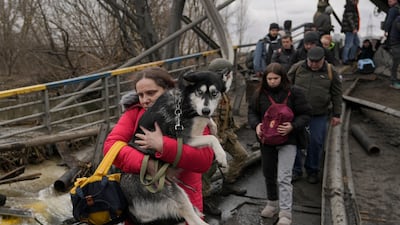
A woman holds a dog while crossing the Irpin River on an improvised path under a bridge that was destroyed by a Russian airstrike, while assisting people fleeing the town of Irpin, Ukraine. AP Photo -
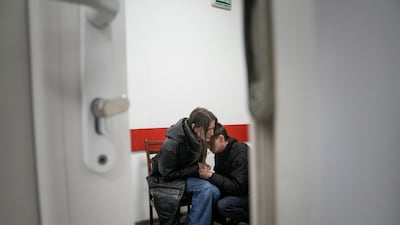
Marina Yatsko and her boyfriend Fedor comfort each other at a hospital in Mariupol after her 18-month-old son Kirill was killed by shelling. AP Photo -
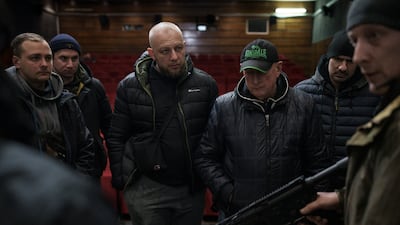
Ukrainian civilians receive weapons training in a cinema in Lviv, western Ukraine. AP Photo -
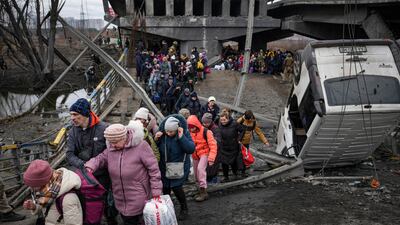
Residents flee the town of Irpin, near Kyiv, Ukraine. AP Photo -
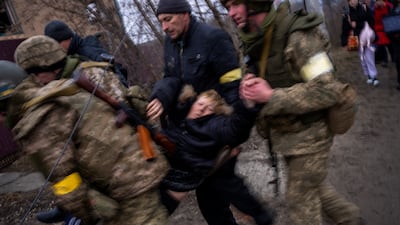
Ukrainian soldiers carry a sick woman as civilians flee Irpin, on the outskirts of Kyiv, after Russian attacks. AP Photo -

Captured Russian soldiers at a press conference in the Interfax news agency in Kyiv, Ukraine. AP Photo -
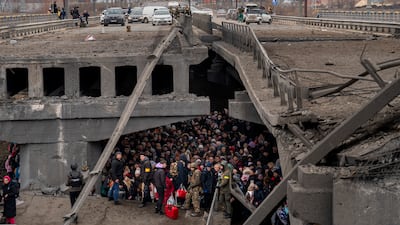
Ukrainians beneath a destroyed bridge in Irpin. AP Photo -

A woman fleeing Ukraine on a bus near the border crossing in Korczowa, Poland. AP Photo -
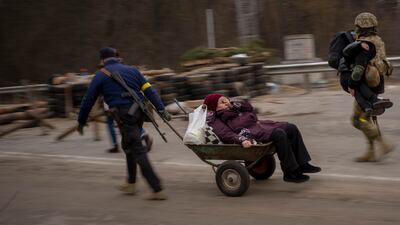
A Ukrainian soldier and a militia man help a fleeing family on the outskirts of Kyiv, Ukraine, on March 5, 2022. AP Photo -
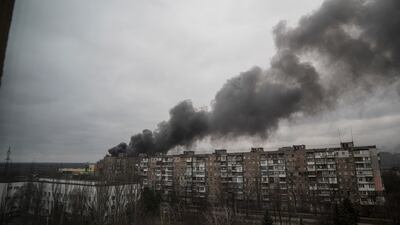
Smoke rises after shelling by Russian forces in Mariupol. AP Photo -
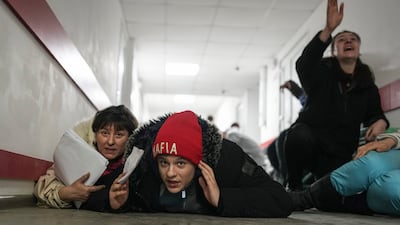
People at a hospital during shelling by Russian forces in Mariupol. AP Photo -
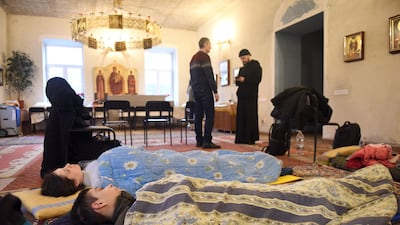
Displaced Ukrainians at the Resurrection New Athos Monastery in the western Ukrainian city of Lviv. AFP


During consideration of the Bill in the Commons, Home Secretary Priti Patel called Mr Putin a “gangster” as MPs sought to rush through the new laws.
Ms Patel said the Bill would give the UK government “greater power and information to identify and investigate the illicit wealth of Russian criminals, their allies and their proxies”, amid concerns that money is often buried in property with the true owners hidden behind shell companies that exist only on paper.
The legislation is set to establish a new register of overseas entities requiring foreign owners of property in the UK to declare their true identity.
The register would need to be updated each year and punishments for failing to declare details, or submitting false information, would result in the asset being frozen and it cannot be sold or rented out.
Amendments to the legislation have also been tabled by ministers to reduce the time given for overseas entities to comply with new rules, from 18 months to six.
Other government amendments include increasing criminal penalties for non-compliance from fines of up to £500 a day to up to £2,500 a day.
Another change will tie the government to publishing an annual report on the use of unexplained wealth orders, which allow law agencies to confiscate criminal assets without ever having to prove that the property was obtained from criminal activity.
Ms Patel, opening the debate at second reading, told the Commons: “Putin is a gangster and his regime is underpinned by a mob of oligarchs and kleptocrats who have abused the financial system and the rule of law for too long.
“Putin’s cronies have hidden dirty money in the UK and across the West and we do not want it here.
“Expediting this legislation, which I know this whole House supports, will mean that we can crack down on the people who abuse the UK’s open society.”
“The new property register will have an immediate effect dissuading those intending to buy UK property with illicit funds.
“Oligarchs could be slapped with an unexplained wealth order, just one of the tools that we will have at our disposal.
“The Treasury will be better able to act when financial sanctions are breached.
“We’re implementing the most severe package of sanctions ever imposed on Russia or on any major economy.”
Ms Patel said a second economic crime bill will follow in the next parliamentary session to introduce further measures.
Shadow home secretary Yvette Cooper offered Labour’s support to the Bill but insisted many of the measures “should have happened some years ago”.
“We want to see stronger action against Russia at this time of international crisis," she said.
“We want to see stronger action against economic crime that puts us to shame and undermines our economy and the rule of law and we need action on transparency, on regulation, on enforcement and on accountability, too many areas where there has not been progress for too long.”
Conservative former cabinet minister David Davis warned of Russian retaliation.
“It (the Bill) will do great harm to the Russian economy, it will do great harm to our adversaries in Russia, but it will also do some harm to us, or at least the retaliation will do some harm to us," he said.
“Particularly it will hit the least well-off, so we’ll see greater price inflation, we’ll see less growth, less trade and therefore less jobs and we must recognise that, when we undertake what we’re doing here.
“We can make Russia a pariah state, but Putin will retaliate and we must be ready.
“We need to be ready for fuel crises, the cyber attacks and for the ludicrous threats from the Kremlin.”

