

The Covax campaign to ensure the world’s most vulnerable people get vaccinated is facing a funding crisis that has resulted in a deficit of vital materials including syringe needles.
Global donors have called for urgent additional funding of $5.2 billion for the Global Alliance for Vaccines and Immunisation (Gavi) project this year, while a separate Unicef report has identified “financing gaps” of billions more for the coming year.
Poorer countries have suffered from vaccine shortages and now an uneven distribution of medicine because they do not have sufficient supplies in place to administer doses at the scale needed. “We are in a position where we will not be able to accept more dose donations [that come without syringes or other accessory elements] unless we get more cash,” Gavi chief executive Seth Berkley told the Financial Times.
Unicef’s report presented the expected financial gaps for vaccine delivery costs when trying to reach the World Health Organisation’s goal of 70 per cent vaccination coverage of the global population by the end of July.
The body analysed the predicted financial gaps for four vaccination scenarios — fully protecting, partially protecting, leveraging and balancing human resource protection for essential health services with speed — in 133 low and middle-income countries.
“The financing gap for the scenario of ‘balancing human resource protection for essential health services with speed’ was $2.3bn for the 133 countries.
The estimate was $6.9bn for ‘protecting fully’, $3.1bn for ‘protecting partially’, and $1.3bn for ‘leveraging’.
-

People wearing face masks are silhouetted against a public awareness notice about social distancing in the Japanese capital Tokyo. AP -
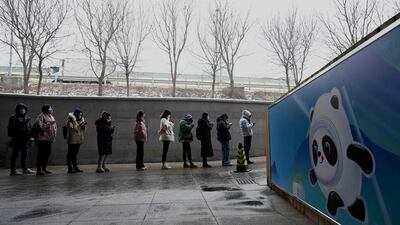
People queue next to a poster of Bing Dwen Dwen, the mascot of the Beijing 2022 Winter Olympics, to have their swab samples taken to test for the Covid-19 coronavirus in Beijing, China. AFP -

A bench taped off to enforce social distancing measures at a subway station in Seoul, South Korea. AP -
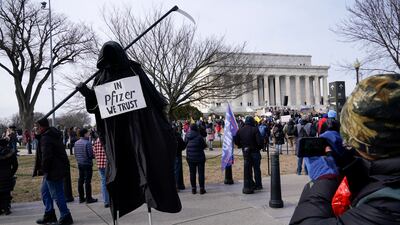
A protester dressed as the Grim Reaper participates in an anti-vaccine rally in front of the Lincoln Memorial in Washington, US. AP -
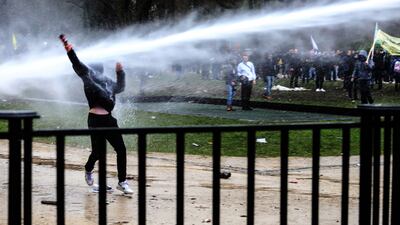
A demonstrator is sprayed by a water cannon as 50,000 people protested against anti-coronavirus measures in EU countries at the bloc's administrative centre in Brussels, Belgium. Bloomberg -
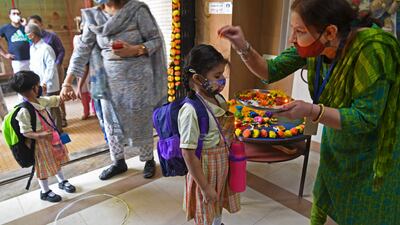
A teacher welcomes a student upon her arrival at a school in Mumbai, after it reopened as Covid-19 measures were eased. AFP -
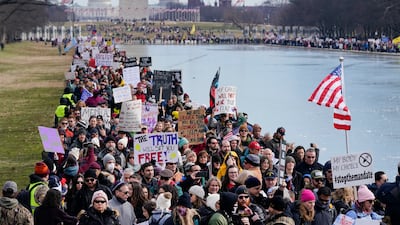
Protesters march alongside the Lincoln Memorial Reflecting Pool before an anti-vaccine rally in Washington, US. AP -
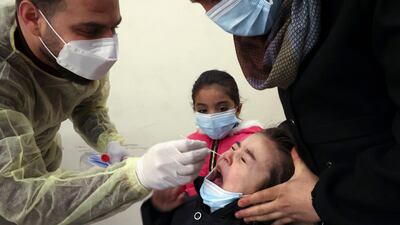
A Palestinian Health Ministry medic takes a swab sample from a child to test for the coronavirus in the village of Dura, west of Hebron, in the Israeli-occupied West Bank. AFP -
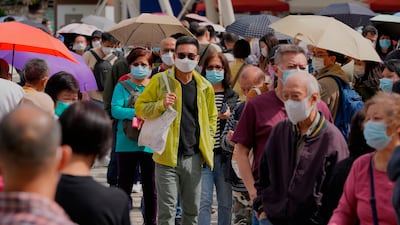
Residents queue for PCR tests at a housing estate in Hong Kong as the territory battles a wave of Covid-19 cases. AP -

Protesters in Ansbach, Germany, march with a banner with the inscription 'Fresse Freiheit. Mask off! Take a breath! Tell the truth!' AP -
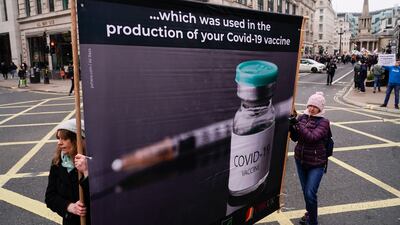
Anti-vaccine protesters with a placard in the UK's capital, London. AP


Covax is a worldwide initiative aimed at equitable access to coronavirus vaccines, directed by Gavi, the Coalition for Epidemic Preparedness Innovations and the WHO, with Unicef as the system’s key delivery partner.
Covax wants to ease the supply chain this year with more efficient distribution set-ups in recipient countries.
“We can break the cycle of transmission and the pain and suffering,” Mr Berkley said.
However, “what we do not have today are the resources to help countries adapt to the new challenges that we know Covid-19 will create in 2022."
Covax wants to build a pool of 600 million doses to ensure a reliable supply and to cover eventual variables such as boosters or new variant-specific vaccines.
“I think we'll still have rocky supply for the next six months or so and I'm a little worried, frankly, if there are new variant vaccines, that we might have an inequity 2.0,” Mr Berkley said.
Covax reckons it has enough confirmed vaccine supplies to inoculate 45 per cent of the population in the poorest 91 economies.
But the WHO wants 70 per cent fully vaccinated in every country by July to end the acute phase of the pandemic.

