


A “silent tsunami” of Omicron has already hit Britain with the country posting the highest rate of daily infections since January, and fears are growing that it could reach a plateau of 100,000 cases a day throughout 2022.
Even if the variant is less lethal than the Delta variant, experts told The National to expect its spread to double the current daily rate of 150 deaths, possibly leading to more than 40,000 fatalities in the next six months.
Britain reported 59,610 new Covid-19 cases on Tuesday, the highest figure since early January. The number of patients being admitted to hospital between December 4 and December 10 was also up 10 per cent compared with the previous seven days, with 5,925 people currently admitted.
There are also concerns that despite Britain’s intensive booster campaign, which hopes to achieve one million doses a day, the new variant will sweep the country before immunity kicks in.
“There’s absolutely no question that it is spreading like the clappers as it is at least two times more infectious than Delta, which is already really fast,” said Prof Jennifer Rohn.
“We're looking at a very difficult time in the next few months. Boosters are great, but it takes one to two weeks to build up that additional help.”
The leading virologist from University College London added that most modelling was showing there are “hundreds of thousands of cases right now”, with London in particular affected.
“So, the silent tsunami is here. We just haven't felt the effects of it yet.”
-

Hundreds of people queue at a vaccination centre in Bristol as the coronavirus booster vaccination programme accelerates to its fastest pace yet. PA -

People queue alongside the National Covid Memorial Wall as they await coronavirus booster vaccinations at St Thomas' Hospital, in London. AP Photo -

People wait to be vaccinated at a Covid-19 vaccination centre in Ramsgate, Kent. PA -
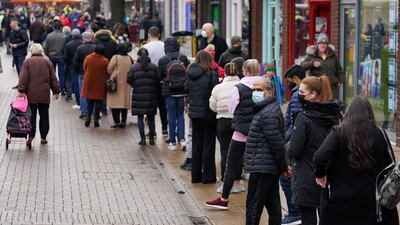
Hundreds of people queue at a vaccination centre on Solihull High Street, West Midlands. PA -

An anti-vaccination sign is displayed near the Houses of Parliament in London. Reuters -

London's Waterloo railway station during the morning rush-hour. People in England have been urged to work from home if possible. AP Photo -

Old Trafford stadium, the home of Manchester United, whose Premier League match against Brentford was postponed after several players and staff. tested positive for the coronavirus. Reuters -

People wait to be vaccinated at a centre in Ramsgate, Kent. Every eligible adult in England is to be offered a Covid-19 booster by the end of December. PA


Omicron is now set to be the dominant variant in London by as soon as Christmas, a statistician from the government’s Scientific Pandemic Influenza Group on Modelling told The National.
Although infections are doubling every two and half days, Prof Graeme Ackland does not believe that exponential rate will be sustainable for long.
“I would be surprised if that phase lasted for more than a couple of weeks, but even so, at that point, there'll be a hell of a lot of infections.”
That phase will then be repeated about two weeks later across Britain as the infection spreads.
His modelling suggests that both the daily infection rate and therefore death rates are now likely to double with Omicron.
“I think people are very uncertain and nobody at the moment really wants to say how dangerous this is going to be,” the Edinburgh University academic said.
“It could be pretty mild, turning into a regular cold spreading through the population, and it could be all over. But that's the dream scenario and I don't think anybody really expects that.”
The statistician said all eyes were now on South Africa’s capital Johannesburg in Gauteng province, where Omicron is dominant.
“Everybody is watching the numbers in Gauteng in South Africa, which has been ahead of the game for long enough that a lot of people would be dying if it was really lethal,” he said.
“But it will take at least a week to understand whether the disease is as lethal as the Delta variant.”
Prof Rohn agreed that while the South Africa data “remains promising”, it has a predominantly younger population than Europe.
Her concern was that even if it is less lethal than Delta, the high infection rates of Omicron mean that “just a small fraction of a very large number is still a very large number”.
The key unknown at present is the percentage of infections that lead to hospital admissions.
“That’s really the missing crucial piece of the puzzle which is going to take a few weeks to clarify,” she said. “I would not be surprised if it was slightly less lethal and that does seem to be the emerging consensus.”
Britain's Health Secretary Sajid Javid announced on Tuesday that hotel quarantine for travellers arriving in England would be abandoned later this week after the rapid spread of Omicron made such measures unnecessary.
People arriving in the UK from 11 African countries have been required to spend 11 nights in a quarantine hotel at a cost of £2,285 ($3,024) for solo travellers.
Meanwhile, England has been hit by a shortage of rapid coronavirus tests at walk-in or drive-through sites following a surge in cases.
UK Health Security Agency sources said “exceptionally high demand” for the in-person tests has created pressure on the system and temporarily led to reduced availability in some areas.
Hospital admissions will play a key role in deciding whether Britain enters another lockdown. Despite the UK’s high Delta infection rate, averaging about 35,000 a day since July, daily hospital admissions are averaging about 700, whereas in January they reached a peak of 4,500.
If Omicron causes the same level of hospital admissions then the government might have to order a lockdown.
“It’s a political decision but ultimately lockdown depends on hospital admissions,” said Prof Ackland.
“Another lockdown, which would probably stop the infection wave, otherwise it would have to run its course through the population so people acquire immunity. This could mean that Omicron becomes no more an irritant than the common cold.”
Again, early data suggests that the variant only affects the nose and throat area, rather than penetrating to the lungs and causing serious illness.
“Therefore, it may well run for a year and possibly nobody will care,” said Prof Ackland.
Prof Rohn, who last week told The National that Omicron could be similar to a common cold, now argues that a cold does not put people in hospital.
“I don't think it's mild enough to be that scenario but maybe evolutionarily speaking, we're getting close to that,” she said.
There are also concerns over Europe’s ability to handle the coming wave of infection as Britain has administered more than double the number of the continent’s booster vaccines. Our Word In Data figures show the UK has given boosters to 35 per cent of its entire population, compared to 17 per cent in all of Europe.
With parts of Europe in lockdown to defeat the currently dominant Delta variant, there is a concern that this could be extended to prevent Omicron overwhelming health systems.
“If they don't get their booster programmes going, they could be in trouble because it’s already sweeping through Denmark and soon it will be sweeping everywhere,” said Prof Rohn.
There is also a suggestion that there could be a rise in deaths among younger people who are unvaccinated. The South Africa evidence showed that up to 90 per cent of those admitted to hospital had not been vaccinated.
The lack of clarity on Omicron’s virulence has led to the government being overcautious before empirical evidence is available, say the scientists.
What happens in the hospitals and mortuaries around Johannesburg in the coming days is likely to determine what lies ahead for the world in the coming year.

