


Bundled from the cold in black woolly hats and puffy coats, some in red life jackets, the migrants hauled the rubber dinghy on their shoulders and heads under a steely November sky, over the dunes towards the beach.
France says it is trying hard to stop illegal crossings of the English Channel but there was no stopping the group of more than 40, including six children, who cast off from near Wimereux in northern France at daybreak on Wednesday.
The group launched their bid for Britain shortly after dawn. Ahead lay frigid waters and some of the world's busiest shipping lanes.
About 15 men carried the dinghy, walking towards the sea. Families trailed after with their children. Behind them men lugged an outboard motor.
One man held a young boy by the hand. Two others carried smaller children on their shoulders, while women carried belongings.
A French police truck headed towards the group, flashed its lights and circled the migrants in an apparent attempt to block their path to the sea.
A woman carrying a small child stepped in front of the vehicle and let out a wail. The police vehicle stopped. Soon after, it left to patrol another part of the beach.
With the police gone, the migrants scrambled over the sand to the shore, loaded the children on to the dinghy and pushed it out to sea.
As a woman waded into the bitingly cold water, she confirmed where they were headed: "Go UK," she shouted back, before swinging a plastic bag containing belongings on to her head to keep it dry.
Waist-high in the surf, more people pulled themselves on to the dinghy, helped by those already on board.
At last, the tiny boat was packed. Some of the migrants waved as they left the shoreline.
They later landed near Dungeness, guided by a rescue boat.
-

A man is brought in to Dover by UK Border Force officers. It was a busy weekend in the English Channel, as 1,100 migrants arrived in England on small boats. All photos: PA -

A group of people thought to be migrants arrive in Dover. The surge in the number of people making the risky voyage came amid a spell of mild weather. -

A girl is helped by a Border Force officer. -

Since the start of the year, more than 18,000 people have succeeded in reaching the UK on board small boats, figures compiled by the PA news agency show. -

The weekend rush was expected to be the final influx of boats before colder weather sets in. -

After 10 days in which no crossings were possible due to bad weather, at least 40 boats managed to reach Britain on Friday and Saturday. -

People are helped off a boat in Dover. -

Migrants arrive in Dover, on board a Border Force vessel.


On Wednesday afternoon, 27 people drowned off the coast of northern France, never making it to the country they desperately wanted to reach.
Their flimsy dinghy capsized in the worst disaster on record involving migrants in the English Channel.
At just after 1pm, a French fisherman came across the horror of corpses – 15 bodies at first glance – floating on the English Channel. Ominously, there was no boat to be seen; no wreckage to cling on to.
In extremely cold temperatures – the water reckoned to be no more than 10°C at most – survival time would be limited, even for those with life jackets.
The seas had been calm, the wind largely still and with winter approaching, Wednesday must have seemed like a good day for migrants to reach Britain.
The fishing vessel that found the corpses put out a mayday signal, starting a huge emergency response.
French and British coastguards, naval ships and helicopters raced to the scene.
What they found were more bodies, including at least one child and five women, and just two survivors, although they were not expected to make it.
Matt Cocker, a Dover fishing skipper out in the Channel on his boat Portia, had heard the mayday call. He was too far away to help but listened to the tragedy as it unfolded.
“A French fishing vessel must have gone past and they alerted their coastguard. They initially reported 15 bodies in the water,” Mr Cocker said, speaking from out at sea.
“The scenes must have been desperate. Awful. Picking bodies out of the water for anyone is the end of things and you don’t want to be doing it.”
His onboard radar did not appear to show other boats in the immediate vicinity of the stricken boat – about 10 kilometres north of Calais in French waters – suggesting, he said, it had not been hit by a larger vessel.
More likely, the boat was overloaded and either split or sank under the weight of its passengers. One big wave might have been enough to force it under.
“These are really cheaply made flimsy craft. You can barely call them boats,” Mr Cocker said.
“It was absolutely flat, with probably about 30 migrant boats taking advantage of the best weather for days to cross. But the traffickers put them in cheap plastic inflatables.
“They’re not proper boats. They overload them and they split and deflate and the people end up in the water. They often don’t have life jackets. They don’t stand a chance.”
-
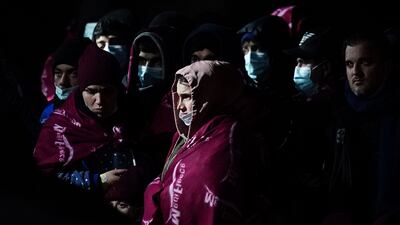
About 1,000 people reached the UK in a single day on November 11 after risking their lives in small boats in the English Channel, a new record for the current crisis. All photos: PA -
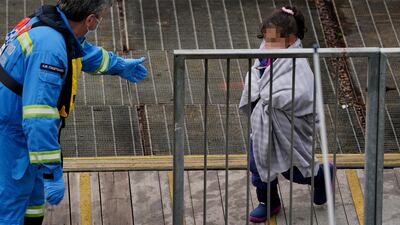
That total will surpass the previous single-day record for the current crisis of 853 when figures are confirmed officially. -
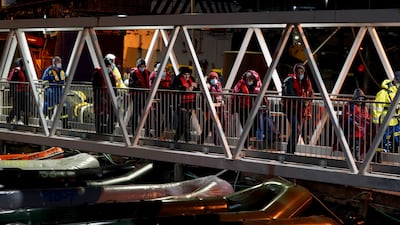
Lifeboat crews and Border Force boats were busy well into the evening after spending hours intercepting boats in the Dover Straight throughout the day. -
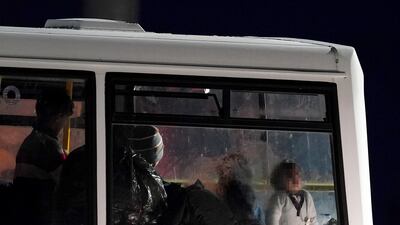
A group of people thought to be migrants wait to be transported onboard a bus after being brought into Dover. -
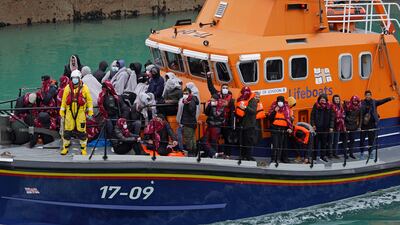
More than 1,200 people had reached the UK in the previous seven days after undertaking the perilous journey from France on small boats. -
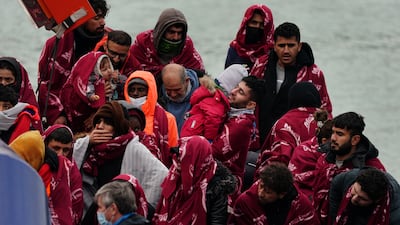
Children wrapped in jackets and blankets against the autumn chill, some carried in the arms of adults, were among those being brought ashore. -
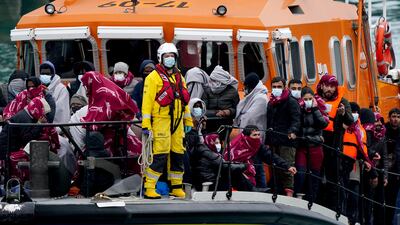
More than 22,300 people have so far succeeded in reaching the UK aboard small boats this year. -
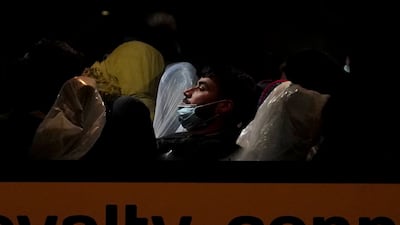
A man sleeps on a bus after arriving in Dover.


Earlier in the day, Nicolas Margolle, a French fisherman, said he had seen two small dinghies; one with people on board and another empty.
It is unclear if the empty boat was the stricken craft.
With at least eight dinghies making the crossing successfully on Wednesday, it is unclear if Mr Margolle was witnessing the disaster unfold and had not realised it.
He said that another fisherman had later called rescue services after seeing 15 people floating motionless near by, either unconscious or dead.
Three helicopters and three boats were sent in the initial search, local authorities said.
That included a British helicopter from the Maritime Rescue Co-ordination Centre in Dover, along with a French naval helicopter and patrol vessel, a police boat and a lifeboat.
It appears two bodies were pulled out of the water, still conscious but badly suffering from hypothermia.
Should they pull through, they will be crucial in helping to piece together what happened in the Channel on that fateful Wednesday afternoon.

