

The UAE’s prominent role in climate change initiatives at the Cop26 summit shows the country is ready to "ride the crest of a wave" of global progress, said Mariam Al Mheiri, Minister of Climate Change and Environment.
Ms Al Mheiri, who has been in Glasgow this week for the launch of the UAE and US joint initiative AIM for Climate to drive rapid and transformative climate action in the agriculture sector, said the nation began its energy transition 15 years ago.
"We like to ride on the crest of the wave, not under it, in many things that we do. I think it's also part of our DNA,” Ms Al Mheiri told The National in Glasgow.
The UAE has been a leader in the drive to net zero for some time, she said.
“When you look at all the discussions that are happening here, everyone's talking about the energy transition. Actually, the energy transition started 15 years ago, our leadership saw the writing on the wall and said we must invest in diversifying our energy mix, even though we are a hydrocarbon producer and exporter. But it's really important that we invest in this and we become experts in it,” she said.
The Agriculture Innovation Mission for Climate unveiled at Cop26 this week has so far mobilised $4 billion of investment, including $1bn from the UAE, to enhance the agriculture sector’s resilience to climate change.
Ms Al Mheiri said the mission plans on "going big”, matching US President Joe Biden’s pledge to double the investment to $8bn “in the next few years”.

The joint initiative is the first global agriculture and climate change coalition and so far has 33 countries on board from six continents, as well as prominent non-governmental backers, such as the Bill and Melinda Gates Foundation.
“We see that food systems are a solution provider for the whole climate mitigation efforts. Innovation and research and development is really key in driving how you can grow foods,” Ms Al Mheiri said.
"The last few months, it's been about mobilising the political will, mobilising investments and putting together a coalition so that we can accelerate our efforts in the next five years to be able to push the boundaries and transition our food systems."
She highlighted the UAE, a country with a hot, arid climate that does not have arable land and where water is scarce, as an example of the challenge.
“But we've got the sunshine, we've got the sea and we've got the sand, so how can we now look at innovation and technology to actually grow food?” she said.
With the UAE importing 90 per cent of its food, she said food security was a top priority for the country.

“The leadership recognised from an early stage that in order for us to be more resilient, we really need to invest more money and effort into building more sustainable food systems. So in 2018, we launched the National Food Security Strategy, we set up the governance model in the UAE and this is all towards a national transition.”
Look at the UAE today, Ms Al Mheiri said, and it is home to a number of ag-tech companies growing blueberries, raspberries, quinoa, salmon and even tomatoes, “food that no one ever thought would be possible to be grown in the desert”.
“It's all down to innovation, research and development that this is now possible and commercially viable. Now, we want to do the same thing globally, helping everyone because it's really our duty as responsible global citizens to share the knowledge to help each other to transition to a more resilient and sustainable world."
The UAE was the first GCC country to sign and ratify the Paris Agreement and the first country in the Mena region to commit to an economywide reduction in emissions.
Unveiled last month, the UAE's strategy to reduce carbon emissions by 2050 will see Dh600bn ($163.35bn) invested in clean and renewable energy sources in the next three decades.
These commitments highlight how the UAE is driving the global net-zero agenda, the minister said.
““We've invested so much in renewable energies that today we're actually operating the three largest in capacity, and lowest in cost, solar power plants in the world,” she said.
“In the region we were the first one that has an industrial scale, carbon capture, utilisation and storage network currently at the capacity of 800,000 tonnes per annum and expanding.”
-
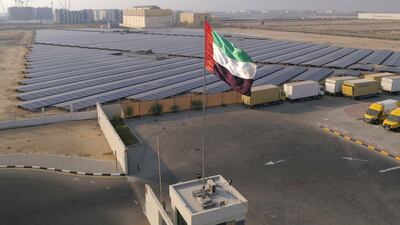
The UAE’s largest ground-mounted private solar plant at Nestle Middle East’s Al Maha factory in Dubai. The UAE intends to derive 44% of its power requirements from clean energy by 2050. -
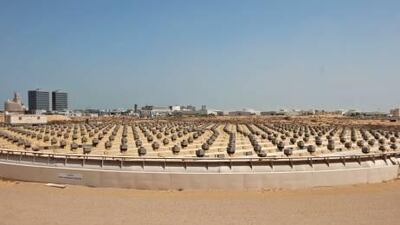
This prototype 100-metre diameter solar island, which can rotate to catch the sun's rays, has been created in a joint partnership between the UAE Centre Suisse d'Electronique et de Microtechnique and the government of Ras al Khaimah. -
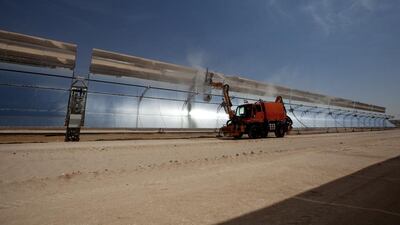
The Shams 1 solar project generates enough electricity to power 20,000 homes in the UAE. -

The Shams 1 project occupies 2.5 square kilometres and has a capacity of 100 megawatts. -
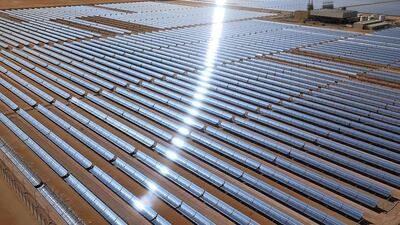
Shams 1 concentrated solar plant in the Abu Dhabi Western region. The UAE accounts for more than half of the GCC’s and Levant’s solar power capacity. -

The President, Sheikh Khalifa, with the leaders of the UAE behind him at the opening of the Shams 1 plant in 2013. -
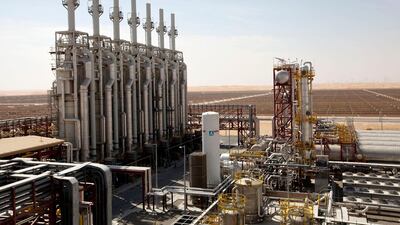
The UAE's first solar plant, Shams 1 was the largest renewable energy project in operation in the Middle East when it launched in 2013


The UAE becoming the first country in the region to have a zero carbon emission nuclear power plant and the country becoming the permanent host country for the International Renewable Energy Agency are other examples of its commitment to a green future.
“So it was a natural step for us to then also launch the Net Zero by 2050 initiative. And, yes, we're now taking the knowledge that we have on solar power and solar innovation to the world. The UAE has so far spent $17bn already in over 70 countries with another $163bn to be spent in the next three decades as well," Ms Al Mheiri said.
She also welcomed the UAE's bid to host Cop28 in November 2023.
“We want to be global, responsible citizens and that's why we're here with such a strong delegation. And we're so excited and we hope that we win Cop28 and invite the world then to come to the UAE to see to see the actions that we're taking and to help other countries accelerate their efforts as well.”
Earlier on Friday, Ms Almheiri attended a panel discussion with Tom Vilsack, US Secretary of Agriculture, on the Aim for Climate initiative.
“Climate change is happening and it threatens to disrupt our food systems, worsen food insecurity and negatively impact the livelihoods of our agricultural producers," Mr Vilsack said.
“Now is the time for global action to address climate change. Together, we can lead the way with investments in climate-smart solutions that improve the profitability and resilience of agricultural producers and improve forest health, while creating new income opportunities and building wealth that stays in rural communities.”
A further $193 million in increased investment was secured by the AIM for Climate initiative at Cop26 on Friday thanks to eight "innovation sprints", partnerships aimed at increasing agricultural productivity, while adapting and building resilience to climate change and helping to reduce or remove greenhouse gas emissions in the sector.
Among the eight is the US Regenerative Cotton Fund, which will work with American cotton growers to introduce regenerative, healthy soil practices across more than one million acres of cropland over the next five years.
The fund, supported by a $5m investment from Ralph Lauren Corporate Foundation, aims to eliminate one million tonnes of carbon-dioxide equivalent from the atmosphere by 2026.

