


The killing of British politician David Amess is fuelling concern about the effectiveness of the UK government’s Prevent counter-terrorism initiative.
Critics have said change is urgently needed to ensure it works.
Questions surfaced soon after Amess was stabbed to death on Friday afternoon amid reports in the British media that the man arrested had been referred to the Prevent programme several years ago but was not currently on the security service’s counter-terrorism watch list.
A man is being held under the Terrorism Act on suspicion of murder. Police say he may have had a “motivation linked to Islamist extremism”.
Under Prevent, Britons are asked to report anyone they suspect may be on the road to becoming radicalised – so the person can get help.
The hope is that early intervention will help to thwart terrorist attacks. Teachers, prison officers and local government agencies are legally required to make such referrals, but anyone is able to.
But the programme, conceived in the years after the September 11, 2001, attacks in the US, has been repeatedly criticised since it was expanded after the deadly bombings of London’s transport network in 2005.
Its detractors say it is not as effective as it could be and that it unfairly targets Muslims.
An independent review of Prevent was launched in 2018, but it has yet to release any conclusions.
Programmes elsewhere have also been criticised. France has repeatedly launched de-radicalisation efforts – only to have their effectiveness questioned time and again. A perfect formula has proved elusive.
The success of such programmes is difficult to measure, because their failures are public but their wins are almost impossible to tally.
But experts says it is clear that Prevent could do better, including by working more closely with communities to build their trust and encourage people to seek out its services.
“I think Prevent does work in many cases and I think it’s an unfair expectation to have to believe it works 100 per per cent of the time,” said Peter Neumann, professor of security studies at King’s College London.
“No government programme ever works 100 per cent of the time, so one case of failure doesn’t necessarily mean the whole programme is rubbish.
"But it is equally wrong to just say everything is fine and let’s just carry on. There are problems with Prevent. It needs to be reviewed, and it should be reinvented.”

As it stands, Prevent was conceived essentially as a police programme, Prof Neumann said. Those links to the police make it difficult for family members to refer people, even if they have concerns about radicalisation.
By contrast, some other European countries have relied on community-led independent initiatives, Prof Neumann said.
In Belgium, deradicalisation programmes are much more regional and local than national. This is partially because the country’s government is decentralised but focusing on the local level is also thought to help the programmes counter the phenomenon as quickly as possible.
Spain’s recently instituted programme puts an emphasis on co-operation with associations that work with what authorities consider to be groups at risk of radicalisation.
“In other European countries because [the local equivalent of] Prevent is not led by the police, it’s led by local community figures; it has more of an appeal of seeking help and trying to do something about someone who is in trouble,” Prof Neumann said.
In Britain, by contrast, the strong association of Prevent with the police may deter family members – the people closest to those at risk – from reporting them.
“If they feel that by contacting Prevent they are basically getting them locked up, a lot of parents will be very reluctant,” Prof Neumann said.

Robert Buckland, a former justice secretary, said the programme should be about more than policing.
He said it should encourage far more co-operation among the police, community groups, schools and the health service to make it easier to share information and intervene effectively.
“We’ve got to make sure that every arm of the state is absolutely working together in order to understand as much as possible about these individuals,” Mr Buckland, who left Prime Minister Boris Johnson’s Cabinet last month, told Times Radio.
When reports are made to Prevent, they are initially screened by police. Those assessed to be at risk of radicalisation are referred to a local panel for review.
If a panel decides further assistance is needed, it is supposed to develop an aid package that may include education and employment support, as well as mentoring.
In the 12 months to March 2020, 6,297 people were referred to Prevent.
This was a 10 per cent increase on the previous year, according to the latest government statistics. Fewer than a quarter of these were referred to a local panel, with 697 being offered further support.
One continuing criticism of Prevent is that it amounts to spying on Muslim communities. Part of the programme’s problem is its history.
It began soon after 9/11, when policymakers were focused on terrorism carried out by extremists.
Critics say Prevent is too centred on Islamist extremists at a time when the risk posed by right-wing extremists is growing.
Amnesty International has long criticised the programme.
Of the 697 people who were offered support packages by local Prevent panels, 43 per cent were referred because of fears about far-right radicalisation and 30 per cent were linked to religious extremism, the Home Office said.
-

Julia Amess, the widow of Conservative MP SIr David Amess, was comforted by relatives at Belfairs Methodist Church, where he died, on Monday morning. She stayed for about 15 minutes. PA -

Julia Amess (second left), the widow of Conservative MP Sir David Amess, arrives at Belfairs Methodist Church to read tributes left to her late husband. PA -

The Rev Clifford Newman of Belfairs Methodist Church hugs Sir David Amess's widow. AP -

A daughter of SIr David Amess is comforted as she views flowers and tributes left for her late father. AP -
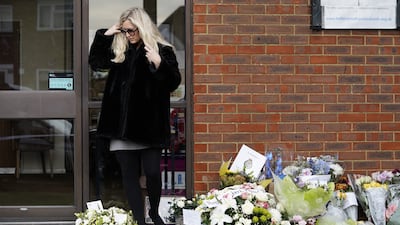
One of Sir David Amess's daughters views flowers and tributes left for her late father at Belfairs Methodist Church. AP -
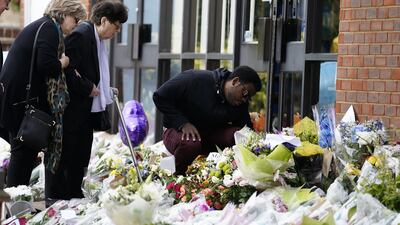
Julia Amess, left, the widow of Sir David Amess, stands with friends and family members to view flowers and tributes left for her late husband. PA -

The mayor of Southend, Councillor Margaret Borton, and mace bearer Adam Tregoning visit Belfairs Methodist Church to pay their respects. Getty Images -

Police officers stand outside Belfairs Methodist Church in Leigh-on-Sea, England. Getty Images -

Tributes outside Belfairs Methodist Church. Getty Images -
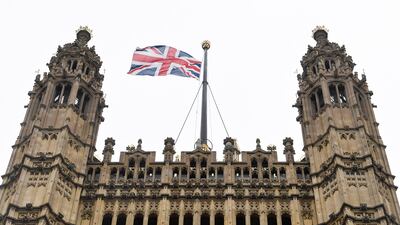
A Union Jack flies at half mast after the killing of British MP David Amess. Reuters -

A book of condolence inside the Southend West Conservative Association's Iveagh Hall. Getty Images -
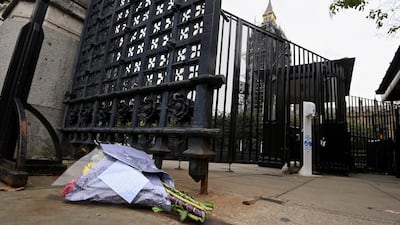
Flowers with a note for Sir David Amess lie outside Parliament buildings in London. Reuters -

A new piece of graffiti artwork depicting the late Sir David Amess appears on a wall in Leigh-on-Sea, England. Getty Images -
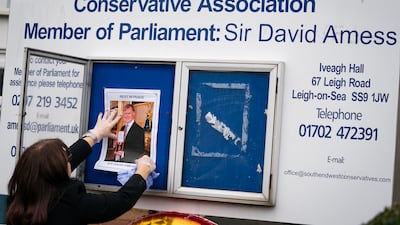
A photograph of Sir David Amess is placed on a noticeboard outside the Iveagh Hall, the home of the Southend West Conservative Association in Leigh-on-Sea. AP -

A Police officer arranges flowers and tributes outside Belfairs Methodist Church in Eastwood Road North. PA -
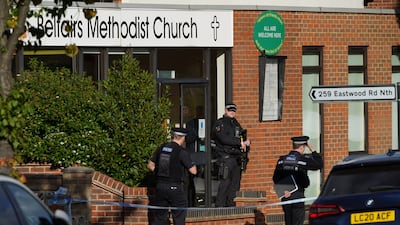
Armed police officers at the scene near the Belfairs Methodist Church, where Conservative MP Sir David Amess died after he was stabbed several times at a constituency surgery. PA -
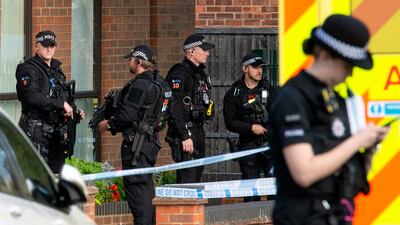
A man was reported to have run into the building and targeted the veteran politician. Police said a suspect had been arrested. AP -
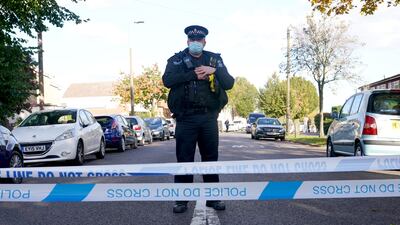
A police officer guards the scene. PA -
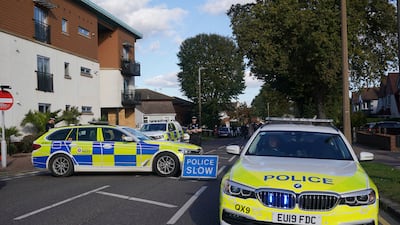
An air ambulance arrived at the scene, before his death was later confirmed by Essex Police. AP -

A police cordon was erected around the crime scene and armed officers were seen standing outside the church. AP


The government promised to conduct an independent review of Prevent in February 2019, but it was delayed when the first person named to lead the inquiry was forced to step down because of concerns about his objectivity. Work resumed after a new leader was appointed in January.
The review is designed to determine whether Prevent is working and what else can be done to protect people from the influence of extremists. No date has been set for when its findings will be published.
“There are problems with Prevent,” Prof Neumann said. “So I think this would be a … tragic opportunity to basically rebrand and reinvent Prevent.”

