


The trial of 20 men accused of plotting and perpetrating the 2015 Paris terror attacks, which left 130 people dead and hundreds injured, got under way on Wednesday.
In one of the biggest court cases in the French history, the long-awaited trial commenced at the Palais de Justice courthouse in Paris under tight security.
ISIS gunmen wearing suicide vests attacked six bars and restaurants, the Bataclan concert hall and sports stadium on November 13, 2015.

The only surviving member of the armed cell, Salah Abdeslam, 31, is being tried along with 19 other detained, absent and deceased defendants.
Fourteen of those accused were taken one by one into a glass-enclosed box at one side of the courtroom, surrounded by armed officers.
When Abdeslam was asked to identify himself and state his profession he told the court he was “a fighter" for ISIS.
The presiding judge, Jean-Louis Peries, acknowledged the extraordinary circumstances of the events of that night.
“The events that we are about to decide are inscribed in their historic intensity as among the international and national events of this century,” he told the court.
It is alleged Abdeslam drove the first three suicide bombers to the Stade de France stadium where France were playing Germany.
They triggered their explosive belts outside killing a Portuguese man.
-

A person is being evacuated after a shooting, outside the Bataclan theater in Paris. A series of attacks targeting young concert-goers, soccer fans and Parisians enjoying a Friday night out at popular nightspots killed over 100 people in the deadliest violence to strike France since the Second World War. Thibault Camus/ AP Photo -

Spectators spill onto the pitch of the Stade de France stadium after three suicide bombers blew themselves up outside the stadium where France were playing Germany in an international football match. Michel Euler/AP Photo -

Spectators running onto the pitch of the Stade de France stadium amid the chaos and aftermath of suicide bombings outside the venue. Christophe Ena/AP Photo -

A victim under a blanket lays dead outside the Bataclan theatre in Paris on Nov 13, 2015, as more than 120 people were killed in a series of shooting and explosions across the French capital. Jerome Delay/AP Photo -
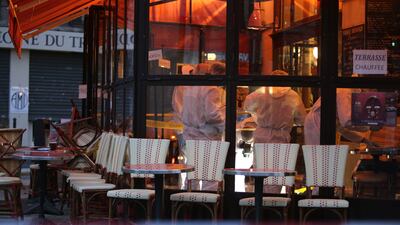
Forensic police searching for evidence inside the Comptoir Voltaire cafe at the site of an attack on November 14, 2015 in Paris, the morning after a series of gun attacks occurred across the city. Kenzo Tribouillard/AFP Photo -
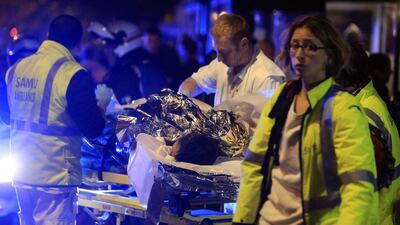
Emergency workers tending to the injured outside the Bataclan theatre. Thibault Camus/AP Photo -
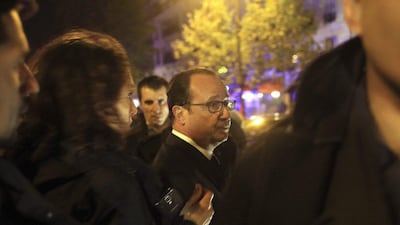
French president Francois Hollande, who declared a state of emergency and announced that he was closing the country's borders, arrives to visit the site of the the Bataclan theatre after the maasacre. Thibault Camus/AP Photo -

Investigators search for clues outside the Stade de France stadium after an explosion and after a friendly soccer match between France and Germany, in Saint Denis, outside Paris, early Saturday Nov 14, 2015. Michel Spingler/ AP Photo -
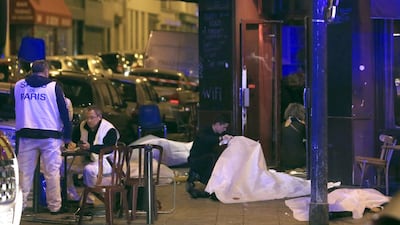
Victims lay on the pavement outside a Paris restaurant. Thibault Camus/AP Photo -
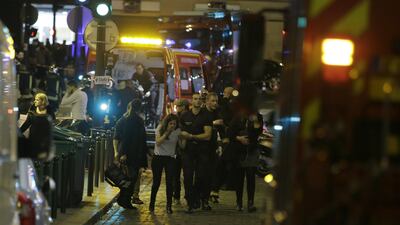
French security moving people in the area of Rue Bichat in the 10th arrondissement of the French capital Paris following a string of attacks on November 13, 2015. At least 18 people were killed as multiple shootings and explosions hit Paris, police said. Police also said there was an ongoing hostage crisis in the Bataclan a concert hall in the French capital.Kenzo Tribouillard/AFP Photo -
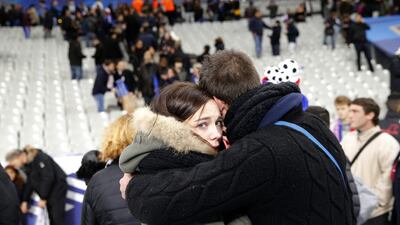
A man comforts a woman after spectators poured onto the pitch of the Stade de France stadium after multiple explosions outside. Christophe Ena/AP Photo


A group of gunmen, including Abdeslam’s brother Brahim, then opened fire indiscriminately on people gathered at restaurants in the capital.
The massacre ended with an attack at the Bataclan venue where US band Eagles of Death Metal were performing to a packed house.
All 10 attackers detonated their suicide vests or were killed by police except for Abdeslam, who dropped his own belt, which was found to be defective, and went on the run for four months.
He was arrested in Belgium after a shoot-out with police.
French-Moroccan Abdeslam and a Tunisian accomplice have since been sentenced to jail for 20 years for shooting and wounding four officers during the incident.

Days after their arrests, members of the same cell launched attacks in Brussels that killed 32 people.
France's Interior Minister Gerald Darmanin on Wednesday gave a warning that the threat of terrorism remains.
"The terrorist threat in France is high, especially at times like the attacks' trial," he told France Inter radio.
"I called on all the prefects to be vigilant."
More than 1,000 police will be devoted to ensuring the security during the trial, he said.

