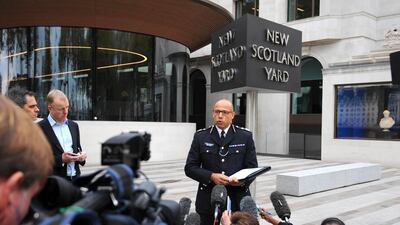
The head of the UK's counter-terrorism police warned online extremism "cannot be policed" as Covid-19 is providing the "perfect storm" for terrorists.
Metropolitan Police assistant commissioner Neil Basu said action needs to be taken to prevent police being overwhelmed.
In its latest report, the UN’s counter-terrorism committee said nations needed to be aware that terrorist groups are exploiting the coronavirus pandemic and using online games in a bid to target children in lockdown.
The UN's Counter-Terrorism Committee Executive Directorate (CTED) revealed it had seen an increase in the online radicalisation of children and urged countries to be alert.
Mr Basu said extremism has become too widespread online and that the combination of lockdown, isolation, mental illness and increasing time spent online created a “perfect storm”.
"When you look at the volume of material which is horrific and shouldn't be allowed online, it is really distressing for a lot of people, the volume is so high it cannot be policed," he told The Independent newspaper. "It would have to be prevented and that is the most important thing."
The new Online Harms Bill, which proposes internet regulation that would force companies to remove material or face fines, is currently being considered by the UK parliament.
Mr Basu said this bill is “fundamental” to combating the issue.
“The thing that has always been my biggest concern is the growth of online radicalisation,” he said. “It has allowed conspiracy theories and existing Islamist and extreme right-wing terrorism, and all kinds of other single-issue terrorism, to thrive 24/7 internationally at the speed it takes to press a button.”
He said the "cure" to tackling terrorism is to stop radicalisation.
“The way to stop the very high threat is to stop people becoming terrorists in the first place," he said.
“Too much emphasis is on people coming out of prison, people returning from abroad and whether we can deradicalise them.
“That isn’t the cure for this. The cure for this is getting them before radicalisers really get to grips with them, and steering them to a different path.”
The country’s independent counter-extremism adviser, Sara Khan, said the government has still not responded to a report she published in October 2019 which criticised the current response to extremism as “inadequate” and “unfocused”, and demanded an overhaul of the system.
Ms Khan said the current strategy was “weak, disjointed and behind the curve” and that the system had to fundamentally change if the country was “going to deal with this huge growing problem of extremism”.
Appointed in 2018, Ms Khan’s work has focused on behaviour she has described as ‘hateful extremism’ that falls short of being prosecuted for terrorism but creates divisions in society and attempts to provide a moral justification for violence.
Police fear that such attitudes will develop into promoting terrorist acts.
Ms Khan launched a legal review in 2020 over concerns that there were gaps in the law that allowed extremists to push their agenda without punishment.
The Home Office has said it is still considering the Commission for Countering Extremism’s recommendations and will respond in due course.

MATCH INFO
Manchester United 1 (Rashford 36')
Liverpool 1 (Lallana 84')
Man of the match: Marcus Rashford (Manchester United)
Quick pearls of wisdom
Focus on gratitude: And do so deeply, he says. “Think of one to three things a day that you’re grateful for. It needs to be specific, too, don’t just say ‘air.’ Really think about it. If you’re grateful for, say, what your parents have done for you, that will motivate you to do more for the world.”
Know how to fight: Shetty married his wife, Radhi, three years ago (he met her in a meditation class before he went off and became a monk). He says they’ve had to learn to respect each other’s “fighting styles” – he’s a talk it-out-immediately person, while she needs space to think. “When you’re having an argument, remember, it’s not you against each other. It’s both of you against the problem. When you win, they lose. If you’re on a team you have to win together.”
Scoreline:
Cardiff City 0
Liverpool 2
Wijnaldum 57', Milner 81' (pen)
Ten tax points to be aware of in 2026
1. Domestic VAT refund amendments: request your refund within five years
If a business does not apply for the refund on time, they lose their credit.
2. E-invoicing in the UAE
Businesses should continue preparing for the implementation of e-invoicing in the UAE, with 2026 a preparation and transition period ahead of phased mandatory adoption.
3. More tax audits
Tax authorities are increasingly using data already available across multiple filings to identify audit risks.
4. More beneficial VAT and excise tax penalty regime
Tax disputes are expected to become more frequent and more structured, with clearer administrative objection and appeal processes. The UAE has adopted a new penalty regime for VAT and excise disputes, which now mirrors the penalty regime for corporate tax.
5. Greater emphasis on statutory audit
There is a greater need for the accuracy of financial statements. The International Financial Reporting Standards standards need to be strictly adhered to and, as a result, the quality of the audits will need to increase.
6. Further transfer pricing enforcement
Transfer pricing enforcement, which refers to the practice of establishing prices for internal transactions between related entities, is expected to broaden in scope. The UAE will shortly open the possibility to negotiate advance pricing agreements, or essentially rulings for transfer pricing purposes.
7. Limited time periods for audits
Recent amendments also introduce a default five-year limitation period for tax audits and assessments, subject to specific statutory exceptions. While the standard audit and assessment period is five years, this may be extended to up to 15 years in cases involving fraud or tax evasion.
8. Pillar 2 implementation
Many multinational groups will begin to feel the practical effect of the Domestic Minimum Top-Up Tax (DMTT), the UAE's implementation of the OECD’s global minimum tax under Pillar 2. While the rules apply for financial years starting on or after January 1, 2025, it is 2026 that marks the transition to an operational phase.
9. Reduced compliance obligations for imported goods and services
Businesses that apply the reverse-charge mechanism for VAT purposes in the UAE may benefit from reduced compliance obligations.
10. Substance and CbC reporting focus
Tax authorities are expected to continue strengthening the enforcement of economic substance and Country-by-Country (CbC) reporting frameworks. In the UAE, these regimes are increasingly being used as risk-assessment tools, providing tax authorities with a comprehensive view of multinational groups’ global footprints and enabling them to assess whether profits are aligned with real economic activity.
Contributed by Thomas Vanhee and Hend Rashwan, Aurifer
