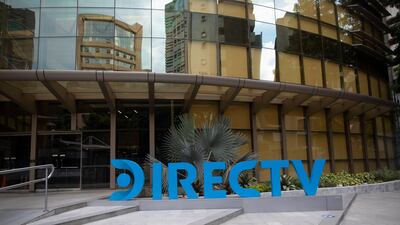
Venezuela's high court ordered the immediate seizure of all DirecTV property on Friday, days after the US company abandoned its services in the South American nation, citing US sanctions.
The Supreme Court ruling told the nation's telecommunications agency to seize satellite dishes and office space at transmission centers. It also said DirecTV programming should immediately return to the airwaves, in an order that was not likely to be heeded.
Dallas-based AT&T on Tuesday cut off pay TV services in Venezuela, saying U.S. sanctions prohibit its DirecTV platform from broadcasting channels that it is required to carry by the administration of President Nicolas Maduro.
However, pro-Maduro politician Maria Alejandra Diaz said the company is legally bound to uphold its programming.
"DirecTV unilaterally and illegally suspended the right to freedom of expression and communication for almost 10 million Venezuelans," Mr Diaz said outside the court. "It is not true to say that DirecTV could not comply with internal regulations."
The abrupt move cutting off entertainment, news and sports channels, sparked widespread protests at least two nights in a row, with residents leaning from their windows across the capital of Caracas banging pots and pans.
"I want my DirecTV," some shouted amid chants against Mr Maduro.
Venezuelans have been ordered to stay home on quarantine since mid-March to stop the spread of the new coronavirus, which officials say has killed at least 10 people and sickened hundreds.
US Secretary of State Mike Pompeo took a poke at Mr Maduro over the issue on Friday, saying on Twitter: "Why can't Venezuelans watch Futbol Total? Because Nicolas Maduro drove DirecTV out. Protecting his cronies and their money is more important than allowing ten million citizens access to uncensored information."
DirecTV on Friday did not immediately respond to a request for comment from The Associated Press. It explained its decision to cut services in a statement on Tuesday.
"Because it is impossible for AT&T's DIRECTV unit to comply with the legal requirements of both countries, AT&T was forced to close its pay TV operations in Venezuela, a decision that was made by the company's US leadership team without any involvement or prior knowledge of the DIRECTV Venezuela team," the statement said.
AT&T has a 44 per cent share of the pay TV market and its departure is likely to hit larger cities and the interior that depend on DirecTV for access to information and entertainment.
AT&T joins a number of other US companies — General Motors, Kellogg and Kimberly-Clark — that have abandoned Venezuela due to shrinking sales, government threats and the risk of US sanctions. Around 700 Venezuelans depended on the unit for employment.
AT&T hasn't made money from its Venezuelan operations for years due to strict government controls that keep the price of its packages artificially low — a few pennies per month. The situation has become so dire that DirecTV in 2012 stopped importing set-top boxes, choking its growth. In 2015, it wrote down its assets in the country by $1.1 billion.

Tamkeen's offering
- Option 1: 70% in year 1, 50% in year 2, 30% in year 3
- Option 2: 50% across three years
- Option 3: 30% across five years
Analysis
Members of Syria's Alawite minority community face threat in their heartland after one of the deadliest days in country’s recent history. Read more
COMPANY%20PROFILE
%3Cp%3E%3Cstrong%3EName%3A%20%3C%2Fstrong%3EQureos%0D%3Cbr%3E%3Cstrong%3EBased%3A%20%3C%2Fstrong%3EUAE%0D%3Cbr%3E%3Cstrong%3ELaunch%20year%3A%20%3C%2Fstrong%3E2021%0D%3Cbr%3E%3Cstrong%3ENumber%20of%20employees%3A%20%3C%2Fstrong%3E33%0D%3Cbr%3E%3Cstrong%3ESector%3A%20%3C%2Fstrong%3ESoftware%20and%20technology%0D%3Cbr%3E%3Cstrong%3EFunding%3A%20%3C%2Fstrong%3E%243%20million%0D%3Cbr%3E%3C%2Fp%3E%0A
How to help
Send “thenational” to the following numbers or call the hotline on: 0502955999
2289 – Dh10
2252 – Dh 50
6025 – Dh20
6027 – Dh 100
6026 – Dh 200
Ten tax points to be aware of in 2026
1. Domestic VAT refund amendments: request your refund within five years
If a business does not apply for the refund on time, they lose their credit.
2. E-invoicing in the UAE
Businesses should continue preparing for the implementation of e-invoicing in the UAE, with 2026 a preparation and transition period ahead of phased mandatory adoption.
3. More tax audits
Tax authorities are increasingly using data already available across multiple filings to identify audit risks.
4. More beneficial VAT and excise tax penalty regime
Tax disputes are expected to become more frequent and more structured, with clearer administrative objection and appeal processes. The UAE has adopted a new penalty regime for VAT and excise disputes, which now mirrors the penalty regime for corporate tax.
5. Greater emphasis on statutory audit
There is a greater need for the accuracy of financial statements. The International Financial Reporting Standards standards need to be strictly adhered to and, as a result, the quality of the audits will need to increase.
6. Further transfer pricing enforcement
Transfer pricing enforcement, which refers to the practice of establishing prices for internal transactions between related entities, is expected to broaden in scope. The UAE will shortly open the possibility to negotiate advance pricing agreements, or essentially rulings for transfer pricing purposes.
7. Limited time periods for audits
Recent amendments also introduce a default five-year limitation period for tax audits and assessments, subject to specific statutory exceptions. While the standard audit and assessment period is five years, this may be extended to up to 15 years in cases involving fraud or tax evasion.
8. Pillar 2 implementation
Many multinational groups will begin to feel the practical effect of the Domestic Minimum Top-Up Tax (DMTT), the UAE's implementation of the OECD’s global minimum tax under Pillar 2. While the rules apply for financial years starting on or after January 1, 2025, it is 2026 that marks the transition to an operational phase.
9. Reduced compliance obligations for imported goods and services
Businesses that apply the reverse-charge mechanism for VAT purposes in the UAE may benefit from reduced compliance obligations.
10. Substance and CbC reporting focus
Tax authorities are expected to continue strengthening the enforcement of economic substance and Country-by-Country (CbC) reporting frameworks. In the UAE, these regimes are increasingly being used as risk-assessment tools, providing tax authorities with a comprehensive view of multinational groups’ global footprints and enabling them to assess whether profits are aligned with real economic activity.
Contributed by Thomas Vanhee and Hend Rashwan, Aurifer
The Prison Letters of Nelson Mandela
Edited by Sahm Venter
Published by Liveright
Voy!%20Voy!%20Voy!
%3Cp%3E%3Cstrong%3EDirector%3A%3C%2Fstrong%3E%20Omar%20Hilal%3Cbr%3E%3Cstrong%3EStars%3A%3C%2Fstrong%3E%20Muhammad%20Farrag%2C%20Bayoumi%20Fouad%2C%20Nelly%20Karim%3Cbr%3E%3Cstrong%3ERating%3A%3C%2Fstrong%3E%204%2F5%3C%2Fp%3E%0A
Background: Chemical Weapons
