
The US special representative for Iran said on Thursday the Islamic republic must “immediately” ensure inspectors have access to sites that show traces of nuclear material or activity.
The finding was made public in a report this week by the UN’s nuclear watchdog, which admonished Iran for denying access.
In one of two confidential reports, the International Atomic Energy Agency identified three locations where Iran possibly stored undeclared nuclear material or conducted activities without declaring them to international observers.
The other report showed Iran has nearly tripled its stockpile of enriched uranium since November, violating a deal with world powers.
The IAEA said its request for access to two of the sites was denied, although the nuclear-related activities are thought to date from the early 2000s.
The spokesman for Iran’s nuclear agency, Behrouz Kamalvandi, responded on Wednesday that requests for access must have a legal basis, according to Iran’s semi-official ISNA news agency.
But the US official, Brian Hook, said the access is required under the Nuclear Non-Proliferation treaty to which Iran is a signatory, meaning it must provide access “immediately”.
“Iran must be held to the same standards as every one of the other 190 parties” to the treaty, he told reporters.
-

Iranian President Hassan Rouhani, right, and the head of Atomic Energy Organization of Iran Ali Akbar Salehi inspect the nuclear technology on the occasion of Iran National Nuclear Technology Day in Tehran in 2019. EPA -
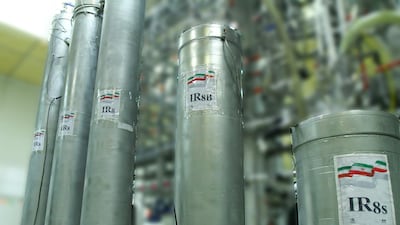
IR-8 centrifuges at Natanz nuclear power plant, some 300 kilometres south of capital Tehran. AFP -
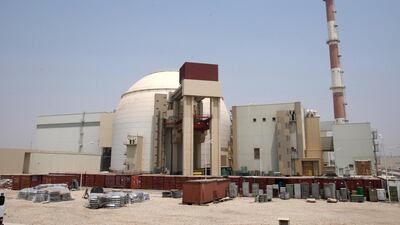
The Iranian nuclear power plant in Bushehr in 2010. EPA -

Salehi speaks with media while visiting Natanz enrichment facility, in central Iran in 2019. Atomic Energy Organization of Iran via AP -
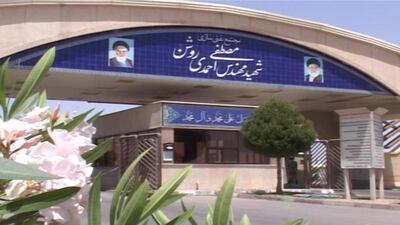
The gate of Natanz nuclear power plant in Natanz , Isfahan province, in 2019. EPA -
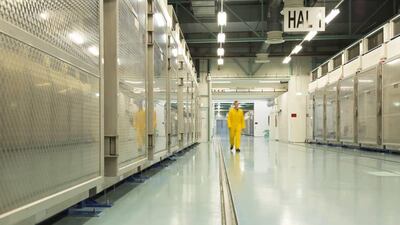
Inside of the Iran's Fordow nuclear facility, in Fordow, Qom province in 2019. EPA -
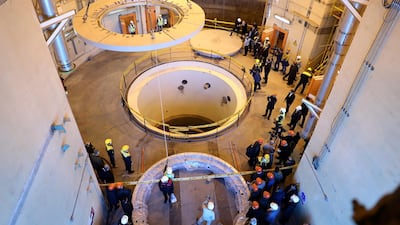
Technicians work at the Arak heavy water reactor's secondary circuit, as officials and media visit the site, near Arak, Iran in 2019. Atomic Energy Organization of Iran via AP -
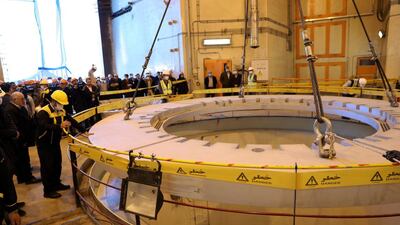
Members of the media and officials tour the water nuclear reactor at Arak in 2019. WANA via Reuters -
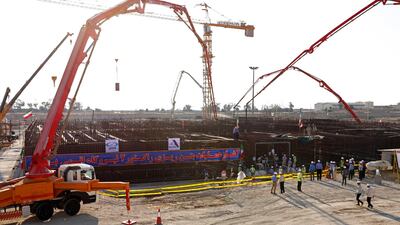
Concrete is poured for the base of the second nuclear power reactor at Bushehr plant in 2019. Atomic Energy Organization of Iran via AP


Mr Hook was in Paris to meet his French, German and British counterparts, signatories of the 2015 nuclear deal with Iran that the Trump administration pulled out of in 2018.
The US wants a more inclusive deal that addresses ballistic missiles and Iran’s regional ambitions in Syria and elsewhere. Instead, Washington has levied punishing economic sanctions on Iran as part of its “maximum pressure” strategy.
While noting the three European nations have “tactical disagreements” with the United States, he stressed their common concern that Iran not obtain nuclear arms.
China and Russia also are signatories to the deal - the Joint Comprehensive Plan of Action - which promised Iran economic incentives in return for curbs on its nuclear program.
Those incentives have failed to materialise, along with European efforts to create a mechanism allowing Iran to get around US sanctions that has yet to get off the ground.
Iran, in turn, has systematically violated the deal’s restrictions with measures it maintains are reversible in what it says is a “maximum resistance” campaign.
Mr Hook expressed particular concern about a step written into the nuclear deal — the lifting of a UN arms embargo and other sanctions in October. He claimed the deal is a first step on the path to allowing Iran to have nuclear weapons once restrictions on centrifuges are lifted in 11 years.
In what appears to be a bid to buy time to negotiate, the European signatories to the nuclear deal have invoked a dispute resolution mechanism. It ultimately could lead to reintroducing sanctions, known as “snapback,” but that is not said to be their goal.
Mr Hook appeared, for now at least, to put to rest any speculation that the US could try to step back into the deal, claiming participation despite the pullout, to trigger the snapback.
“We’re out of the deal,” he said when asked, “and so the countries that are in the deal will make decisions that are in their sovereign capacity”.

