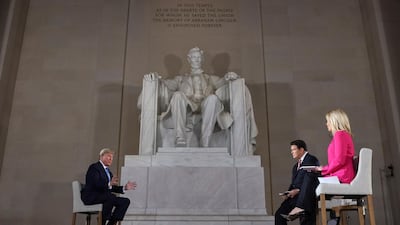
As many as 100,000 Americans could die in the coronavirus pandemic before a vaccine can be developed by the end of the year, US President Donald Trump said on Sunday as the country’s death toll passed earlier estimates.
During a two-hour virtual town hall broadcast by Fox News, Mr Trump alternated between forecasting a rapid recovery for the US economy and casting blame for the pandemic's spread on China, where the disease is believed to have originated.
Covid-19, the disease caused by coronavirus, has sickened more than 1.1 million people in the US and killed more than 68,000, with most schools and many businesses forced to close across the country.
"We're going to lose anywhere from 75, 80 to 100,000 people. That's a horrible thing," said Mr Trump.
As recently as last Friday he said he hoped fewer than 100,000 Americans would die during the outbreak, having earlier in the week talked about 60,000 to 70,000 deaths.
About half the states have moved towards at least partial lifting of shutdowns as the number of new Covid-19 cases has begun to drop or level off. Citizens have also agitated for relief from restrictions that have sent the US economy into a tailspin.
"We can't stay closed as a country or we're not going to have a country left," Mr Trump said.
Coronavirus across the world
-
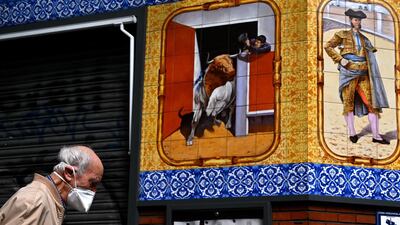
An elderly man,, wearing a face mask, walks past a closed restaurant in Madrid, during the hours allowed by the government to exercise, for the first time since the beginning of a national lockdown to prevent the spread of the Covid-19 disease. AFP -
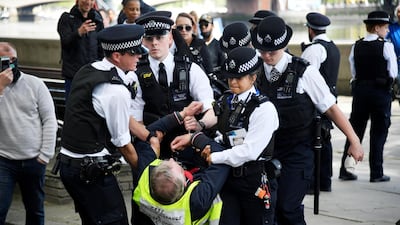
An anti lockdown protester is detained by police officers in London, following the outbreak of the coronavirus disease, London, Britain. Reuters -
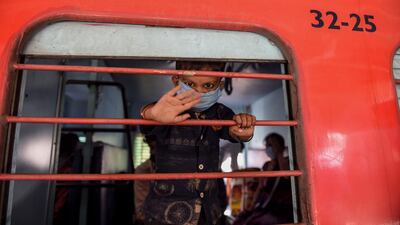
A young boy from a migrant workers' family waves from a railway compartment before the departure of a special train to Agra in Uttar Pradesh state during a government-imposed nationwide lockdown as a preventive measure against the coronavirus, at Sabarmati Railway Station on the outskirts of Ahmedabad. AFP -
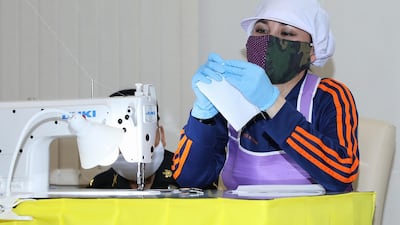
Thailand's Queen Suthida as she sews a face mask that will be donated to the public as a preventive measure against the spread of the coronavirus in Bangkok. AFP -
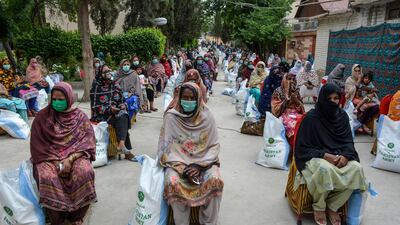
People sit maintaining social distancing as Frontier Corps (FC) personnel distribute food on a street during a government-imposed nationwide lockdown as a preventive measure against the coronavirus, in Quetta. AFP -
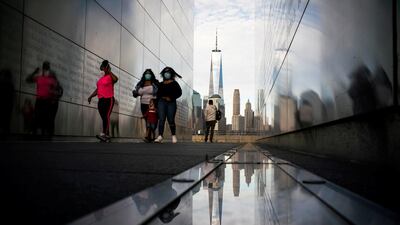
People visit the Empty Sky Memorial as the The One World Trade Center in New York is seen from Liberty State Park after many New Jersey Parks set to re-open during the outbreak of the coronavirus disease in Jersey City, New Jersey. Reuters -
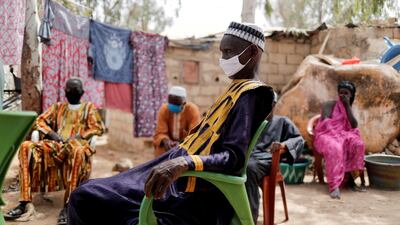
An Imam wearing a face mask wait for the start of the awareness campaign and distribution of sanitary products to people of extreme vulnerability by the REVOCAP association, amid the spread of the coronavirus disease, in Liberte 6 Baraka district of Dakar, Senegal. Reuters -
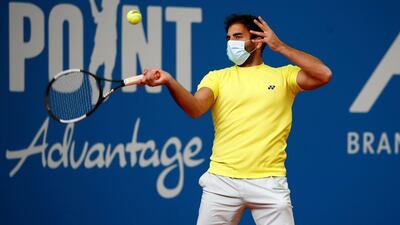
Benjamin Hassan, a German ATP player wears a face mask as he warms up for an exhibition tennis match played without spectators and broadcasted by remote controlled cameras, during the spread of the coronavirus disease in a tennis academy in Hoehr-Grenzhausen, near Koblenz, Germany. Reuters -
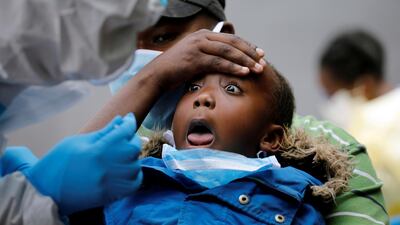
A young girl reacts as a Kenyan ministry of health medical worker takes a swab during mass tasting in an effort to fight against the spread of the coronavirus disease in the Kawangware neighbourhood of Nairobi, Kenya. Reuters -
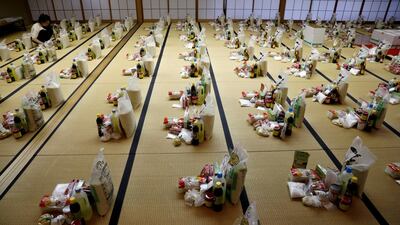
A Vietnamese volunteer prepares packages of food and protective masks for Vietnamese people in need and living in Japan, amid the coronavirus disease, at Nisshinkutsu temple in Tokyo, Japan. Reuters -
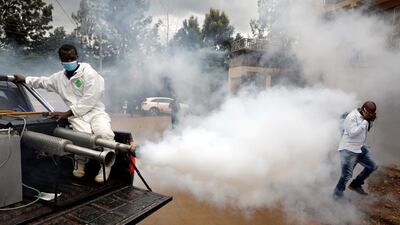
A man walks through smoke generated by Nairobi municipality worker in an effort to fight against the spread of the coronavirus disease in the Kawangware neighborhood of Nairobi, Kenya. Reuters -
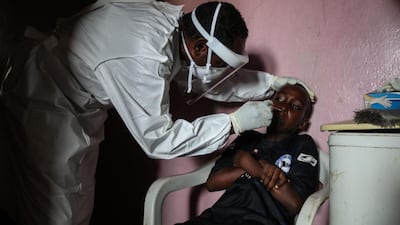
A staff member of the Ministry of Health takes samples from a boy during the first day of mass testing of the coronavirus in Djibouti. AFP


Mr Trump criticised Fox recently, casting the conservative-leaning network as insufficiently supportive. He faced few tough questions during Sunday's event, which gave him a new format to reach the public while he is unable to hold campaign rallies and after he faced widespread criticism for his combative daily briefings.
In an assessment that clashes with those offered by some public health experts, Mr Trump said he believed that by the end of the year there would be a Covid-19 vaccine.
"The doctors would say, 'well, you shouldn't say that'," Mr Trump said. "I'll say what I think ... I think we’ll have a vaccine sooner than later."
Many health experts, including Dr Anthony Fauci, the top infectious disease expert in the US, have said a vaccine was likely a year to 18 months away from being developed.
There is an "incredibly small" chance of having a highly effective vaccine or treatment for coronavirus within the next year, England's Chief Medical Officer Chris Whitty said on April 22.
Mr Trump said he wanted pupils and students to return to schools and colleges in autumn, even as he acknowledged the possibility of a resurgence of the disease.
"We'll put out the embers, we'll put out whatever it may be. We may have to put out a fire," he said.
Speaking the day before the US Senate returns to Washington, Mr Trump said it was possible that federal coronavirus aid could increase to $6 trillion (Dh22.035tn) from the nearly $3tn Congress has already passed to try to ease the heavy economic toll of the crisis.
"There is more help coming. There has to be," he said.
Democrats have made it clear they want to provide a sizeable rescue package for state and local governments as part of a broader bill – one that could total more than $2tn – but some Republicans criticised the idea as unreasonably expensive.
"We will be doing infrastructure and I told Steve [US Treasury Secretary Steven Mnuchin] just today we are not doing anything unless we get a payroll tax cut," Mr Trump said.
Mr Trump, who has been criticised for not moving faster early in the year to stop the spread of the virus, sought to blunt the criticism by blaming China.
He said China made a "horrible mistake" without saying precisely what this was or providing specific evidence for his assertion.
Earlier in the day, US Secretary of State Mike Pompeo said there was "a significant amount of evidence" that Covid-19 came from a Chinese laboratory, but did not dispute US intelligence agencies' conclusions that the disease was not man-made.

