US President Donald Trump angrily defended his administration's response to the coronavirus outbreak on Monday in a contentious news conference at the White House in which he claimed “total” authority.
In response to questions about the rights of states to react to the crisis, which has killed more than 23,000 Americans, the president said he had the ultimate authority to re-open the largely dormant economy.
"The president of the United States calls the shots. If we weren't here for the states, you'd have had a problem in this country like you've never seen before," Mr Trump said.
"When somebody is the president of the United States, the authority is total, and that's the way it's got to be. ... It's total. The governors know that."
Mr Trump’s comments came as 10 US governors on the east and west coasts banded together in two regional pacts to co-ordinate gradual economic re-openings.
Coronavirus around the world
-
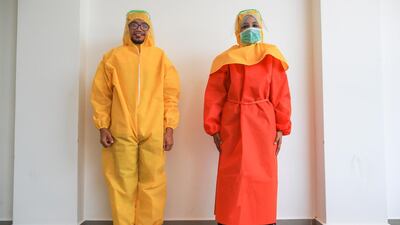
Volunteers pose in protective suits at the International Islamic University Malaysia in Gombak, outside Kuala Lumpur. EPA -
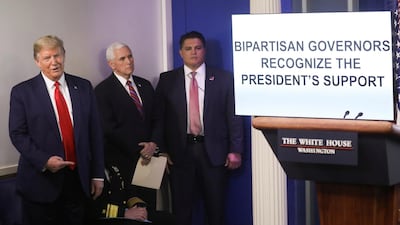
US President Donald Trump gestures towards a multimedia presentation created by the White House to defend the president's response to the coronavirus outbreak as he stands beside Vice President Mike Pence during the daily coronavirus task force briefing at the White House in Washington, US. Reuters -
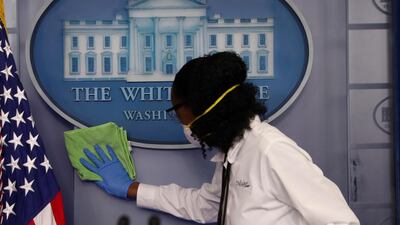
Workers clean the area around the podium before the daily coronavirus outbreak task force briefing at the White House, Washington, US. Reuters -

A 'thank you' message and blue floodlights in honor of health care workers and first responders are visible on the California Tower and Museum of Man in an empty Balboa Park, in San Diego. AP Photo -
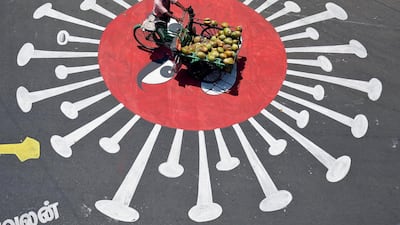
A man selling coconuts rides his trishaw across graffiti depicting the coronavirus in Chennai, India. Reuters -

A woman wears a blanket printed with the South African national flag as she queues at the Kwa Mai Mai market in the Johannesburg CBD during a food distribution. AFP -
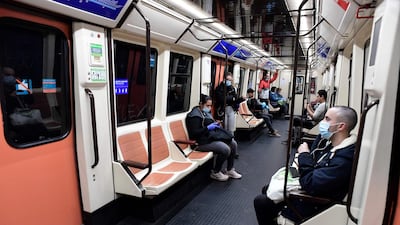
Commuters wearing face masks sit on a train at the Atocha Station in Madrid as some companies were set to resume operations at the end of a two-weeks halt of all non-essential activity. AFP -
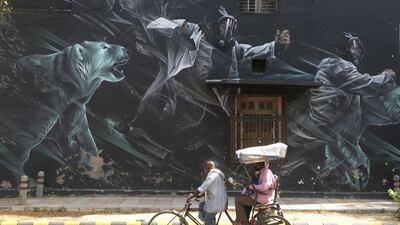
A rickshaw driver carries passengers wearing facemasks past a mural at Lodhi Art District during a government-imposed nationwide lockdown, in New Delhi, India. AFP -
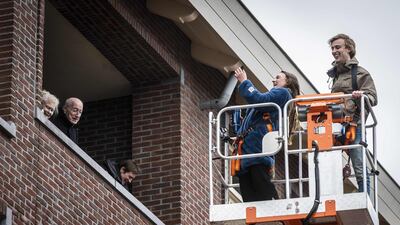
Dutch dj Luc Sarneel surprises the grandfather and grandmother of 23-year-old Djura during the extra edition of Serious Request in Drachten, the Netherlands. AFP -
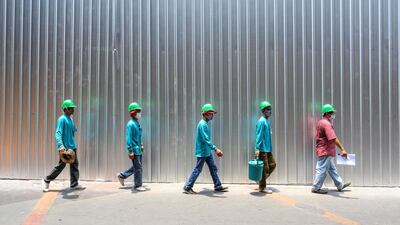
Construction workers wearing face masks and keeping safe distance walk on a street in Bangkok. AFP -
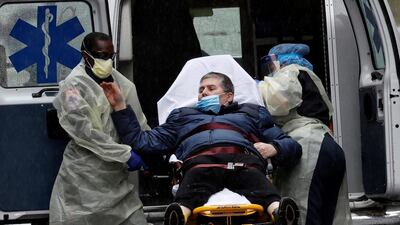
A patient is transported at the emergency entrance outside Mount Sinai Hospital in Manhattan, New York City, US. Reuters -
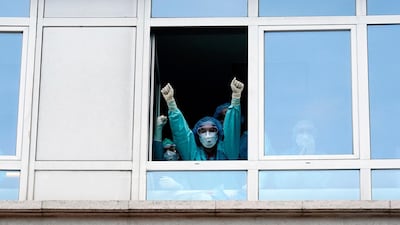
Medical staff from the Fundacion Jimenez Diaz Hospital gesture as neighbours applaud from their balconies in support of healthcare workers in Madrid, Spain. Reuters -
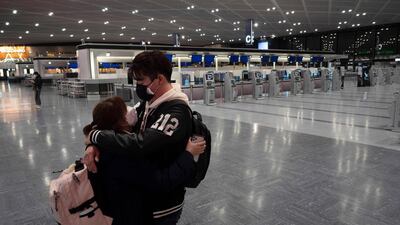
A couple hugs in the empty ticketing area at the Narita International Airport near Tokyo. AP Photo -
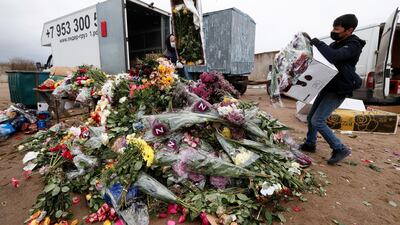
Russian florists dispose unsold flowers in St. Petersburg, Russia. EPA


The governors, all Democrats except for Charlie Baker of Massachusetts, gave no timeline for ending social lockdowns that have restricted the movements of the vast majority of more than 100 million residents in their states.
But they said that decisions about when and how to reopen non-essential businesses, along with schools and universities, would put the health of residents first and rely on science rather than politics.
The announcements came as signs emerged that the crisis had peaked. At least 1,500 new US fatalities were reported on Monday, below last week's running tally of roughly 2,000 deaths every 24 hours.
Likewise, the number of additional confirmed cases counted on Monday, about 23,000, was well below last week's trend of 30,000 to 50,000 new cases a day.
Mr Trump, who said a plan to open businesses again would be completed shortly, interrupted his daily briefing to play a campaign-style video that highlighted his actions to tackle the virus and included clips of Democratic and Republican governors praising his efforts.
Challenged by journalists on what action his administration took to halt the spread of the virus in February, which was not shown in the video, Mr Trump deflected, instead attacking CBS News and other news outlets’ “approval rating”.
Mr Trump was also at pains to show a positive relationship with the director of the National Institute of Allergy and Infectious Diseases Dr Anthony Fauci, after retweeting a call to fire him on Sunday.
Dr Fauci earlier said lives could have been saved if the country had shut down sooner.
At the briefing on Monday, Dr Fauci said he was answering a hypothetical question in the television interview and made it clear that Mr Trump had listened to him when he recommended mitigation efforts.
Mr Trump said he and Dr Fauci had been on the same page "from the beginning" and declared he liked the respected doctor.
"I think he's a wonderful guy," Mr Trump said, while adding that not everyone was happy with the health expert.

