
A SpaceX Crew Dragon capsule carrying four astronauts splashed down in the Gulf of Mexico in the early hours of Sunday morning, in Nasa’s first night-time ocean landing since the Apollo 8 Moon mission in 1968.
The crew reported feeling well after arriving back on Earth at the end of an almost six-month stay aboard the International Space Station, Nasa said.
Night vision imagery captured by one of Nasa’s experimental high-altitude research planes showed the capsule descending under its parachutes, landing safely off the coast of Panama City after a six-and-a-half-hour flight from the ISS.
“We welcome you back to planet Earth and thanks for flying SpaceX,” SpaceX’s Mission Control radioed moments after splashdown.
“For those of you enrolled in our frequent flyer programme, you’ve earned 68 million miles on this voyage.”
“We’ll take those miles,” said spacecraft commander Mike Hopkins. “Are they transferrable?”
SpaceX replied that the astronauts would have to check with the company’s marketing department.
Within a few minutes, Mr Hopkins reported he could see light from the approaching recovery boats out the capsule’s window.
He was the first to emerge after the hatch was opened, dancing as he set foot on deck.
"On behalf of Crew-1 and our families, we just want to say thank you ... It's amazing what can be accomplished when people come together. Y'all are changing the world. Congratulations. It's great to be back," Mr Hopkins said in a Nasa tweet.
Fellow Nasa astronauts Victor Glover, Shannon Walker and Japan's Soichi Noguchi were the other three aboard.
"Welcome home Victor, Michael, Shannon, and Soichi, and congratulations to the teams at Nasa and SpaceX who worked so hard to ensure their safe and successful splashdown," said new Nasa administrator Bill Nelson.
"We've accomplished another incredible spaceflight for America and our commercial and international partners. Safe, reliable transportation to the International Space Station is exactly the vision that Nasa had when the agency embarked on the commercial crew programme."
-
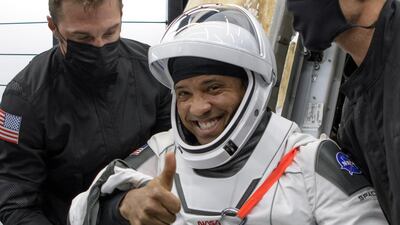
Nasa astronaut Victor Glover gives the thumbs up as he helped out of the SpaceX Crew Dragon capsule, after splashing down in the Gulf of Mexico, off the coast of Panama City, Florida, US. EPA -

Nasa astronaut Mike Hopkins is assisted out of the SpaceX Crew Dragon capsule onboard the SpaceX GO Navigator recovery ship. AP Photo -
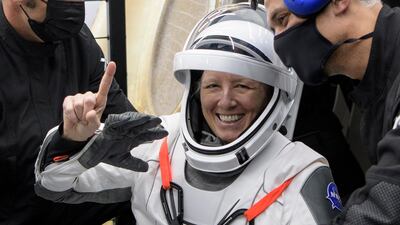
Nasa astronaut Shannon Walker emerges from the SpaceX Crew Dragon capsule onboard the SpaceX GO Navigator recovery ship. AP Photo -
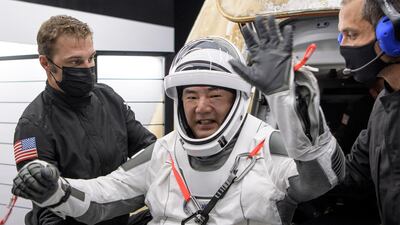
Japan Aerospace Exploration Agency astronaut Soichi Noguchi gives a wave as he is helped out of the SpaceX Crew Dragon. AP Photo -
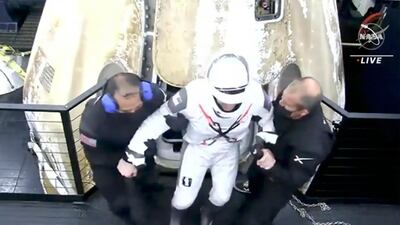
In this image from Nasa TV footage, Mike Hopkins is carried from the SpaceX Dragon capsule. After medical checks, the four astronauts were due to be reunited with their families. AP Photo -
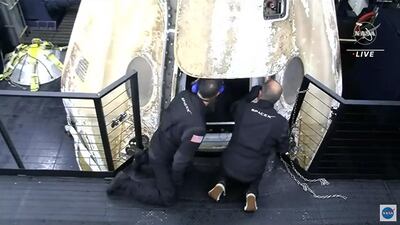
The recovery team open the hatch of the SpaceX's Crew Dragon, following its return to Earth from the International Space Station. AFP -
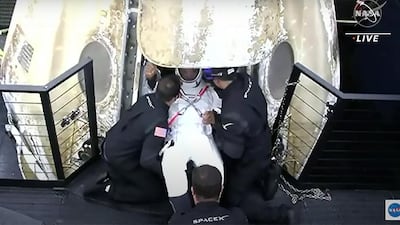
The 167-day mission was the longest for astronauts launching from the US. AFP -
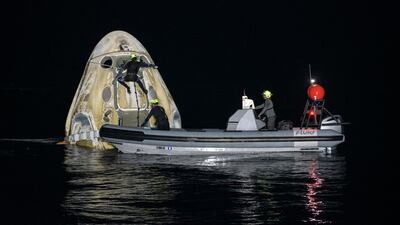
A support team work around the SpaceX Crew Dragon capsule shortly after it splashed down. AP Photo -
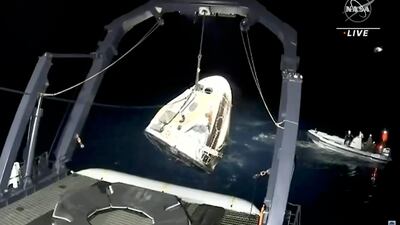
A support team winches up the SpaceX Dragon capsule from the Gulf of Mexico. AP Photo -
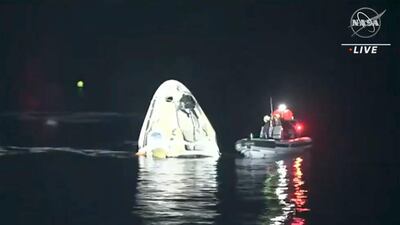
The return of the SpaceX Dragon capsule had been postponed twice due to high winds. AP Photo -
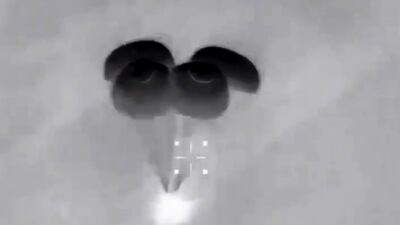
A screen grab from the Nasa live feed shows the SpaceX's Crew Dragon capsule with parachutes open, as it returns to Earth. AFP -
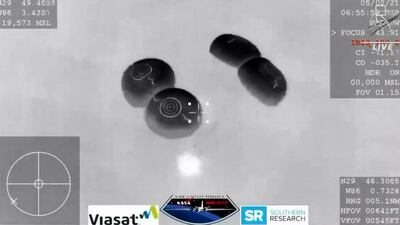
The SpaceX Crew Dragon capsule just before splashdown. AFP -
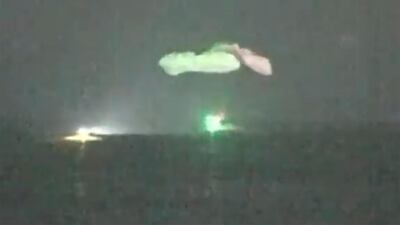
The SpaceX Dragon capsule splashes down into the Gulf of Mexico. AP Photo -
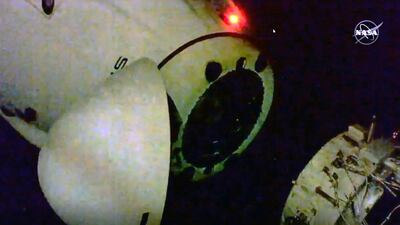
This image from video provided by Nasa shows the SpaceX capsule as it departs the International Space Station on its journey back to Earth. AP Photo -
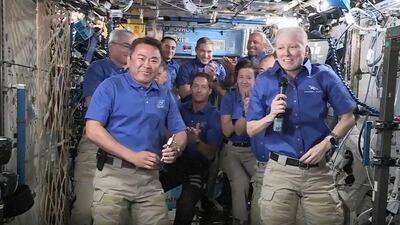
This Nasa TV frame grab image shows astronaut Shannon Walker of Nasa handing over International Space Station command to Japan Aerospace Exploration Agency's Akihiko Hoshide, as the the rest of the crew look on. AFP -
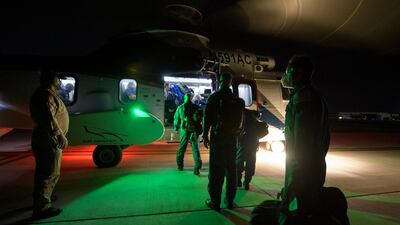
Nasa and SpaceX support teams board a helicopter at Pensacola, Florida, to head to a ship in the Gulf of Mexico. AP Photo -

This photo combination provided by Nasa shows from left, Expedition 64 Flight Engineers and SpaceX Crew-1 members Michael Hopkins, Victor Glover, Shannon Walker and Soichi Noguchi. AP Photo -

European Space Agency French astronaut Thomas Pesquet waves from the International Space Station at the end of a question and answer session with media representatives in Paris. AFP -
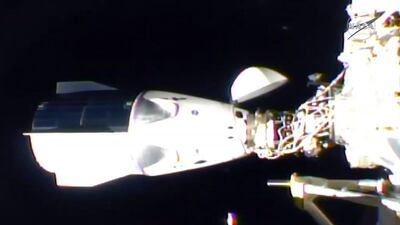
Nasa's SpaceX Crew-1 mission aboard the SpaceX Crew Dragon, right, is docked to the International Space Station. Nasa TV / AFP -
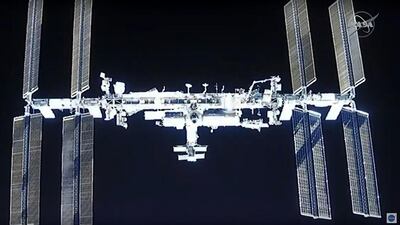
Nasa's SpaceX Crew-1 mission aboard the SpaceX Crew Dragon approaches the International Space Station. Nasa TV / AFP -

Nasa's SpaceX Crew-1 mission aboard the SpaceX Crew Dragon approaches the International Space Station. Nasa TV / AFP -

the SpaceX Dragon capsule approaches the International Space Station. Nasa TV / AP -
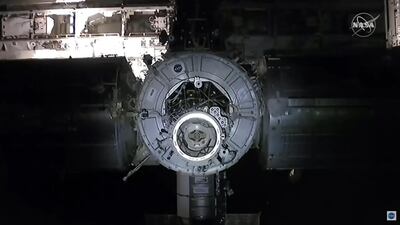
Nasa's SpaceX Crew-1 mission aboard the SpaceX Crew Dragon approaches the International Space Station. Nasa TV / AFP -

Nasa's SpaceX Crew-1 mission aboard the SpaceX Crew Dragon approaches the International Space Station with Earth visible in the distance. Nasa TV / AFP -
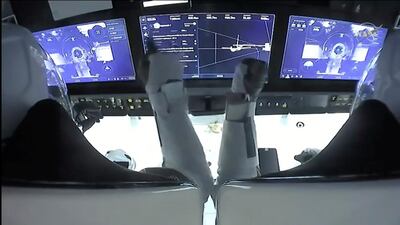
Astronauts Mike Hopkins, left, and Victor Glover monitor controls aboard SpaceX Dragon as the capsule approaches the International Space Station. Nasa TV / AP -

Crowds on the beach in Cape Canaveral, Florida, watch the launch of the SpaceX Falcon 9 Crew Dragon on its Crew-1 mission carrying four astronauts. Florida Today via AP -
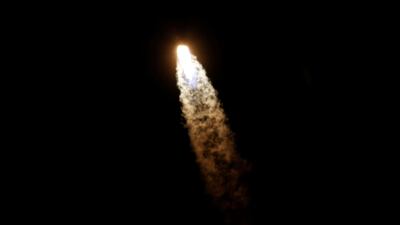
A SpaceX Falcon 9 rocket, topped with the Crew Dragon capsule, is launched carrying four astronauts on the first operational NASA commercial crew mission at Kennedy Space Centre in Cape Canaveral, Florida. Reuters -
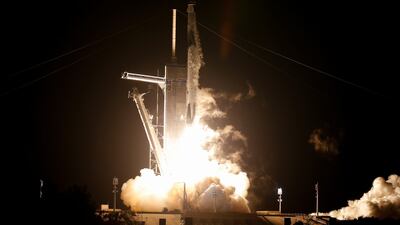
A SpaceX Falcon 9 rocket, topped with the Crew Dragon capsule, is launched at Kennedy Space Centre in Cape Canaveral, Florida. Reuters -
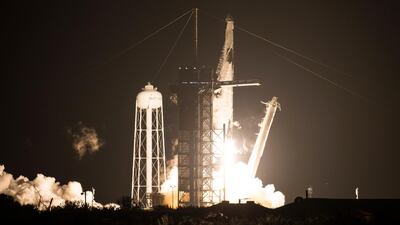
A SpaceX Falcon 9 rocket carrying the company's Crew Dragon spacecraft, is launched for NASA's SpaceX Crew-1 mission, to the International Space Station, in Cape Canaveral, Florida. EPA -
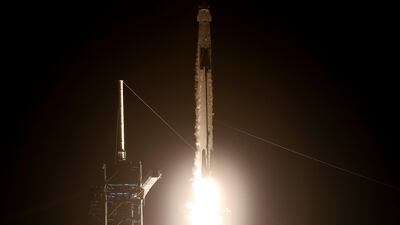
A SpaceX Falcon 9 rocket, topped with the Crew Dragon capsule, is launched at Kennedy Space Centre in Cape Canaveral, Florida. Reuters -
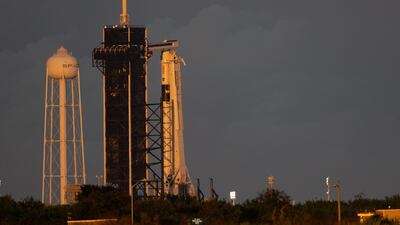
A SpaceX Falcon 9 rocket carrying the company's Crew Dragon spacecraft prepares to launch. EPA -
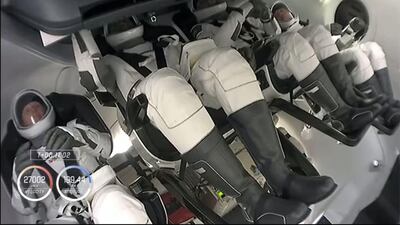
This SpaceX video grab shows Nasa's SpaceX Crew-1 members waiting for second Stage separation, (from left) Shannon Walker, Victor Glover, Michael Hopkins and Soichi Noguchi, after launching from NASA's Kennedy Space Centre in Florida. AFP -

Japan Aerospace Exploration Agency (JAXA) astronaut Soichi Noguchi gestures as the crew of a SpaceX Falcon 9 rocket departs for the launch pad for the first operational NASA commercial crew mission at Kennedy Space Centre in Cape Canaveral, Florida, US. Reuters -

Astronaut Soichi Noguchi, wearing a SpaceX spacesuit, preparing to depart the Neil Armstrong Operations and Checkout Building with his fellow crewmates. AFP -
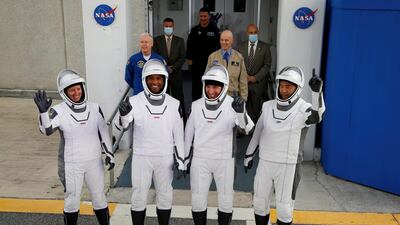
Crew members of a SpaceX Falcon 9 rocket commander Mike Hopkins, Victor Glover, Shannon Walker and Japanese astronaut Soichi Noguchi, gesture as they depart for the launch pad for the first operational NASA commercial crew mission at Kennedy Space Centre in Cape Canaveral, Florida. Reuters -

A full-size model of the Crew-1 spacecraft module sits near the launch pad as a SpaceX Falcon 9 rocket is seen at launch complex 39A in the distance at the Kennedy Space Cente in Florida. AFP


The four astronauts flew to space last November as the crew on the first fully operational mission to the ISS aboard a vehicle made by Elon Musk's SpaceX, which has become Nasa's favoured commercial transportation partner.
The 167-day mission is the longest for astronauts launching from the US. The previous record of 84 days was set by Nasa’s final Skylab station crew in 1974.
After medical checks, the four astronauts were due to be flown by helicopter to Pensacola to board a plane for Houston to be reunited with their friends and family, Nasa said.
"The reports are all four crew members are in great shape and in great spirits and doing really well," Nasa chief flight director Holly Ridings said at a post-landing news briefing.
"Really just a great day. It's not very often you get to wake up on the Space Station and go to sleep in Houston," she said.
Hiroshi Sasaki, vice president of human spaceflight technology at Japan’s space agency, Jaxa, told Nasa television that the mission “opened a new era for human space flight”.
The replacements for the four returning astronauts – from the US, Japan and France – arrived at the space station last weekend in their own SpaceX capsule for a six-month mission.
The three other crew currently aboard the ISS – one American and two Russians – arrived in a Russian capsule launched from Kazakhstan three weeks ago.
As the SpaceX capsule detached from the space station, Mr Hopkins thanked the crew left behind for their hospitality.
"We'll see you back on Earth," he said.
SpaceX made history last year when two American astronauts, Bob Behnken and Doug Hurley, carried out a test flight to the ISS in May and stayed for two months.
It was the first launch to the ISS from US soil since the end of the Space Shuttle programme in 2011, and the first crewed mission run by a private company.
Until then, US astronauts had flown to the ISS on board Russian Soyuz rockets.
SpaceX plans to use a modified version of its Crew Dragon capsule fitted with an observation dome to send an all-civilian crew into space for the first time this year.
All four crew members of the Inspiration4 mission have now been selected for the pioneering flight, with SpaceX targeting a launch date of no earlier than September 15.
Speaking to Nasa television, SpaceX flight reliability adviser Hans Koenigsmann said: “We’re ready for the private astronaut mission.”

