

US Secretary of State Mike Pompeo said on Thursday that Washington was working in more than one way with Arab Gulf partners to offset a growing missile threat from Iran.
And Mr Pompeo warned in a briefing that letting the UN arms embargo expire in October would create instability throughout the Middle East.
He said the US was committed to provide security help for the Gulf as Iran increased its missile capability.
This week, Tehran announced it was building underground missile cities along the Gulf coastline, calling them "a nightmare for Iran's enemies”.
-
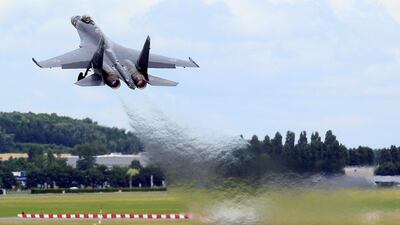
Iran could buy some of the latest Russian-made fighter aircraft if the UN embargo ends. Reuters -
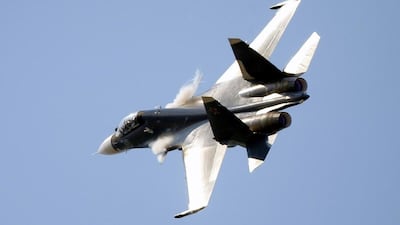
A Sukhoi Su-30, a highly-manoeuvrable two-seat fighter jet designed and built in Russia. EPA -
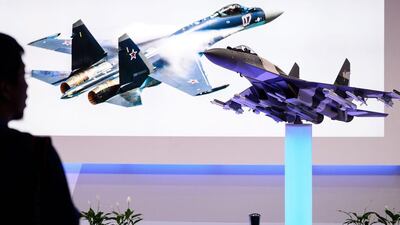
Iran is likely to want to bolster its air defence capabilities, experts have warned. AFP -
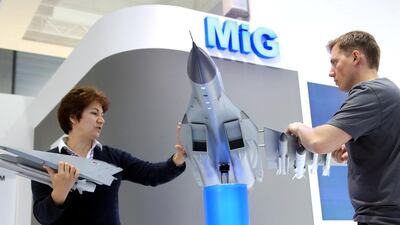
Russia's MIG-35 is also a contender to replace the Iranian air force's ageing fleet of Cold War-era fighter jets. EPA -
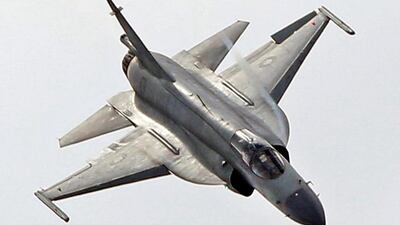
The JF-17 Thunder, jointly developed by China and Pakistan, performs a demonstration flight at the Paris Air Show in 2015. AP -
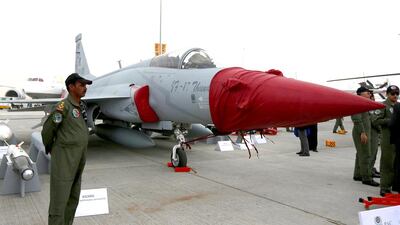
The multi-role aircraft is another being eyed for Iran's air force. AFP -
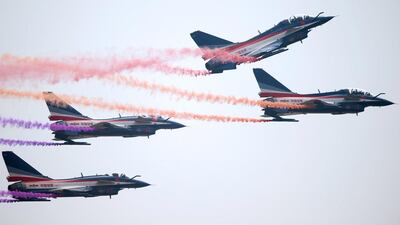
Chinese made J-10 fighter jets of the Bayi Aerobatic Team. There are fears Iran could try to start a bidding war between Russia and China to build up its military capabilities cheaply. AFP -
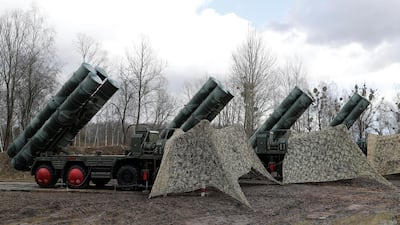
Russia's highly advanced S-400 surface-to-air missile system at a military base outside near Kaliningrad, Russia March 11, 2019. Reuters -
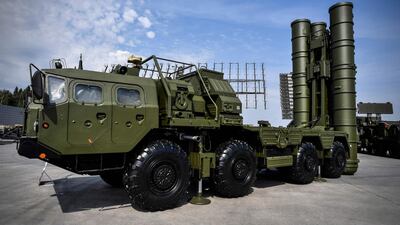
Improved surface-to-air missiles are also thought to be a high priority for the Islamic republic. AFP -
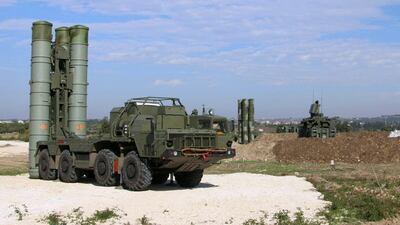
If the S-400 system, seen here in Syria, proves too expensive, Iran could opt for the cheaper but less advanced S-300. AFP


Mr Pompeo said Iran’s missile programme was is in breach of a UN resolution and a critical threat that requires an extension of the UN arms embargo set to expire on October 18.
“We think it’s so important that the world unites to extend the arms embargo that expires just a handful of months from now … that would be tragically dangerous for the region,” Mr Pompeo said.
He said Washington was helping to boost Gulf states' defences by pushing for the embargo to be extended, weapons sales and other ways that are not made public.
Mr Pompeo said there were “things we can do both publicly and otherwise to help provide security in the face of an increasing capability for the Iranians".
He said Iran’s goal were to “ultimately establish missile capability that is robust enough to defeat missile defence capabilities throughout the region and strike in places that are beyond their near neighbourhood".
A UN report released in June found Iran to be the origin of cruise missiles that attacked oil installations in Saudi Arabia last September.
Mr Pompeo mentioned the satellite launches by Iran as another aspect of the missile threat.
“We watched as they continued to build their space vehicle programme," he said.
"They would of course claim it is for civilian purposes to put a commercial satellite up, but the world is smarter than that and realises the programme is deeply connected to their desire to have a longer and longer missile range system.”
The US concerns come as the UN Security Council struggles to renew the five-year arms embargo on Iran.
Russia and China have made it clear that they oppose an extension.
But Gulf states are highlighting the ballistic missile threat they face from Tehran.
“The Iranian national security strategy depends on the use of a wide range of ballistic missiles, delivered from Iran's territory or by Iran's regional proxies,” said Nicholas Heras, the Middle East security manager at the Study of War Institute.
"Iran is at a significant technological disadvantage in military hardware, such as fighter planes, compared to its regional rivals.
"Therefore, Iran uses ballistic missiles that can strike its opponents anywhere on their territory as both deterrence and as a threat that Iran can go on the offensive.”
Mr Heras said intelligence and weapons were key parts of the US assistance to the region.
“The US plays an important role by providing advanced weapons and intelligence gathering capabilities to detect Iran's military advances, and by deploying US forces to the Gulf to send the message to Iran that an Iranian attack on Gulf allies would be like an attack on the US,” he said.
If the UN arms embargo were not extended in October, Mr Heras said the US would most probably work with European countries to co-ordinate a sanctions regime against Iran.

