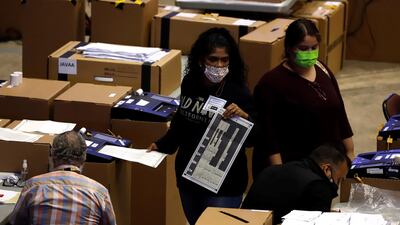
Polling station personnel prepare early voting boxes in San Juan, Puerto Rico. Citizens are voting in a general election, but have no say over who the next US president will be. EPA

'I want to have a say': the 4 million US citizens without a vote


  • English
  • Arabic

More than 4 million American citizens will not have a say in this year’s heated US presidential election because they live in United States territories.

Although they are directly affected by US policy, residents of these territories including Puerto Rico, the US Virgin Islands and American Samoa, are not eligible to vote for a president. Citizens living in one of the 50 states also lose their right to cast a vote once they move to these territories, yet citizens living in foreign countries can vote via absentee ballot.

Sean Liphard, who moved from Washington DC to the island of St Thomas more than four years ago, calls the current system “offensive” and “unconstitutional”.

"I wasn't actually aware that I couldn't vote before I moved here," the 47-year-old, who works at the Community Foundation of the Virgin Islands, tells The National.

“I was surprised and very disappointed, especially since the last election and this one have been so critically important to the future of democracy in our nation.”

Anyone born in Guam, the Virgin Islands, the Northern Mariana Islands and Puerto Rico is considered a US citizen. They can participate in the presidential primaries but not in the November 3 vote, unless they live in the US.

The exception is American Samoans, who are considered nationals of the US, not citizens. According to US law, being a national means you owe "permanent allegiance to the state", are under protection of the government and can travel to and live in the US, but cannot get an American passport or a job that requires citizenship, or vote in elections.

The reason residents of the US territories cannot vote in the presidential election is simply a historic one: because there was no provision for it in the Constitution that came into force in 1789. In the 1890s, the Supreme Court ruled that the territories belonged to the US but were “not a part” of the country.

Few Americans are aware of the issue, says Tappan Vickery, director of voting engagement at HeadCount, a voter registration group.

Even her organisation took some time to recognise there was an issue. “For a long time, like we weren't honestly even thinking about the people in the territories,” she says.

It was only after a mass exodus of Puerto Ricans to the States following the destruction of Hurricane Maria in 2017 that the organisation took note.

“We realised that this was a problem when our federal voter registration form that we rely on to do our work didn't actually support their voter registration process. It was very eye-opening to be honest, for us as an organisation. We realised we weren’t serving this population and we realised there was an immediate need to serve them.”

As a non-profit organisation, Headcount cannot campaign for the right to vote for the territories, but Ms Vickery believes there should at least be a dialogue about their representation.

“We need to make sure they know what their rights are and how they’re different to US state citizen rights so they can advocate for themselves and say they want to have change."

But the territories have been fighting for decades to win the right to vote for president. In 2000, the US government argued the Commonwealth of Puerto Rico was not a state, and so did not have the constitutional right to vote for president.

“I have always wanted to vote in the election but now I want to more than ever,” says Puerto Rico resident Gustavo Rivera. “We have had so many disasters, such as hurricanes, and aid from the US has been so restricted, that I want to have a say in the election of the leader who decides our fate.

“We have really struggled over the past few years with having access to basic rights: clean water, enough food, somewhere safe to live,” the 28-year-old adds, “and it feels so unfair that we cannot vote for somebody who impacts our lives so much on an everyday basis.”

For those who are used to being able to vote in the elections, to have it stripped away because they have moved is a tough pill to swallow.

“Why shouldn't we get the same federal economic and political benefits as the rest of the country?” Mr Liphard says. “The current system is un-American and undemocratic. We're talking about colonialism here – the type of racist disenfranchisement that dates back to the 1900s. Clearly the laws should have been changed a long time ago.”

  • Dominican Sisters of Hartland, Michigan, listen as US President Donald Trump speaks at a "Make America Great Again" rally at Oakland County International Airport. AFP
    Dominican Sisters of Hartland, Michigan, listen as US President Donald Trump speaks at a "Make America Great Again" rally at Oakland County International Airport. AFP
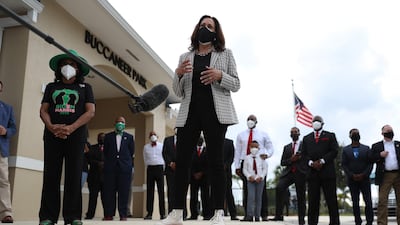
  • Democratic Vice Presidential Nominee Sen. Kamala Harris speaks to the media during a stop at Buccaneer Park, Miami Gardens, Florida. AFP
    Democratic Vice Presidential Nominee Sen. Kamala Harris speaks to the media during a stop at Buccaneer Park, Miami Gardens, Florida. AFP
  • US President Donald Trump speaks at a "Make America Great Again" rally in Newton, Pennsylvania. AFP
    US President Donald Trump speaks at a "Make America Great Again" rally in Newton, Pennsylvania. AFP
  • Supporters of US President Donald Trump unfurl a flag reading, "Trump Law and Order" on Black Lives Matter Plaza in Washington, DC. AFP
    Supporters of US President Donald Trump unfurl a flag reading, "Trump Law and Order" on Black Lives Matter Plaza in Washington, DC. AFP
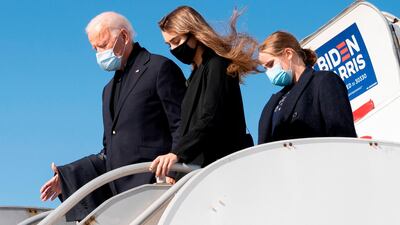
  • Democratic Presidential Candidate Joe Biden arrives with his granddaughters in Flint, Michigan. AFP
    Democratic Presidential Candidate Joe Biden arrives with his granddaughters in Flint, Michigan. AFP
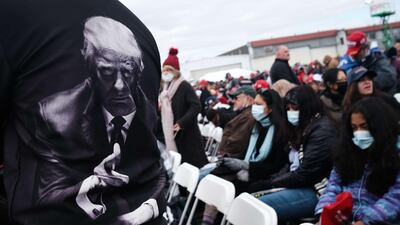
  • Supporters of President Donald Trump arrive to a rally in Reading, Pennsylvania. Donald Trump is crossing the crucial state of Pennsylvania in the last few days of campaigning. AFP
    Supporters of President Donald Trump arrive to a rally in Reading, Pennsylvania. Donald Trump is crossing the crucial state of Pennsylvania in the last few days of campaigning. AFP
  • US President Donald Trump speaks at a "Make America Great Again" rally in Newton, Pennsylvania. AFP
    US President Donald Trump speaks at a "Make America Great Again" rally in Newton, Pennsylvania. AFP
  • Pedestrians walk past campaign signs for Democratic presidential candidate former Vice President Joe Biden ahead of Election Day near the White House in Washington, D.C.. Reuters
    Pedestrians walk past campaign signs for Democratic presidential candidate former Vice President Joe Biden ahead of Election Day near the White House in Washington, D.C.. Reuters
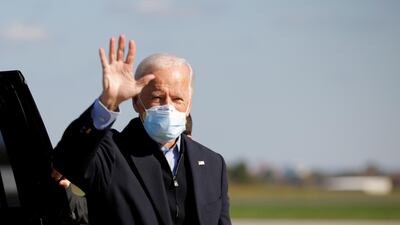
  • Democratic U.S. presidential nominee and former Vice President Joe Biden gestures at the airport in Flint, Michigan, U.S. Reuters
    Democratic U.S. presidential nominee and former Vice President Joe Biden gestures at the airport in Flint, Michigan, U.S. Reuters
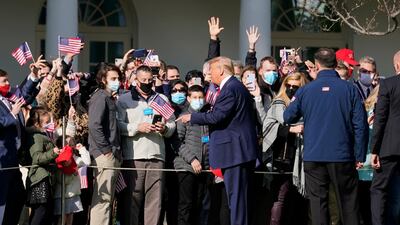
  • President Donald Trump speaks to supporters as he departs the South Lawn of the White House. AP
    President Donald Trump speaks to supporters as he departs the South Lawn of the White House. AP
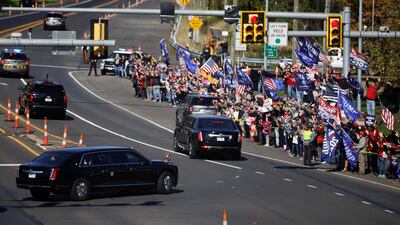
  • The presidential limousine is seen as U.S. President Donald Trump arrives to hold a campaign event in Newtown, Pennsylvania, U.S. Reuters
    The presidential limousine is seen as U.S. President Donald Trump arrives to hold a campaign event in Newtown, Pennsylvania, U.S. Reuters
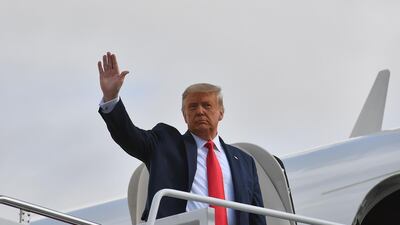
  • US President Donald Trump boards Air Force One at Andrews Air Force Base in Maryland. AFP
    US President Donald Trump boards Air Force One at Andrews Air Force Base in Maryland. AFP
  • Democratic presidential candidate Joe Biden arrives to board his plane in New Castle, Delaware. AFP
    Democratic presidential candidate Joe Biden arrives to board his plane in New Castle, Delaware. AFP
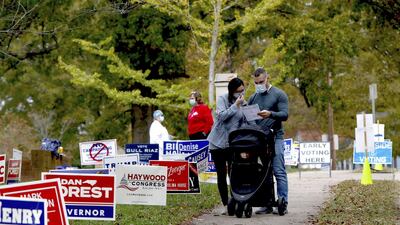
  • Voters look over a sample ballot handed to them by a volunteer as they arrive at a polling place in Winston-Salem, North Carolina. AFP
    Voters look over a sample ballot handed to them by a volunteer as they arrive at a polling place in Winston-Salem, North Carolina. AFP
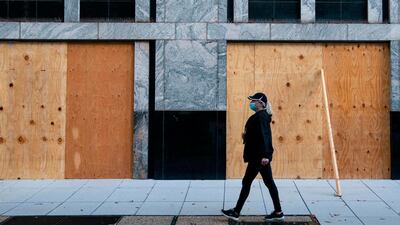
  • Wooden boards protect a Starbucks location near the White House in Washington, DC. Many Washington businesses are boarding up windows in preparation for possible election related violence. AFP
    Wooden boards protect a Starbucks location near the White House in Washington, DC. Many Washington businesses are boarding up windows in preparation for possible election related violence. AFP
  • Ron Briggs dresses as George Washington on Halloween to attend a rally with President Donald Trump in Newtown, Pennsylvania. With the election only three days away. AFP
    Ron Briggs dresses as George Washington on Halloween to attend a rally with President Donald Trump in Newtown, Pennsylvania. With the election only three days away. AFP
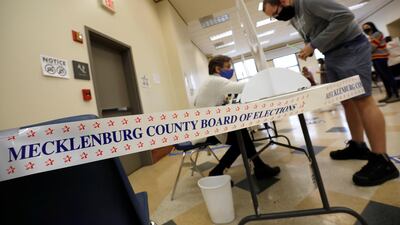
  • A poll worker assists a voter on the last day of early in-person voting for the general elections near tape identifying the Mecklenburg County Board of Elections in Cornelius, North Carolina. Reuters
    A poll worker assists a voter on the last day of early in-person voting for the general elections near tape identifying the Mecklenburg County Board of Elections in Cornelius, North Carolina. Reuters

Professor Malik Sekou, chairman of the social and political sciences department at the University of the Virgin Islands, says the Virgin Islanders deserve full political power within the US system.

“No voting rights means colonialism. It is not fair,” Mr Sekou says. “All presidential elections are important. However this 2020 election cycle has grave repercussions based on the confluence of domestic and foreign challenges.”

US Virgin Islands residents are affected by Washington's domestic and foreign policies “in every way", he says.

“Frankly, racism in the continental US has always been a problem for us in the Virgin Islands but our concern is our need for more political power to protect our territorial interests and economic development.”

Mr Liphard says that the voting system has left him feeling “angry and frustrated”.

“Quite honestly, it's offensive and should be unconstitutional in my opinion,” he says. “It makes me feel helpless, like there is nothing I can do about it to make my voice heard. I'm a US citizen and should have the ability to vote for president, just like other US citizens.”


Company%C2%A0profile
%3Cp%3E%3Cstrong%3EDate%20started%3A%20%3C%2Fstrong%3EMay%202022%3Cbr%3E%3Cstrong%3EFounder%3A%20%3C%2Fstrong%3EHusam%20Aboul%20Hosn%3Cbr%3E%3Cstrong%3EBased%3A%20%3C%2Fstrong%3EDIFC%3Cbr%3E%3Cstrong%3ESector%3A%20%3C%2Fstrong%3EFinTech%20%E2%80%94%20Innovation%20Hub%3Cbr%3E%3Cstrong%3EEmployees%3A%20%3C%2Fstrong%3Eeight%3Cbr%3E%3Cstrong%3EStage%3A%20%3C%2Fstrong%3Epre-seed%3Cbr%3E%3Cstrong%3EInvestors%3A%20%3C%2Fstrong%3Epre-seed%20funding%20raised%20from%20family%20and%20friends%20earlier%20this%20year%3C%2Fp%3E%0A
Why your domicile status is important

Your UK residence status is assessed using the statutory residence test. While your residence status – ie where you live - is assessed every year, your domicile status is assessed over your lifetime.

Your domicile of origin generally comes from your parents and if your parents were not married, then it is decided by your father. Your domicile is generally the country your father considered his permanent home when you were born. 

UK residents who have their permanent home ("domicile") outside the UK may not have to pay UK tax on foreign income. For example, they do not pay tax on foreign income or gains if they are less than £2,000 in the tax year and do not transfer that gain to a UK bank account.

A UK-domiciled person, however, is liable for UK tax on their worldwide income and gains when they are resident in the UK.

Ferrari 12Cilindri specs

Engine: naturally aspirated 6.5-liter V12

Power: 819hp

Torque: 678Nm at 7,250rpm

Price: From Dh1,700,000

Available: Now

Ten tax points to be aware of in 2026

1. Domestic VAT refund amendments: request your refund within five years

If a business does not apply for the refund on time, they lose their credit.

2. E-invoicing in the UAE

Businesses should continue preparing for the implementation of e-invoicing in the UAE, with 2026 a preparation and transition period ahead of phased mandatory adoption. 

3. More tax audits

Tax authorities are increasingly using data already available across multiple filings to identify audit risks. 

4. More beneficial VAT and excise tax penalty regime

Tax disputes are expected to become more frequent and more structured, with clearer administrative objection and appeal processes. The UAE has adopted a new penalty regime for VAT and excise disputes, which now mirrors the penalty regime for corporate tax.

5. Greater emphasis on statutory audit

There is a greater need for the accuracy of financial statements. The International Financial Reporting Standards standards need to be strictly adhered to and, as a result, the quality of the audits will need to increase.

6. Further transfer pricing enforcement

Transfer pricing enforcement, which refers to the practice of establishing prices for internal transactions between related entities, is expected to broaden in scope. The UAE will shortly open the possibility to negotiate advance pricing agreements, or essentially rulings for transfer pricing purposes. 

7. Limited time periods for audits

Recent amendments also introduce a default five-year limitation period for tax audits and assessments, subject to specific statutory exceptions. While the standard audit and assessment period is five years, this may be extended to up to 15 years in cases involving fraud or tax evasion. 

8. Pillar 2 implementation 

Many multinational groups will begin to feel the practical effect of the Domestic Minimum Top-Up Tax (DMTT), the UAE's implementation of the OECD’s global minimum tax under Pillar 2. While the rules apply for financial years starting on or after January 1, 2025, it is 2026 that marks the transition to an operational phase.

9. Reduced compliance obligations for imported goods and services

Businesses that apply the reverse-charge mechanism for VAT purposes in the UAE may benefit from reduced compliance obligations. 

10. Substance and CbC reporting focus

Tax authorities are expected to continue strengthening the enforcement of economic substance and Country-by-Country (CbC) reporting frameworks. In the UAE, these regimes are increasingly being used as risk-assessment tools, providing tax authorities with a comprehensive view of multinational groups’ global footprints and enabling them to assess whether profits are aligned with real economic activity. 

Contributed by Thomas Vanhee and Hend Rashwan, Aurifer

2021 World Triathlon Championship Series

May 15: Yokohama, Japan
June 5: Leeds, UK
June 24: Montreal, Canada
July 10: Hamburg, Germany
Aug 17-22: Edmonton, Canada (World Triathlon Championship Final)
Nov 5-6 : Abu Dhabi, UAE
Date TBC: Chengdu, China