
A post-mortem examination commissioned for George Floyd’s family found that he died of asphyxiation caused by neck and back compression when three Minneapolis police officers kneeled on him for several minutes, the family’s lawyers have said.
The examination found the compression cut off blood to the African-American man's brain and weight on his back made it hard to breathe.
The results of the Floyd family’s post-mortem examination, published on Monday, differs from those of the official process, as described in a criminal complaint against the officer.
The official results included the effects of being restrained, along with underlying health issues and possible intoxicants in Floyd’s system.
But it found nothing “to support a diagnosis of traumatic asphyxia or strangulation".
The doctor who performed the examination for the family also examined the body of Eric Garner, an African-American man who died after being put in a choke-hold by a New York City police officer in 2014.
Floyd, who was in handcuffs at the time of the arrest, died after the white officer ignored bystander's shouts to get off him and the victim’s cries that he could not breathe.
His death, captured on video, sparked days of protests in Minneapolis that have spread to cities all over the US and later the world.
US cities braced on Monday for more fury on the streets as a hearing was postponed for Derek Chauvin, the Minneapolis police officer who was charged with Floyd's killing.
Floyd's brother Terrence visited Minneapolis on Monday and called for calm.
“Do this peacefully, please,” Mr Floyd urged the crowd while wearing a coronavirus mask with George’s image on it.
Chants of “What’s his name?” “George Floyd” filled the air on Monday as a large crowd gathered at the spot in Minneapolis where he took his last breaths.
Earlier, his brother said violent protests were “overshadowing” his brother’s memory because he “was about peace” and the unrest was a “destructive unity”.
US President Donald Trump on Monday urged state governors to crack down on protests over racial inequality that have engulfed the American cities since Floyd’s death.
-
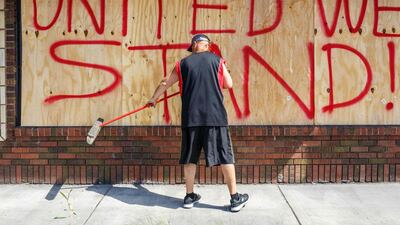
Tom Bernard, cleans the front of his damaged shop on June 1, 2020 in Minneapolis, Minnesota, after protests for George Floyd, an unarmed black man who died after being pinned to the ground by a Minneapolis police officer in Minneapolis, Minnesota. AFP -
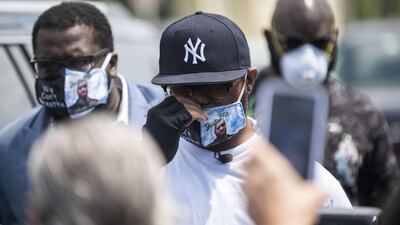
Terrence Floyd, centre, attends a vigil where his brother George Floyd was killed by police one week ago, on June 1, 2020 in Minneapolis, Minnesota. Getty -
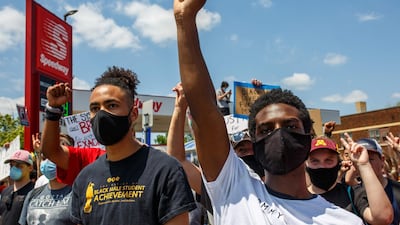
Protesters call for justice for George Floyd during his brother Terrence's visit, outside the Cup Foods on June 1, 2020 in Minneapolis, Minnesota. AFP -
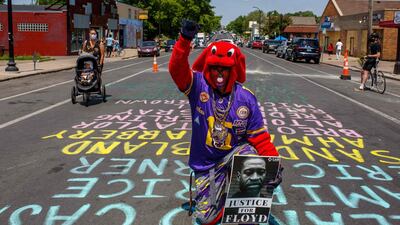
A protester kneels during a call for justice for George Floyd during his brother Terrence's visit, outside the Cup Foods on June 1, 2020 in Minneapolis, Minnesota. AFP -
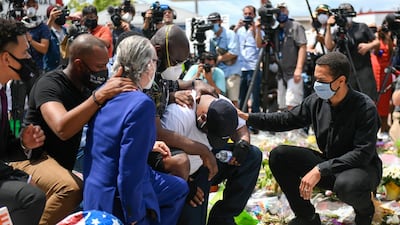
Terrence Floyd, wearing white T-shirt, kneels at a makeshift memorial for his brother, George Floyd, near the intersection of 38th and Chicago in front of the Cup Foods at the spot where he was arrested and died in police custody, in Minneapolis, Minnesota, US. EPA -
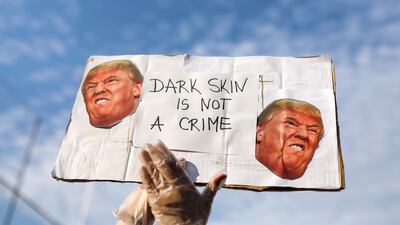
A person carries a banner during a protest against the death in Minneapolis police custody of George Floyd, in front of a US consulate, in Barcelona, Spain June 1, 2020. Reuters -
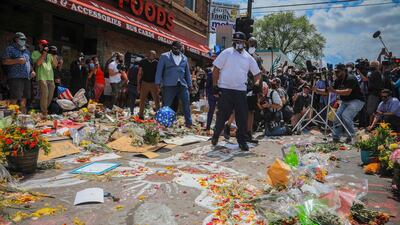
Terrence Floyd, centre, at the spot in the intersection of 38th Street and Chicago Avenue, Minneapolis, where his brother George Floyd died while in police custody, Monday June 1, 2020. AP -
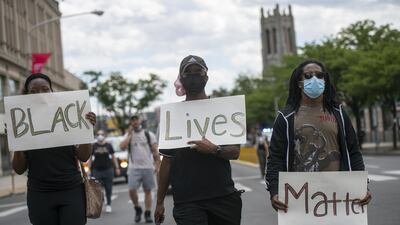
Protesters march with three placards stating "Black Lives Matter" in the aftermath of widespread unrest following the death of George Floyd on June 1, 2020 in Philadelphia, Pennsylvania. Getty -
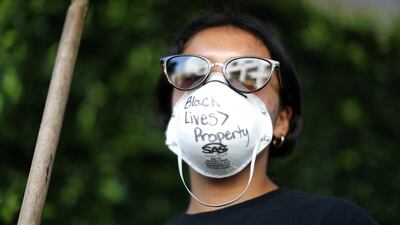
A woman sweeping outside looted stores wears a protective mask that reads: "Black Lives are greater than property" during nationwide unrest following the death in Minneapolis police custody of George Floyd, amid the coronavirus outbreak in Santa Monica, California, US, June 1, 2020. Reuters -
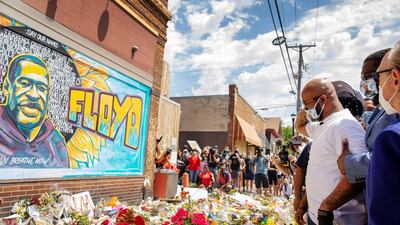
Terrence Floyd, brother of George Floyd, reacts at a makeshift memorial honouring George Floyd, at the spot where he was taken into custody, in Minneapolis, Minnesota on June 1, 2020. Reuters


"My administration is fully committed that for George and his family, justice will be served," Mr Trump said in a speech to the nation. "He will not have died in vain."
Mr Trump called the riots "acts of domestic terror".
He said he would immediately mobilise all available federal resources, civilian and military to try to quell the unrest.
As protests raged outside the White House, Mr Trump said he "strongly recommended" to every state governor that they call in the National Guard.
He said that if they rejected him, he would send in the US military.
Residents and business owners in cities from New York to Santa Monica, California, spent Monday sweeping up broken glass and taking stock of damage after protests over excessive police force against African-Americans turned violent again overnight.
Dozens of cities across the US remain under curfews at a level not seen since riots after the 1968 assassination of civil rights activist Martin Luther King Jr.
The National Guard was posted in 23 states and Washington.
Police in the capital arrested 88 people on Sunday night during violence and looting from the protests.
Police Department Chief Peter Newsham said half of those arrested were charged with felony rioting and the rest with offences including breaches of the 11pm curfew.
“We are not done making arrests,” Mr Newsham said.
He said the central area where much of the damage occurred was full of government and private security cameras that would provide evidence for more arrests.
He encouraged the residents of Washington and those protesters opposed to violent tactics to help police identify vandals and looters.
District of Columbia mayor Muriel Bowser imposed a 7pm curfew for Monday and Tuesday nights.
On Sunday, Ms Bowser dismissed the idea of a curfew but then changed course on Sunday evening.
She said the decision was made based on real-time intelligence and was designed to give police “additional tools” to keep the peace.
Ms Bowser's decision drew criticism from White House press secretary Kayleigh McEnany, who said the mayor acted slowly and should have started the curfew much earlier.
Ms Bowser said she supported the cause of the peaceful protesters enraged over a long string of black American deaths at police hands.
“We certainly empathise with the righteous cause that people are here protesting," she said.
"Everyone should be outraged by the murder of George Floyd.
"However, smashed windows and looting are becoming a bigger story than the broken systems that got us here.”

