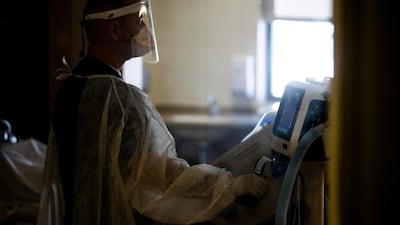
A caregiver attends to a Covid-19 patient in an ICU room at the Sharp Chula Vista Medical Center, in Chula Vista, south of San Diego, California. EPA

Forty per cent of US Covid deaths linked to Trump's health policies


Patrick deHahn
  • English
  • Arabic

A healthcare system deteriorating for decades, compounded by policies created by former president Donald Trump, led to unnecessary deaths early in Mr Trump's presidency and during the Covid-19 pandemic, a recent study said.

The peer-reviewed study by medical journal The Lancet reported that when comparing the situation in the US with other G7 countries such as the UK, Germany and Japan, at least 40 per cent of the Covid-19 death toll – expected to reach half a million in February – is attributable to Mr Trump's actions.

"About 40 per cent of [the deaths] could have been averted had the US death rate mirrored the weighted average of the other G7 nations," the report read. "Many of the cases and deaths were avoidable."

The US faces the world's largest coronavirus outbreak. As of February 10, more than 27 million infections had been recorded by Johns Hopkins University, and more than 470,000 people had died as a result of the disease.

Trump's disastrous actions compounded long-standing failures in health policy in the USA. We know what it will take to create a healthy society. We just need the political will to do it.

Researchers pointed to an array of actions taken by Mr Trump that caused the further spread of the coronavirus and a high death toll.

"Instead of galvanising the US populace to fight the pandemic, President Trump publicly dismissed its threat (despite privately acknowledging it), discouraged action as infection spread and eschewed international co-operation," the report read.

"His refusal to develop a national strategy worsened shortages of personal protective equipment and diagnostic tests. President Trump politicised mask-wearing and school reopenings and convened indoor events attended by thousands, where masks were discouraged and physical distancing was impossible."

The nation's top infectious diseases expert, Dr Anthony Fauci, shared similar thoughts about Mr Trump's role in the pandemic in an appearance at the World Economic Forum in January.

“There were a few things that were complicating and overlapping, and explain almost the unimaginable, about how a very, very rich country got hit the worst,” the director of the National Institute of Allergy and Infectious Diseases said.

“We had a situation where, instead of concentrating from the top down on the data and science and realising that we must make decisions based on evidence, there was a considerable amount of mixed messaging from the top down," said Dr Fauci, now chief medical adviser to President Joe Biden. "That cost us dearly.”

The Lancet report further declared that 461,000 lives were unnecessarily lost in the year 2018.

The researchers examined 40 years of the US healthcare system, starting after Ronald Reagan's presidency, when life expectancy in the country was shown to decline when compared with countries such as Italy, France and Canada.

The study found that deaths in the US began to increase when Mr Reagan left office and peaked during the early years of Mr Trump's presidency.

His attempts to scrap the Affordable Care Act, or Obamacare, and his changes to US health policy led to 2.3 million more people becoming uninsured, the report said.

A large chunk of the report emphasised the crisis of health care for racial minorities, during the pandemic and beyond. Researchers said there was concern over a weakened safety net for black, Latino and indigenous people in the US.

"Trump's disastrous actions compounded long-standing failures in health policy in the US," said Dr Kevin Grumbach, a Lancet Commission member from the University of California, San Francisco.

"We know what it will take to create a healthy society. We just need the political will to do it."

Mr Biden and Vice President Kamala Harris have promised to address the pandemic and the nation's racial disparities.

After rejoining the World Health Organisation, Mr Biden began a 100-day plan to push the countrywide adoption of wearing face masks, increase vaccinations and ensure safe school reopenings. He has already mandated masks in federal spaces and tried to address the country's rocky vaccination distribution programme.

He also presented an ambitious $1.9 trillion proposal that will send direct payments to Americans, help support small businesses hit by the pandemic's economic fallout and improve the country's Covid-19 testing systems.

The plan is moving through Congress. Democrats hope to pass it before mid-March, when many enhanced unemployment benefits and eviction moratorium protections expire.

Mr Biden indicated that there will be a secondary bill acting as a recovery plan after his first rescue bill passes.

The White House suggested the bill may be presented later in the year and that it will directly address racial equity in the country as well as job creation, infrastructure and climate change.

The recovery plan may be more aligned with the Lancet Commission's recommendations to tackle healthcare issues in the US.

"The disastrous, bungled response to the pandemic made clear how existing, long-standing racial inequities simply have not been addressed. It's time to stop saying these preventable gaps cannot be eliminated," said Dr Mary Bassett, a Lancet Commission member and director of the FXB Centre for Health and Human Rights at Harvard University.

Additionally, researchers declared that the former president's reductions in environmental and workplace protections led to increased pollution and harmful occupational situations for many in the US, leading to more than 22,000 deaths between 2016 and 2019.

The study said that these decisions "reversed 15 years of steady progress".

How to avoid crypto fraud
  • Use unique usernames and passwords while enabling multi-factor authentication.
  • Use an offline private key, a physical device that requires manual activation, whenever you access your wallet.
  • Avoid suspicious social media ads promoting fraudulent schemes.
  • Only invest in crypto projects that you fully understand.
  • Critically assess whether a project’s promises or returns seem too good to be true.
  • Only use reputable platforms that have a track record of strong regulatory compliance.
  • Store funds in hardware wallets as opposed to online exchanges.
COMPANY%20PROFILE
%3Cp%3E%3Cstrong%3EName%3A%20%3C%2Fstrong%3ESmartCrowd%0D%3Cbr%3E%3Cstrong%3EStarted%3A%20%3C%2Fstrong%3E2018%0D%3Cbr%3E%3Cstrong%3EFounder%3A%20%3C%2Fstrong%3ESiddiq%20Farid%20and%20Musfique%20Ahmed%0D%3Cbr%3E%3Cstrong%3EBased%3A%20%3C%2Fstrong%3EDubai%0D%3Cbr%3E%3Cstrong%3ESector%3A%20%3C%2Fstrong%3EFinTech%20%2F%20PropTech%0D%3Cbr%3E%3Cstrong%3EInitial%20investment%3A%20%3C%2Fstrong%3E%24650%2C000%0D%3Cbr%3E%3Cstrong%3ECurrent%20number%20of%20staff%3A%3C%2Fstrong%3E%2035%0D%3Cbr%3E%3Cstrong%3EInvestment%20stage%3A%20%3C%2Fstrong%3ESeries%20A%0D%3Cbr%3E%3Cstrong%3EInvestors%3A%20%3C%2Fstrong%3EVarious%20institutional%20investors%20and%20notable%20angel%20investors%20(500%20MENA%2C%20Shurooq%2C%20Mada%2C%20Seedstar%2C%20Tricap)%3C%2Fp%3E%0A
Who's who in Yemen conflict

Houthis: Iran-backed rebels who occupy Sanaa and run unrecognised government

Yemeni government: Exiled government in Aden led by eight-member Presidential Leadership Council

Southern Transitional Council: Faction in Yemeni government that seeks autonomy for the south

Habrish 'rebels': Tribal-backed forces feuding with STC over control of oil in government territory

THE BIO

Favourite place to go to in the UAE: The desert sand dunes, just after some rain

Who inspires you: Anybody with new and smart ideas, challenging questions, an open mind and a positive attitude

Where would you like to retire: Most probably in my home country, Hungary, but with frequent returns to the UAE

Favorite book: A book by Transilvanian author, Albert Wass, entitled ‘Sword and Reap’ (Kard es Kasza) - not really known internationally

Favourite subjects in school: Mathematics and science

Company profile

Company name: Dharma

Date started: 2018

Founders: Charaf El Mansouri, Nisma Benani, Leah Howe

Based: Abu Dhabi

Sector: TravelTech

Funding stage: Pre-series A 

Investors: Convivialite Ventures, BY Partners, Shorooq Partners, L& Ventures, Flat6Labs

AWARDS
%3Cp%3E%3Cstrong%3EBest%20Male%20black%20belt%3A%20%3C%2Fstrong%3ELucas%20Protasio%20(BRA)%3Cbr%3E%3Cstrong%3EBest%20female%20black%20belt%3A%20%3C%2Fstrong%3EJulia%20Alves%20(BRA)%3Cbr%3E%3Cstrong%3EBest%20Masters%20black%20belt%3A%3C%2Fstrong%3E%20Igor%20Silva%20(BRA)%3Cbr%3E%3Cstrong%3EBest%20Asian%20Jiu-Jitsu%20Federation%3A%3C%2Fstrong%3E%20Kazakhstan%3Cbr%3E%3Cstrong%3EBest%20Academy%20in%20UAE%3A%20%3C%2Fstrong%3ECommando%20Group%2C%20Abu%20Dhabi%3Cbr%3E%3Cstrong%3EBest%20International%20Academy%3A%3C%2Fstrong%3E%20Commando%20Group%2C%20Abu%20Dhabi%3Cbr%3E%3Cstrong%3EAfrican%20Player%20of%20the%20Year%3A%20%3C%2Fstrong%3EKatiuscia%20Yasmira%20Dias%20(GNB)%3Cbr%3E%3Cstrong%3EOceanian%20Player%20of%20the%20Year%3A%20%3C%2Fstrong%3EAnton%20Minenko%20(AUS)%3Cbr%3E%3Cstrong%3EEuropean%20Player%20of%20the%20Year%3A%3C%2Fstrong%3E%20Rose%20El%20Sharouni%20(NED)%3Cbr%3E%3Cstrong%3ENorth%20and%20Central%20American%20Player%20of%20the%20Year%3A%20%3C%2Fstrong%3EAlexa%20Yanes%20(USA)%3Cbr%3E%3Cstrong%3EAsian%20Player%20of%20the%20Year%3A%20%3C%2Fstrong%3EZayed%20Al%20Katheeri%20(UAE)%3Cbr%3E%3Cstrong%3ERookie%20of%20the%20Year%3A%3C%2Fstrong%3E%20Rui%20Neto%20(BRA)Rui%20Neto%20(BRA)%3C%2Fp%3E%0A

Mercer, the investment consulting arm of US services company Marsh & McLennan, expects its wealth division to at least double its assets under management (AUM) in the Middle East as wealth in the region continues to grow despite economic headwinds, a company official said.

Mercer Wealth, which globally has $160 billion in AUM, plans to boost its AUM in the region to $2-$3bn in the next 2-3 years from the present $1bn, said Yasir AbuShaban, a Dubai-based principal with Mercer Wealth.

Within the next two to three years, we are looking at reaching $2 to $3 billion as a conservative estimate and we do see an opportunity to do so,” said Mr AbuShaban.

Mercer does not directly make investments, but allocates clients’ money they have discretion to, to professional asset managers. They also provide advice to clients.

“We have buying power. We can negotiate on their (client’s) behalf with asset managers to provide them lower fees than they otherwise would have to get on their own,” he added.

Mercer Wealth’s clients include sovereign wealth funds, family offices, and insurance companies among others.

From its office in Dubai, Mercer also looks after Africa, India and Turkey, where they also see opportunity for growth.

Wealth creation in Middle East and Africa (MEA) grew 8.5 per cent to $8.1 trillion last year from $7.5tn in 2015, higher than last year’s global average of 6 per cent and the second-highest growth in a region after Asia-Pacific which grew 9.9 per cent, according to consultancy Boston Consulting Group (BCG). In the region, where wealth grew just 1.9 per cent in 2015 compared with 2014, a pickup in oil prices has helped in wealth generation.

BCG is forecasting MEA wealth will rise to $12tn by 2021, growing at an annual average of 8 per cent.

Drivers of wealth generation in the region will be split evenly between new wealth creation and growth of performance of existing assets, according to BCG.

Another general trend in the region is clients’ looking for a comprehensive approach to investing, according to Mr AbuShaban.

“Institutional investors or some of the families are seeing a slowdown in the available capital they have to invest and in that sense they are looking at optimizing the way they manage their portfolios and making sure they are not investing haphazardly and different parts of their investment are working together,” said Mr AbuShaban.

Some clients also have a higher appetite for risk, given the low interest-rate environment that does not provide enough yield for some institutional investors. These clients are keen to invest in illiquid assets, such as private equity and infrastructure.

“What we have seen is a desire for higher returns in what has been a low-return environment specifically in various fixed income or bonds,” he said.

“In this environment, we have seen a de facto increase in the risk that clients are taking in things like illiquid investments, private equity investments, infrastructure and private debt, those kind of investments were higher illiquidity results in incrementally higher returns.”

The Abu Dhabi Investment Authority, one of the largest sovereign wealth funds, said in its 2016 report that has gradually increased its exposure in direct private equity and private credit transactions, mainly in Asian markets and especially in China and India. The authority’s private equity department focused on structured equities owing to “their defensive characteristics.”

The bio

Date of Birth: April 25, 1993
Place of Birth: Dubai, UAE
Marital Status: Single
School: Al Sufouh in Jumeirah, Dubai
University: Emirates Airline National Cadet Programme and Hamdan University
Job Title: Pilot, First Officer
Number of hours flying in a Boeing 777: 1,200
Number of flights: Approximately 300
Hobbies: Exercising
Nicest destination: Milan, New Zealand, Seattle for shopping
Least nice destination: Kabul, but someone has to do it. It’s not scary but at least you can tick the box that you’ve been
Favourite place to visit: Dubai, there’s no place like home

While you're here