Pope Francis is welcomed by Canada's Prime Minister Justin Trudeau after arriving at Edmonton International Airport on Sunday. Reuters

Pope Francis arrives in Canada to apologise to indigenous Canadians


Willy Lowry
  • English
  • Arabic

Pope Francis arrived in the Canadian city of Edmonton late on Sunday morning to kick off a week-long trip to Canada. The Pope will meet indigenous leaders and is expected to apologise for the Catholic church's treatment of indigenous Canadians.

“Dear brothers and sisters of Canada, I come among you to meet the indigenous peoples,” the Pope tweeted, before departing the Vatican for Canada. “I hope, with God's grace, that my penitential pilgrimage might contribute to the journey of reconciliation already undertaken. Please accompany me with prayer.”

The Pope was met at the airport by Canadian Prime Minister Justin Trudeau, Governor General Mary Simon, and several survivors of the country’s disastrous residential school programme.

The leader of the Catholic Church, 85, who has been experiencing knee troubles which forced him to cancel a previously planned trip to Africa, used a wheelchair to travel from his Fiat 500 car to the stage. He then sat with Canadian dignitaries for a brief welcome ceremony.

The discovery in May 2021 of more than 200 unmarked graves at the site of a former residential school in Kamloops, British Columbia, sparked a nationwide reckoning with the country’s historical and present-day treatment of indigenous people.

That reckoning stretched beyond the borders of Canada to the Vatican. In April of this year, members of Canada’s indigenous communities travelled to Vatican City, where they met with the Pope, who apologised for the church's role in the residential school system.

Starting in the 1800s and continuing for more than 100 years, the Canadian government ran a large network of schools designed to forcibly assimilate the country's indigenous peoples. The government often relied on the Catholic church to oversee the schools.

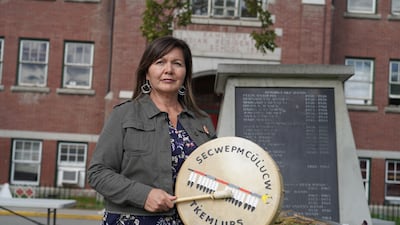
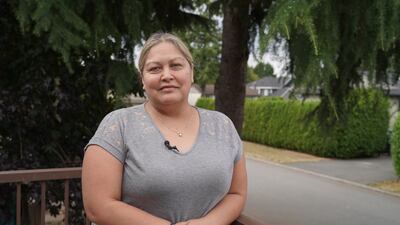
  • Chief Rosanne Casimir of the Tk'emlups te Secwepemc First Nation poses in front of the former Kamloops Indian Residential School in British Columbia,Canada. Willy Lowry / The National
    Chief Rosanne Casimir of the Tk'emlups te Secwepemc First Nation poses in front of the former Kamloops Indian Residential School in British Columbia,Canada. Willy Lowry / The National
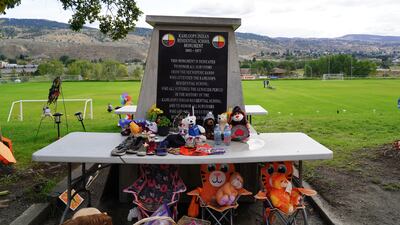
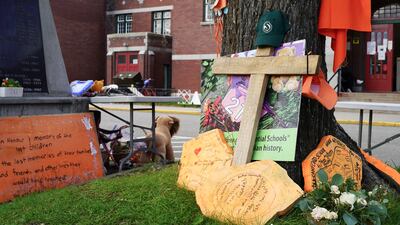
  • A to the children discovered buried at the Kamloops Indian residential School. Willy Lowry / The National
    A to the children discovered buried at the Kamloops Indian residential School. Willy Lowry / The National
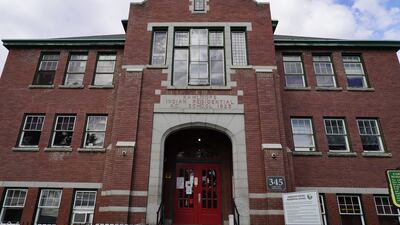
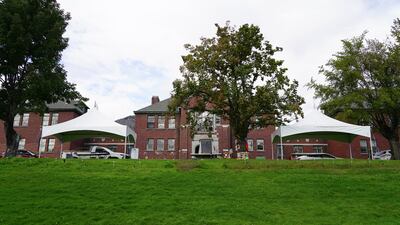
  • The former Kamloops Indian Residential School still stands on the grounds of the Tk'emlups te Secwepemc First Nation. Willy Lowry / The National
    The former Kamloops Indian Residential School still stands on the grounds of the Tk'emlups te Secwepemc First Nation. Willy Lowry / The National
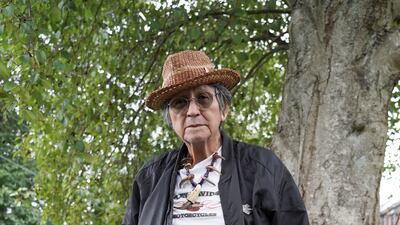
  • Sam George a survivor of Canada's Indian residential schools poses near where the St Paul's Indian Residential School in North Vancouver, Canada used to stand. Willy Lowry / The National
    Sam George a survivor of Canada's Indian residential schools poses near where the St Paul's Indian Residential School in North Vancouver, Canada used to stand. Willy Lowry / The National
  • Angela White, the executive director of the Indian Residential Schools Survivors Society poses outside her home near Vancouver, Canada. Willy Lowry / The National
    Angela White, the executive director of the Indian Residential Schools Survivors Society poses outside her home near Vancouver, Canada. Willy Lowry / The National
  • A shrine to the children discovered buried at the Kamloops Indian residential School. Willy Lowry / The National
    A shrine to the children discovered buried at the Kamloops Indian residential School. Willy Lowry / The National
  • The community created a shrine to the children discovered buried at the Kamloops Indian residential School. Willy Lowry / The National
    The community created a shrine to the children discovered buried at the Kamloops Indian residential School. Willy Lowry / The National
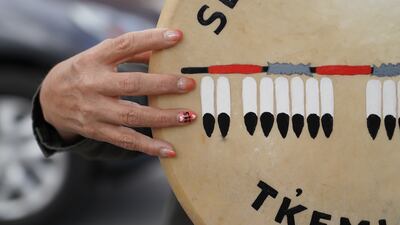
  • The manicured nails of Tk'emlups te Secwepemc First Nation's Chief Rosanne Casimir. She has written 215 on one nail to represent the 215 graves that were discovered at the site of the former Kamloops Indian Residential School. Willy Lowry / The National
    The manicured nails of Tk'emlups te Secwepemc First Nation's Chief Rosanne Casimir. She has written 215 on one nail to represent the 215 graves that were discovered at the site of the former Kamloops Indian Residential School. Willy Lowry / The National
  • Sam George a survivor of Canada's Indian residential schools poses near where the St Paul's Indian Residential School in North Vancouver, Canada. Willy Lowry / The National
    Sam George a survivor of Canada's Indian residential schools poses near where the St Paul's Indian Residential School in North Vancouver, Canada. Willy Lowry / The National
  • The former Kamloops Indian Residential School still stands on the grounds of the Tk'emlups te Secwepemc First Nation. Willy Lowry / The National
    The former Kamloops Indian Residential School still stands on the grounds of the Tk'emlups te Secwepemc First Nation. Willy Lowry / The National
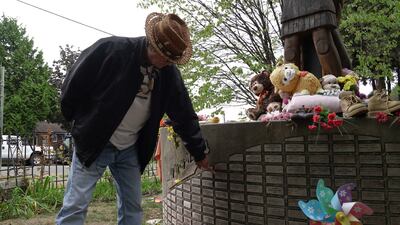
  • Sam George a survivor of Canada's Indian residential school system points to a plaque with his name on it outside the former St Paul's Indian Residential School in North Vancouver, Canada. Willy Lowry / The National
    Sam George a survivor of Canada's Indian residential school system points to a plaque with his name on it outside the former St Paul's Indian Residential School in North Vancouver, Canada. Willy Lowry / The National
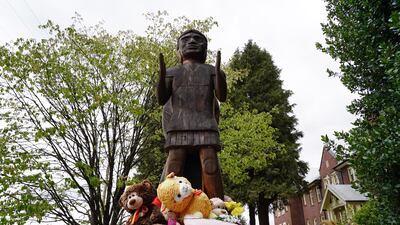
  • A monument to the children who were forced to attend the St Paul's Indian Residential School in North Vancouver, British Columbia. Willy Lowry / The National
    A monument to the children who were forced to attend the St Paul's Indian Residential School in North Vancouver, British Columbia. Willy Lowry / The National
  • Sam George a survivor of Canada's Indian residential school system points to a plaque with his name on it outside the former St Paul's Indian Residential School in North Vancouver, Canada. Willy Lowry / The National
    Sam George a survivor of Canada's Indian residential school system points to a plaque with his name on it outside the former St Paul's Indian Residential School in North Vancouver, Canada. Willy Lowry / The National

It was not until 1996 that the last residential school closed, officially ending a school system that ripped communities apart.

Children as young as 3 were taken from their homes, often without their parents’ permission, and dropped at boarding schools where they were not allowed to use their native languages. Punishments were often severe and sexual abuse was rife.

For years, the federal government and Canadians in general ignored the horror stories that came out of these schools. However, in 2008, the federal government launched a National Truth and Reconciliation Commission.

The commission, which ran for about seven years, published a report that said what transpired at Canada’s residential schools amounted to a “cultural genocide".

It estimated that more than 4,100 children died or went missing while attending residential schools across the country.

On Monday, Pope Francis will visit the site of a former residential school in Maskwacis, a first nations community south of Edmonton.

The Pope will also travel to Quebec City and the northern territory of Nunavut, where he will meet residential school survivors.


The specs
 
Engine: 3.0-litre six-cylinder turbo
Power: 398hp from 5,250rpm
Torque: 580Nm at 1,900-4,800rpm
Transmission: Eight-speed auto
Fuel economy, combined: 6.5L/100km
On sale: December
Price: From Dh330,000 (estimate)
Ten tax points to be aware of in 2026

1. Domestic VAT refund amendments: request your refund within five years

If a business does not apply for the refund on time, they lose their credit.

2. E-invoicing in the UAE

Businesses should continue preparing for the implementation of e-invoicing in the UAE, with 2026 a preparation and transition period ahead of phased mandatory adoption. 

3. More tax audits

Tax authorities are increasingly using data already available across multiple filings to identify audit risks. 

4. More beneficial VAT and excise tax penalty regime

Tax disputes are expected to become more frequent and more structured, with clearer administrative objection and appeal processes. The UAE has adopted a new penalty regime for VAT and excise disputes, which now mirrors the penalty regime for corporate tax.

5. Greater emphasis on statutory audit

There is a greater need for the accuracy of financial statements. The International Financial Reporting Standards standards need to be strictly adhered to and, as a result, the quality of the audits will need to increase.

6. Further transfer pricing enforcement

Transfer pricing enforcement, which refers to the practice of establishing prices for internal transactions between related entities, is expected to broaden in scope. The UAE will shortly open the possibility to negotiate advance pricing agreements, or essentially rulings for transfer pricing purposes. 

7. Limited time periods for audits

Recent amendments also introduce a default five-year limitation period for tax audits and assessments, subject to specific statutory exceptions. While the standard audit and assessment period is five years, this may be extended to up to 15 years in cases involving fraud or tax evasion. 

8. Pillar 2 implementation 

Many multinational groups will begin to feel the practical effect of the Domestic Minimum Top-Up Tax (DMTT), the UAE's implementation of the OECD’s global minimum tax under Pillar 2. While the rules apply for financial years starting on or after January 1, 2025, it is 2026 that marks the transition to an operational phase.

9. Reduced compliance obligations for imported goods and services

Businesses that apply the reverse-charge mechanism for VAT purposes in the UAE may benefit from reduced compliance obligations. 

10. Substance and CbC reporting focus

Tax authorities are expected to continue strengthening the enforcement of economic substance and Country-by-Country (CbC) reporting frameworks. In the UAE, these regimes are increasingly being used as risk-assessment tools, providing tax authorities with a comprehensive view of multinational groups’ global footprints and enabling them to assess whether profits are aligned with real economic activity. 

Contributed by Thomas Vanhee and Hend Rashwan, Aurifer

SPECS

Engine: Two-litre four-cylinder turbo
Power: 235hp
Torque: 350Nm
Transmission: Nine-speed automatic
Price: From Dh167,500 ($45,000)
On sale: Now

Updated: July 24, 2022, 8:49 PM