


Follow the latest updates on Afghanistan here
Foreign policy can sometimes fall by the wayside during Canadian federal elections as voters and leaders focus their attention on domestic issues.
But a group of young Afghan Canadians is trying to change that.
The Afghan Youth Engagement Development Initiative (AYEDI), a national, non-partisan organisation that aims to empower the Afghan-Canadian community, is calling on federal leaders to put the situation in Afghanistan front and centre during the country’s 36-day election, which was called right as Kabul fell to the Taliban.
“Afghanistan is the number one foreign policy crisis in the world right now,” said Khalidha Nasiri, executive director of AYEDI. “It needs to be something that our leaders, especially people who are seeking to become prime minister, need to discuss and lay out what they would want the government to do and what they would do differently.”
The Canadian Armed Forces spent 12 years fighting in Afghanistan, making it the country’s longest combat mission. More than 40,000 Canadians fought as allies in the US-led war, with 158 Canadians dying and thousands more injured in the conflict.
Canada ended its combat mission in 2011 and former Conservative prime minister Stephen Harper brought the last Canadian soldiers home in 2014.
The Canadian government under Liberal leader Justin Trudeau has pledged to take in 20,000 Afghan refugees in the coming months and years, but Ms Nasiri said that’s not enough.
Her organisation wants the government to double that number. She said the resettlement process so far has been very “bureaucratic” and that the government should do more to “remove barriers” that prevent Afghans from seeking refuge in Canada.
-
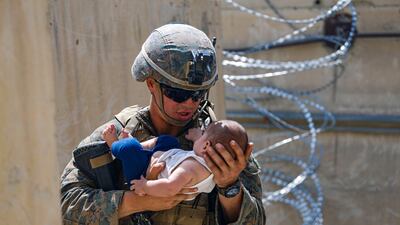
A US marine cradles an infant while waiting for the mother to return during an evacuation at Hamid Karzai International Airport. Reuters -
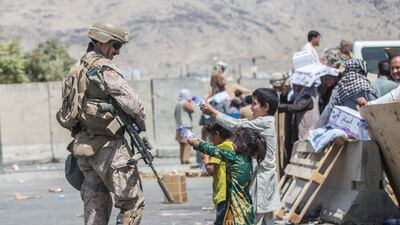
Children playfully squirt a US Marine with water during an evacuation at Hamid Karzai International Airport, Kabul. Reuters -
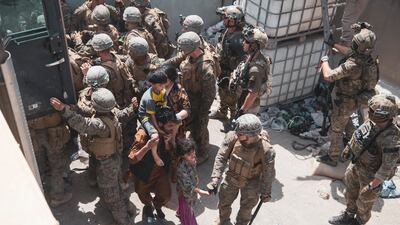
US marines and Norwegian coalition forces provide security during an evacuation at Kabul's airport. Reuters -

Afghans wait outside the foreign military-controlled part of the airport in Kabul, hoping to flee the country following the Taliban's military takeover of Afghanistan. AFP -
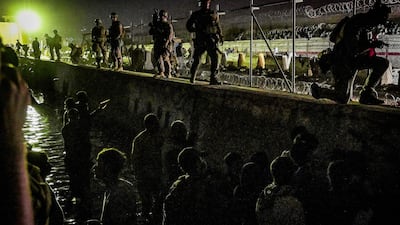
British and Canadian soldiers stand guard near a canal as Afghans wait outside the foreign military-controlled part of the airport in Kabul. AFP -
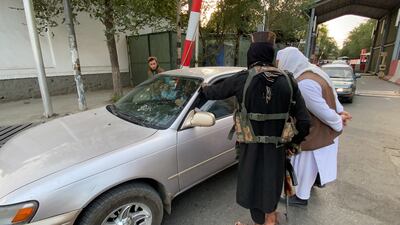
Taliban members check vehicles at the entrance to the Green Zone in Kabul. EPA -

A Taliban check on a car entering the Green Zone, where most of the embassies are located. EPA -

A Green Zone checkpoint manned by the Taliban. EPA -
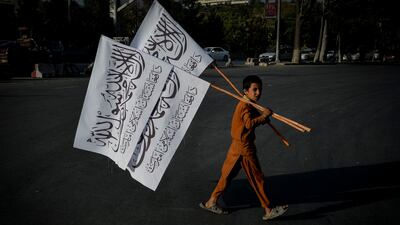
A boy carries Taliban flags to sell at the Karte Mamorin area of Kabul. AFP -
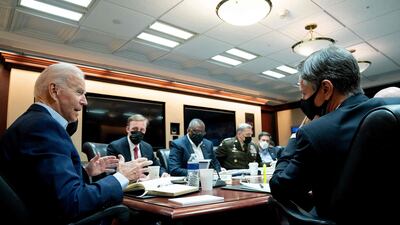
US President Joe Biden speaks to his national security team during a briefing on Afghanistan at the White House. AFP -
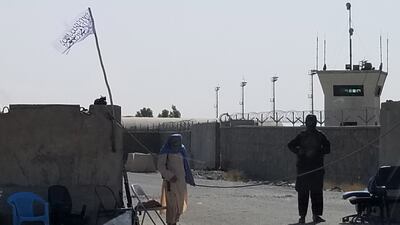
Taliban members stand guard at the main entrance to Kandahar International Airport. EPA -
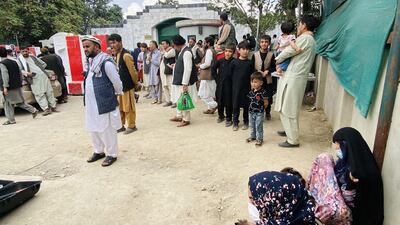
People gather outside the Pakistani embassy to obtain a visa after Taliban took over in Kabul. EPA


On August 17, two days into the federal election, Ms Nasiri launched the Canadian Campaign for Afghan Peace. The campaign published an open letter outlining four ways the Canadian government could contribute to improving the situation in Afghanistan.
Ms Nasiri wants the leaders of Canada’s federal parties to commit to making the situation in Afghanistan part of their election agenda.
“We are actively involved, meeting with party leaders and trying to encourage them to use our demand as the basis for their policies and platforms and advocate and pressure the government essentially to take action,” Ms Nasiri told The National.
So far, Jagmeet Singh, the leader of the New Democratic Party, often considered Canada’s third most popular party after the Liberals and Conservatives, is the only leader to openly endorse the letter, Ms Nasiri said.
Some political experts believe it's unlikely that Afghanistan will play a major role in the election.
“Foreign policy is never a hot-button topic [during federal elections],” said Stephanie Chouinard, an associate professor at the Royal Military College of Canada and Queen’s University.
Prof Chouinard added that Canada’s two main political parties are reluctant to attack each other over Afghanistan.
“The war in Afghanistan is seen as a shared burden between the two main political parties, between the decision to go to war and the decision to extend the mission,” she told The National.
Where the opposition parties could find fault, Prof Chouinard said, was in Canada’s slow response to recent events.
“When you compare Canada's attempts at bringing in former helpers, former interpreters, as refugees, we haven't acted as quickly as some of our allies.”
Ms Nasiri said she hopes Afghanistan will come up as an important issue during the leaders' debate on September 9.
Canadian Prime Minister Justin Trudeau called a snap election for September 20 to seek voter approval for the government's costly plans to combat Covid-19, among other issues.
The prime minister has a minority government and currently relies on other parties to push through legislation.

