The bodies of a blue whale, a dozen dolphins and about 100 turtles have washed ashore in Sri Lanka since a container ship burnt and sank, raising fear of a severe marine disaster.
Ecologists believe the deaths were directly caused by the fire and subsequent release of hazardous chemicals while the Singapore-flagged X-Press Pearl burnt for 12 days off Sri Lanka's main port in the capital Colombo. The turtle carcasses displayed throat and shell damage.
-

Sri Lankan wild life workers prepare to remove decomposed remains of a turtle lies on a beach polluted following the sinking of a container ship that caught fire while transporting chemicals off Kapungoda, outskirts of Colombo, Sri Lanka, Monday, June 21, 2021. AP -

A stray dog stands amid the waves as decomposed remains of a turtle lies on a beach polluted following the sinking of a container ship that caught fire while transporting chemicals off Kapungoda, outskirts of Colombo, Sri Lanka, Monday, June 21, 2021. AP -
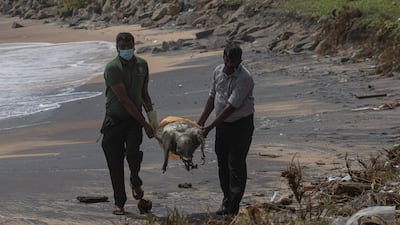
Sri Lankan wild life workers remove decomposed remains of a turtle lies on a beach polluted following the sinking of a container ship that caught fire while transporting chemicals off Kapungoda, outskirts of Colombo, Sri Lanka, Monday, June 21, 2021. AP -
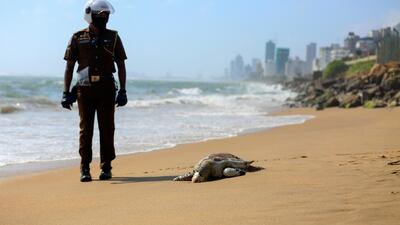
A Sri Lankan policeman looks at a dead turtle that washed ashore in Colombo, Sri Lanka, June 10, 2021. Carcasses of nearly a hundred turtles believed to have been killed due to heat and chemical poisoning from a fire-ravaged ship that sank off while transporting chemicals have been washed to Sri Lanka’s ashore in recent weeks, raising fears of a severe marine disaster. AP -
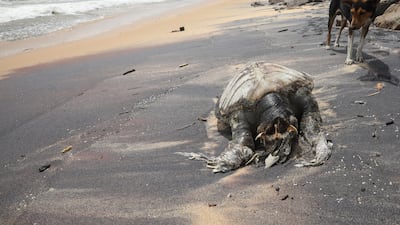
A stray dog looks at a partly decomposed, headless carcass of a marine turtle (Caretta caretta) washed ashore on the beach at Uswetikeiyyawa in the suburbs of Colombo, Sri Lanka, June 21, 2021.EPA -
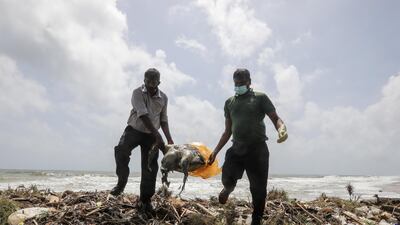
Sri Lankan Wildlife Department officials remove a partly decomposed, headless carcass of a marine turtle (Caretta caretta) for further examination after it was washed ashore on the beach at Uswetikeiyyawa in the suburbs of Colombo, Sri Lanka, June 21, 2021. EPA


But government officials said these causes were “provisionally” confirmed and the investigation was continuing.
The fire started on May 20 and dead marine species started washing ashore days later.
A ship manifest seen by The Associated Press said 81 of about 1,500 containers onboard held “dangerous” goods.
The Sri Lankan navy believes the blaze was caused by its chemical cargo, most of which was destroyed in the fire. But debris including burnt fibreglass and tonnes of plastic pellets have severely polluted the surrounding waters and a long stretch of the island’s famed beaches.
Postmortem analysis on the carcasses is being performed at five government-run laboratories and separately by the Government Analysts Department, a wildlife department official said.
“Provisionally, we can say that these deaths were caused by two methods – one is due to burns from the heat and secondly due to chemicals. These are obvious,” Anil Jasinghe, secretary of the environment ministry, said.
He refrained from giving an exact cause, saying “postmortem analysis are still being conducted.”
Thushan Kapurusinghe of the Turtle Conservation Project said the fire and chemicals the ship carried killed the turtles.
Mr Kapurusinghe, who has more than three decades of experience in turtle conservation, said the dead creatures had oral, cloacal and throat bleeding and “specific parts of their carapace [shell] have burns and erosion signs”.
The sea off Sri Lanka and its coastline are home to five species of turtles that regularly come to lay eggs. March to June is the peak season for their arrival.
Lalith Ekanayake, a marine and coastal ecologist, said that based on the nature of the fire and the amount of chemicals onboard, he suspects “at least 400 turtles may have died and their carcasses may have sunk in the sea or drifted to the deep sea”.
Sri Lanka plans to claim compensation from X-Press Feeders, the ship’s owner, and has submitted an interim claim of $40 million.

