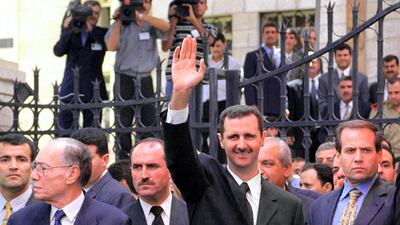
President Bashar Al Assad upon inheriting power in July 2000, which also marked the rise of his tycoon cousin, Rami Makhlouf. AFP

Rami Makhlouf: Tycoon warns of ‘earthquake’ if he is driven from Syrian business scene


Khaled Yacoub Oweis
  • English
  • Arabic

The tycoon cousin of President Bashar Al Assad has warned Syria’s small but powerful Alawite community it could suffer what he described as an earthquake without him at its business helm.

In the second month of a public spectacle centring on the wealth of the inner circle, Rami Makhlouf escalated his verbal response to an official seizure of his assets.

The authorities are seeking to strip Mr Makhlouf of telecom operator Syriatel, the country’s largest company, along with the rest of his empire. Regional bankers say his fortune also comprises shares of vast assets he manages on behalf of the ruling Assad family through frontmen and business networks.

In his latest Facebook pronouncement this week, Mr Makhlouf said that 70 per cent of the shareholder profit of Syriatel went to “acts of charity” in the past decade.

“Curse me if there will be no divine intervention to stop this farce and shake the earth from underneath the feet of the oppressors,” Mr Makhlouf wrote on Facebook on Monday.

“You will be enamoured with his might and majesty,” Mr Makhlouf said, using religious terminology more familiar to Alawites than to the country’s Sunni-majority population.

“No one can prevent such deeds from reaching their deserving recipients,” he said.

The continued, and widely followed, statements by Mr Makhlouf, ultimately challenging Mr Assad, prompted some political commentators to suggest he is enjoying de facto Russian protection.

Mr Makhlouf’s father, the oligarch Mohammad Makhlouf, has been reportedly living in Moscow for several years. Russia intervened militarily in Syria to prop up the regime in late 2015.

Rami, 50, the maternal cousin of Mr Assad and his brother Maher Al Assad, has not disclosed where he is. Maher heads the army’s elite Fourth Mechanised Division, which operates its own intelligence network.

Rami Makhlouf has been singling out the Alawite-dominated security apparatus for acting against him, under orders from someone he did not name, although he said he has been the main financier of the same security operatives seeking his downfall.

Mr Makhlouf said on Monday that “an invisible hand with super powers that lets some people violate private property and threaten serious measures” would act against his businesses if he “does not submit”.

He said that in the past month the authorities expanded a tax dispute with Syriatel, demanding half of the company’s revenue, and that Syriatel’s managers were pressured through arrests and other means to stop communicating with him. Some of Mr Makhlouf’s personal assets were also seized.

The billionaire termed the measures being taken against Syriatel and himself as a “clear violation” of property rights he said were guaranteed under Syria’s paper constitution.

But Syriatel, which Mr Makhlouf set up two decades ago, is one of many monopolies he obtained since Bashar Al Assad inherited power in 2000 from his late father, Hafez.

Two prominent members of the intelligentsia, Aref Dalila and Riad Seif, spoke out at the time Mr Makhlouf and his patronage network were undermining the rule of law. The authorities jailed the two men for a total of 12 years for “undermining national morale”.


if you go

The flights

Flydubai flies to Podgorica or nearby Tivat via Sarajevo from Dh2,155 return including taxes. Turkish Airlines flies from Abu Dhabi and Dubai to Podgorica via Istanbul; alternatively, fly with Flydubai from Dubai to Belgrade and take a short flight with Montenegro Air to Podgorica. Etihad flies from Abu Dhabi to Podgorica via Belgrade. Flights cost from about Dh3,000 return including taxes. There are buses from Podgorica to Plav. 

The tour

While you can apply for a permit for the route yourself, it’s best to travel with an agency that will arrange it for you. These include Zbulo in Albania (www.zbulo.org) or Zalaz in Montenegro (www.zalaz.me).


Mercer, the investment consulting arm of US services company Marsh & McLennan, expects its wealth division to at least double its assets under management (AUM) in the Middle East as wealth in the region continues to grow despite economic headwinds, a company official said.

Mercer Wealth, which globally has $160 billion in AUM, plans to boost its AUM in the region to $2-$3bn in the next 2-3 years from the present $1bn, said Yasir AbuShaban, a Dubai-based principal with Mercer Wealth.

Within the next two to three years, we are looking at reaching $2 to $3 billion as a conservative estimate and we do see an opportunity to do so,” said Mr AbuShaban.

Mercer does not directly make investments, but allocates clients’ money they have discretion to, to professional asset managers. They also provide advice to clients.

“We have buying power. We can negotiate on their (client’s) behalf with asset managers to provide them lower fees than they otherwise would have to get on their own,” he added.

Mercer Wealth’s clients include sovereign wealth funds, family offices, and insurance companies among others.

From its office in Dubai, Mercer also looks after Africa, India and Turkey, where they also see opportunity for growth.

Wealth creation in Middle East and Africa (MEA) grew 8.5 per cent to $8.1 trillion last year from $7.5tn in 2015, higher than last year’s global average of 6 per cent and the second-highest growth in a region after Asia-Pacific which grew 9.9 per cent, according to consultancy Boston Consulting Group (BCG). In the region, where wealth grew just 1.9 per cent in 2015 compared with 2014, a pickup in oil prices has helped in wealth generation.

BCG is forecasting MEA wealth will rise to $12tn by 2021, growing at an annual average of 8 per cent.

Drivers of wealth generation in the region will be split evenly between new wealth creation and growth of performance of existing assets, according to BCG.

Another general trend in the region is clients’ looking for a comprehensive approach to investing, according to Mr AbuShaban.

“Institutional investors or some of the families are seeing a slowdown in the available capital they have to invest and in that sense they are looking at optimizing the way they manage their portfolios and making sure they are not investing haphazardly and different parts of their investment are working together,” said Mr AbuShaban.

Some clients also have a higher appetite for risk, given the low interest-rate environment that does not provide enough yield for some institutional investors. These clients are keen to invest in illiquid assets, such as private equity and infrastructure.

“What we have seen is a desire for higher returns in what has been a low-return environment specifically in various fixed income or bonds,” he said.

“In this environment, we have seen a de facto increase in the risk that clients are taking in things like illiquid investments, private equity investments, infrastructure and private debt, those kind of investments were higher illiquidity results in incrementally higher returns.”

The Abu Dhabi Investment Authority, one of the largest sovereign wealth funds, said in its 2016 report that has gradually increased its exposure in direct private equity and private credit transactions, mainly in Asian markets and especially in China and India. The authority’s private equity department focused on structured equities owing to “their defensive characteristics.”