
Nancy Pelosi, the speaker of the US House of Representatives, told The National on Thursday that she supports a $735 million sale of precision-guided bombs to Israel despite attempts by high-profile members of Congress to halt the deal.
“I support the arms sale,” Ms Pelosi said. “But I appreciate the informed debate that our members are having on the subject.”
Her endorsement came the same day that Bernie Sanders, an independent senator from Vermont who votes with the Democrats, introduced a Senate bill seeking to halt the sale of weapons while the conflict rages between Israel and Hamas.
“At a moment when US-made bombs are devastating Gaza and killing women and children, we cannot simply let another huge arms sale go through without even a congressional debate,” Mr Sanders said in a statement introducing the bill.
Though Mr Sanders’s bill is unlikely to pass the Senate, he will likely have the option to force a vote on the issue, marking the first time Congress has had to consider blocking an arms sale to Israel, which has previously enjoyed unconditional bipartisan support on Capitol Hill.
“I believe that the United States must help lead the way to a peaceful and prosperous future for both Israelis and Palestinians,” Mr Sanders said.
“We need to take a hard look at whether the sale of these weapons is actually helping do that or whether it is simply fuelling the conflict.”
Congresswoman Alexandria Ocasio-Cortez of New York this week introduced a similar bill in the House.
“For decades, the US has sold billions of dollars in weaponry to Israel without ever requiring them to respect basic Palestinian rights,” Ms Ocasio-Cortez said when introducing the bill.
“In so doing, we have directly contributed to the death, displacement and disenfranchisement of millions.”
Democratic leaders in the US Congress are trying to clamp down on a growing movement in their ranks to restrict arms sales and put conditions on military aid to Israel.
The pro-Israel old guard in the House has started to lose traction as a new generation of Democrats willing to criticise the crucial US ally rises through the ranks and vocally pro-Palestinian members continue to win elections.
The violence in Gaza has also proved to be a major test for President Joe Biden and his handling of an international crisis as well as his relationship with Israeli Prime Minister Benjamin Netanyahu.
US efforts continued on Thursday to push for a ceasefire. Vice President Kamala Harris held a call with Jordan’s King Abdullah II, while Secretary of State Antony Blinken and National Security Adviser Jake Sullivan spoke with their Israeli counterparts, Gaby Ashkenzi and Meir Ben Shabbat.
-

A Palestinian man inspects the damage of a six-storey building destroyed by an early morning Israeli air strike in Gaza city. AP Photo -

Palestinians, who fled their homes due to Israeli air and artillery strikes, wash their clothes at a UN-run school in Gaza city. Reuters -
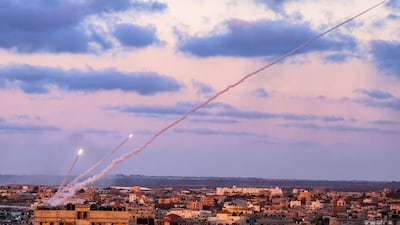
Rockets are launched towards Israel from the southern Gaza Strip. AFP -

A satellite image shows the rubble of a Gaza Strip high-rise building. AP Photo -

A member of the Palestinian Abu Dayer family receives treatment at Al-Shifa Hospital following an Israeli air strike on their home in Gaza city. AFP -

More than 200 people, most of them Palestinians, have been killed in the attacks. AFP -

Palestinians run amid Israeli air strikes on Gaza city. AFP -

A Palestinian man reacts to the death of his father who was killed by an Israeli airstrike that destroyed the upper floors of a commercial building and caused damage to a health ministry and prime health care clinic in Gaza city. AP Photo -
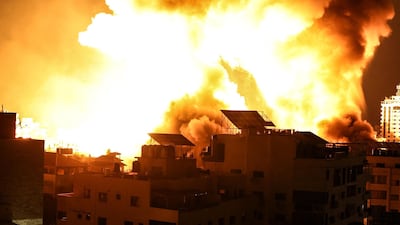
A ball of fire explodes above buildings in Gaza city as Israeli forces shell the Palestinian enclave. AFP -

Israeli soldiers cheer as they take photos at an artillery position along the Israel-Gaza border. AP Photo -

Wounded Palestinian girl Sara Al-Metrabeeay lies on a bed in Shifa Hospital in Gaza city. Reuters -

Fighting continues between the Israeli Army and Hamas forces at the Gaza border, Israel. EPA -

Israelis gather to watch the Iron Dome aerial defence system launch a missile to intercept a rocket launched from the Gaza Strip, above the city of Ashdod. AFP -
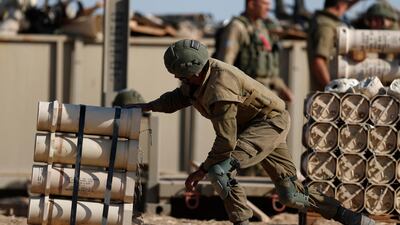
An Israeli artillery soldier carries shells as their unit aims at targets in the Gaza Strip. EPA -

People inspect a destroyed car inside a house, following an Israeli airstrike on the upper floors of a commercial building in Gaza city. AP Photo


On Wednesday, Mr Biden told Israeli Prime Minister Benjamin Netanyahu that he expected "a significant de-escalation today on the path to a ceasefire", after drawing criticism domestically for his staunchly pro-Israel response to the crisis.
While the request marked Mr Biden’s toughest public statement yet, Mr Netanyahu seemed to brush it aside, saying he was “determined to continue this operation until its aim is met” as fighting continued into Thursday.
The two leaders have had tense moments over the years, and their current differences over Gaza create a challenge Mr Biden had hoped to avoid as he tries to focus on domestic issues.
On Thursday, US sources told The National they were cautiously optimistic that a ceasefire was imminent. Negotiations are focused on the exact timing of the cessation of hostilities.
The Biden administration insists it is working frantically behind the scenes to force a reduction in violence, but at the UN, the US has repeatedly blocked proposed statements calling for a ceasefire. Regional envoy Hady Amr remains in the region and is speaking with both parties.
Mr Biden spoke with Egyptian President Abdel Fattah Al Sisi by phone on Thursday, as Cairo seeks to help broker an end to hostilities.

