


Lebanon formed a new government on Tuesday night under Prime Minister Hassan Diab, 34 days after he was nominated on December 19.
The former university professor is tasked with addressing Lebanon's worst economic crisis since the end of the civil war in 1990 amid nationwide violent protests.
While the line up includes many relative unknowns, the key posts of finance minister and foreign minister went to Ghazi Wazni and Nassif Hitti.
Mr Diab initially wanted a government of 18 ministers but agreed to include 2 more at the last minute to satisfy different political parties, which have greenlighted the ministers' nomination after intense behind-the-door negotiations. This is considered to be a small Cabinet in Lebanon where there are usually closer to 30 ministers to satisfy each religious community.
While many of those represented have some relevant expertise in their field, they are not the independent government that Mr Diab promised the protesters on the street. Demonstrators demanded a technocratic government after Saad Hariri resigned as prime minister, collapsing the government on October 29.
Many had already taken to the street on Tuesday night before the names were announced to reject the new government, already calling it a “one colour” Cabinet. This means they see it as an administration backed by President Michel Aoun and his allies, including Iran-backed Hezbollah.
The administration includes five women and the Middle East’s first woman defence minister.
The share of ministers nominated by party appears to breakdown as the following:
Prime minister’s share: 4.
Free Patriotic Movement: 6.
Amal Movement: 2.
Marada Movement: 2.
Hezbollah: 2.
Lebanese Democratic Party: 2.
The pro-Hezbollah Sunni Consultative Gathering: 1.
Tashnag: 1.
-

Anti-government protesters throw firecrackers at riot police during a demonstration against the new government, near Parliament Square, in Beirut, Lebanon. AP Photo -
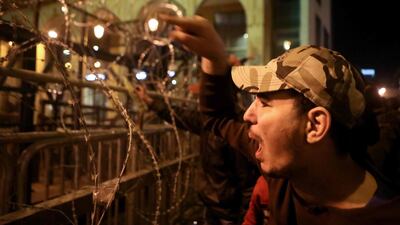
Lebanese anti-corruption protesters shout slogans outside the parliament during a protest in downtown Beirut. AFP -
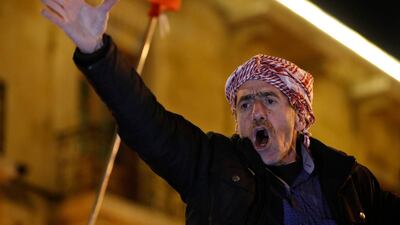
An anti-government protester shouts slogans during a protest against the new government, near the parliament square, in Beirut. AP Photo -

An anti-government protester shows off the liquid pepper on his hand after he was sprayed by the riot police during continuous anti-government protests outside of the Lebanese Parliament building in downtown Beirut. EPA -
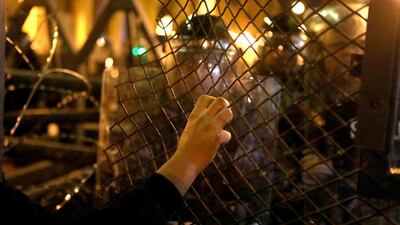
A Lebanese anti-government protester holds on to a police fence as riot police guard an access to the parliament during clashes with anti-government protesters in downtown Beirut. AFP -
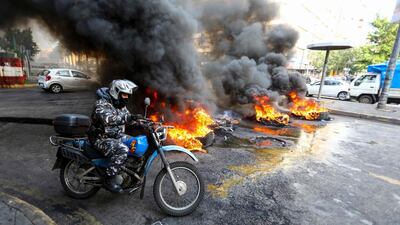
A Lebanese policeman rides his motocycle passed a road, blocked by anti-government protesters with burning tyres, in the capital Beirut. AFP -

An anti-government protester is sprayed by a water cannon as he films by his mobile phone during a protest against the new government, near the parliament square, in Beirut. AP Photo -
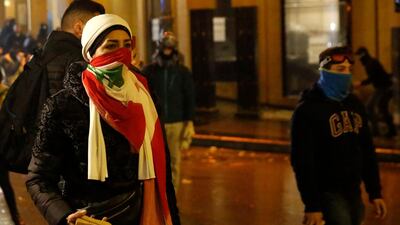
An anti-government protester holds a stone as she prepares to throw it at the riot police during a protest against the new government, near the parliament square, in Beirut. AP Photo -
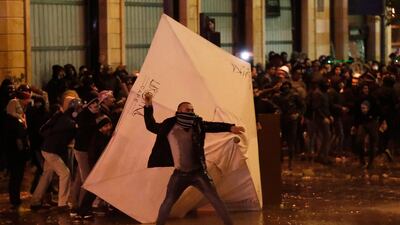
An anti-government protester prepares to throw stones at the riot police during a protest against the new government, near the parliament square, in Beirut. AP Photo -

Anti-government protesters remove barbed wire during continuous anti-government protests outside of the Lebanese Parliament building in downtown Beirut. EPA -
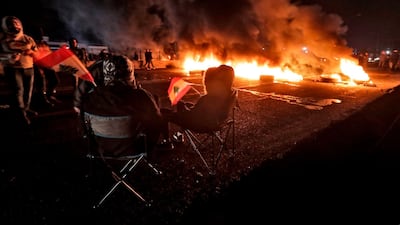
Anti-government protesters sit on chairs waving Lebanese national flags as tyres are aflame to cut off a section of the Beirut-Byblos highway in the coastal city of Byblos, as they protest the newly-announced government formed by Prime Minister Hassan Diab. AFP -
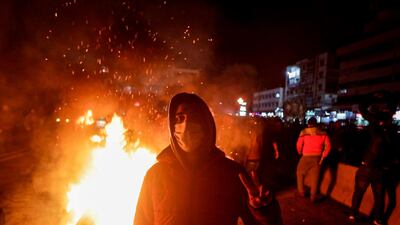
An anti-government protester flashes the victory gesture while tyres are set aflame as demonstrators cut off a section of the Beirut-Byblos highway in Byblos, as they protest the newly-announced government formed by Prime Minister Hassan Diab. AFP


Ministers:
Prime Minister:
Hassan Diab (Sunni), elected by parliamentary blocs during presidential consultations.
The 60-year-old engineering professor at the American University of Beirut is a relatively little-known figure in Lebanon. Mr Diab was education minister between 2011 and 2014.
Because he was backed by Mr Aoun's Christian Free Patriotic Movement and two Shiite parties – Hezbollah and its ally Amal – he does not have strong backing from Lebanon's Sunni Muslim community, unlike his predecessor Saad Hariri.
After he was appointed, many protesters rejected him and quickly criticised his laudatory 136-page CV and the 1,315-page book he wrote dedicated to his achievements at the education ministry.
Deputy Prime Minister and Defence Minister:
Zeina Akar (Greek-Orthodox Christian), proposed by FPM
Mrs Akar is executive director of Information International, a Beirut-based research and consultancy firm that was founded by her husband Jawad Adra. On its website, it says that she leads the firm in survey research, database collection and project analysis for the Arab world and the Near East in the areas of health, education, agriculture, and infrastructure facilities.
She holds a degree in social sciences from the Lebanese America University.
Foreign Minister:
Nassif Hitti (Maronite Christian), proposed by FPM
Born in Tripoli, Mr Hitti is a former Lebanese ambassador the Arab League. He obtained a doctorate in International Relations at the University of South California. He is a regular contributor to Lebanese newspaper Annahar and Egyptian daily Shorouk.
Mr Hitti is also director of the higher institute of political and administrative sciences at the school of law and political sciences at the Holy Spirit University of Kaslik north of Beirut.
Interior Minister:
Mohammad Fahmy (Sunni), proposed by Hassan Diab
Born in Beirut in 1958, retired Brig Gen Mohamed Fahmy enrolled in the army in 1978, three years after the beginning of Lebanon's 15-year civil war. He left in 2016 and became security and safety advisor to the board of directors of Blom Bank, a job he still holds.
Brig Gen Fahmy obtained a diploma in management from James Madison University, Virginia, USA.
Telecoms Minister:
Talal Hawat (Sunni), proposed by Consultative Gathering
Born in 1969 in Tripoli, Mr Hawat studied electrical engineering and electronics at the University of San Jose, California. He worked 19 years with American multinational technology company Cisco, including 8 years in the US and 11 years in Lebanon. In 2018, he became regional vice president for the Middle East, Africa and Turkey with Canadian company Sandvine, a networking equipment company.
Education Minister:
Tarek Majzoub (Sunni), proposed by Hassan Diab
Mr Majzoub is a judge at State Shura Council, according to Lebanese media. He teaches law at Sagesse University in Beirut.
Environment Minister and Administrative Development:
Damianos Kattar (Maronite Christian), proposed by Hassan Diab
Born in Jezzine in 1960, Mr Kattar is an economist and served as Lebanon’s Finance Minister for four months in 2005.
Energy Minister:
Raymond Ghajar (Greek-Orthodox Christian), proposed by FPM
Mr Ghajar obtained a PhD in electrical engineering from the University of Saskatchewan in Canada. He worked as an engineer with several utility providers in Canada and the US. Mr Ghajar became senior energy policy advisor at the Energy Ministry in Lebanon in 2007 and helped prepare the electricity sector policy paper in 2010 that failed to deliver 24/7 power to the country. Dr Ghajar has been a professor of electrical engineering at the Lebanese American University since 1995.
Justice Minister:
Mary-Claude Najem (Maronite Christian), proposed by FPM
Mrs Najem is a law professor at the University Saint Joseph in Beirut, where she heads the centre of legal studies and research for the Arab world.
Economy Minister:
Raul Nehme (Greek Catholic Christian), proposed by FPM
Mr Nehme was appointed executive general manager at Lebanon’s BankMed in 2018. According to the lender, he occupied several other positions in the banking sector, including general manager at BLC Bank. Mr Nehme studied engineering at France’s Ecole Polytechnique and the Ecole des Mines in Paris.
Minister of Affairs for the Displaced:
Ghada Shreim (Greek Catholic Christian), proposed by FPM
According to Lebanese daily L’Orient-Le Jour, Ghada Shreim is a professor at the Lebanese University and used to work at a local magazine, Fairuz.
Labour Minister:
Lamia Yammine Doueihy (Maronite Christian), proposed by Marada Movement
Born in 1974 in Zgharta, Mrs Doueihy is an architect and university professor at the Lebanese University in Tripoli, where she previously studied architectural engineering. She is a member of the board of directors of a wood design company, Douaihy pour le bois.
Public Works Minister:
Michel Najar (Greek Orthodox Christian), proposed by Marada Movement
Born in 1958, Mr Najar obtained a doctorate in civil engineering from Oklahoma State University in the US. After working for several years in research, development, education and consulting in the West and the Gulf, he returned to Lebanon to work at Balamand University as a lecturer in 1991. Mr Najar is vice president for academic and administrative affairs at the American University of Technology in Lebanon.
Youth and Sports Minister:
Varti Ohanian (Armenian Christian), proposed by Tashnag
According to Lebanese daily L’Orient Le Jour, Mrs Ohanian heads an education centre in Beirut for children with special needs.
Social Affairs and Tourism Minister:
Ramzi Msharrafieh (Druze), proposed by LDP
According to his online CV, Mr Msharrafieh is a medical doctor specialised in orthopaedics, hand and reconstructive surgery at Clemenceau Medical Centre in Beirut. He is also a professor of orthopaedic surgery at St Georges University Medical Centre since 2005.
Information Minister:
Manal Abdel Samad (Druze), proposed by LDP
Born in Lebanon’s Chouf region, Mrs Samad obtained a doctorate in law from University Paris Pantheon Sorbonne in Paris. She joined the Finance Ministry in 1997 where she is head of the Tax and Auditing Authority. In 2000, she was a member of the first working group to create and implement VAT in Lebanon. She became a lecturer at AUB and Saint Joseph University in 2009 in administrative leadership, public finances and fiscal studies. She is currently pursuing her studies at the Harvard Kennedy School of Public Policy.
Finance Minister:
Ghazi Wazni (Shiite), proposed by Amal Movement
Mr Wazni served previously as a financial adviser to parliament’s finance and budget committee and heads his own research firm.
Agriculture and Culture Minister:
Abbas Mortada (Shiite), proposed by Amal Movement
Born in a Bekaa Valley village in 1981, Mr Mortada holds a master’s degree in history from the Lebanese University of Beirut and is currently working on a PhD. He was general manager of a Lebanese hotel between 2015 and 2019 as well as general manager of a real estate company.
Health Minister:
Hamad Hasan (Shiite), proposed by Hezbollah
Born in Baalbek in 1969, Mr Hasan obtained a PhD in Molecular Biological Sciences from the Institute of Biological and Environmental Research in Moscow in 1999. He is a professor at the College of Public Health at the Lebanese University and has headed the department of laboratory sciences since 2014. Mr Hasan was mayor of Baalbek from 2013 to 2016 before being appointed president of the Baalbek Municipalities Federation in 2019.
Industry Minister:
Imad Hoballah (Shiite), proposed by Hezbollah
Mr Hoballah became provost of the American University of Dubai in 2017. According to AUD, he taught previously at Syracuse University and Tulsa University in the US as well as at the American University of Beirut in Lebanon. Mr Hoballah was chairman and CEO of the Telecommunications Regulatory Authority in Lebanon for 5 years. He obtained a PhD in electrical engineering from the University of Syracuse.

